



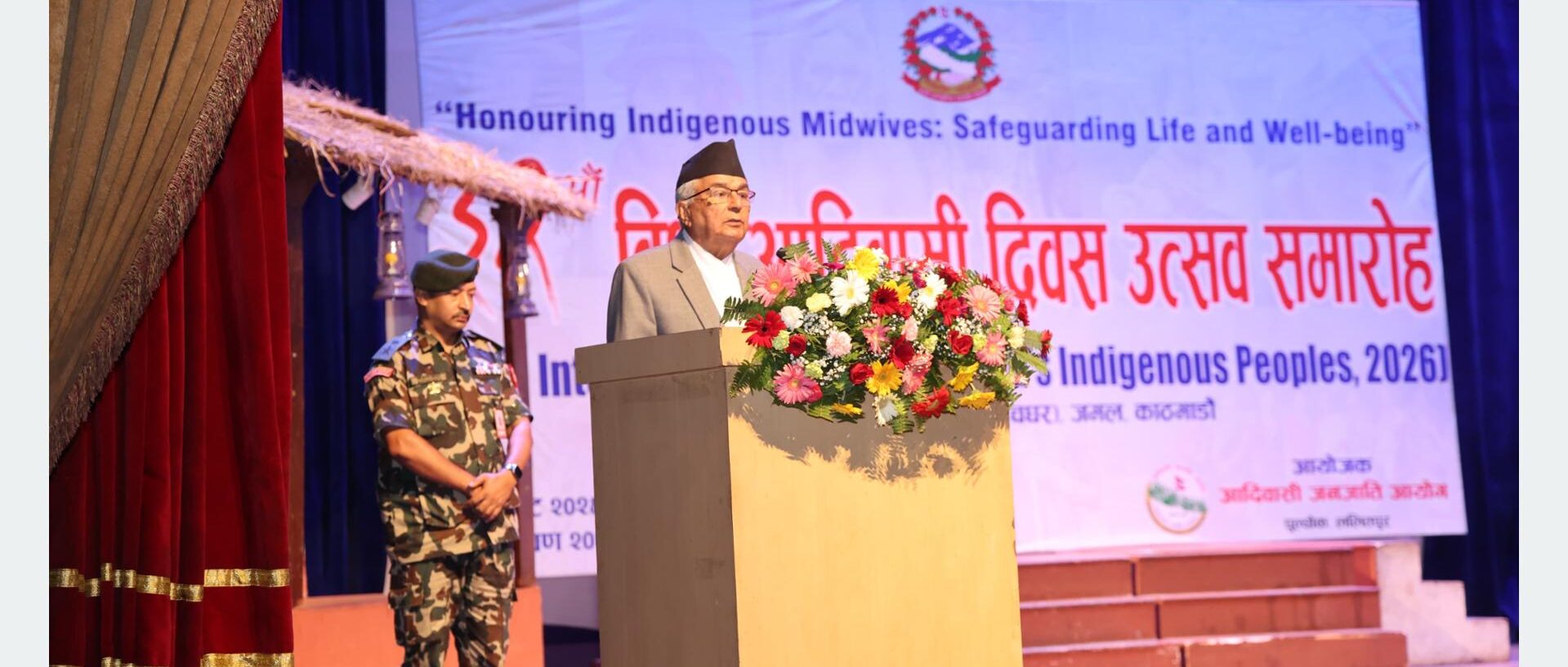
KATHMANDU: President Ram Chandra Paudel has underlined the importance of ensuring meaningful participation of Indigenous peoples in state affairs, saying that lasting peace, social harmony, and national unity are key to safeguarding Nepal’s national integrity.
Speaking at a program organized by the Indigenous Peoples Commission to mark the 32nd International Day of the World’s Indigenous Peoples, President Paudel described Nepal as a country enriched by ethnic, linguistic, religious, and cultural diversity.
He said the traditions, identities, and cultures of Indigenous communities, who have lived in Nepal since ancient times, are a valuable part of the nation’s heritage. According to him, Indigenous peoples maintain a deep spiritual and historical relationship with land, water, and natural resources.
The President stressed that the state has a duty to guarantee Indigenous communities effective participation in policymaking and decision-making bodies. Citing recent data, he noted that Indigenous representation in local governments has reached 36.8 percent, while also emphasizing the need to further expand educational opportunities.
He said Nepal has taken a leading role in advancing Indigenous rights internationally and became the first South Asian country to ratify ILO Convention No. 169. He reaffirmed Nepal’s commitment to the UN Declaration on the Rights of Indigenous Peoples and the Convention on Biological Diversity, both of which recognize the cultural autonomy and rights of Indigenous communities.
President Paudel also highlighted the constitutional establishment of the Indigenous Peoples Commission after the introduction of the federal democratic republic, saying the body was created to protect and promote Indigenous rights and interests. He expressed confidence that the commission would continue to contribute more effectively to preserving Indigenous languages, cultures, and historical heritage while strengthening the empowerment of Indigenous communities.
He further stated that Nepal cannot achieve prosperity without the development of the Terai-Madhes and the protection of justice and rights for Indigenous communities living there. Past grievances and conflicts, he said, should be addressed through democratic dialogue and constitutional mechanisms.
“Sustainable peace, mutual understanding, and unity among all communities reinforce national integrity,” he said, adding that democracy remains the strongest guarantee of the rights of all castes, ethnic groups, and marginalized populations.
The President also called for converting Indigenous traditional knowledge, skills, and technologies into economically productive opportunities. He suggested promoting community-based tourism linked to Indigenous culture through initiatives such as open-air living museums and other cultural tourism models.