


CHITWAN: Complications have arisen in managing the bodies of those killed in the Bhote Koshi River flood that occurred in Rasuwa on August 26.
Human bodies, livestock carcasses, and body parts have been recovered along the banks of the Narayani and Trishuli rivers.
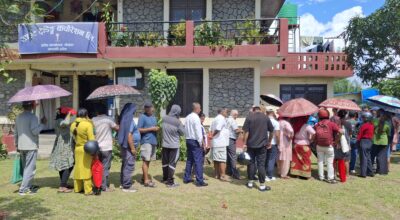
The recovered bodies have been brought by ambulance from the riverbanks. Due to overcrowding, staff at Bharatpur Hospital have been forced to place the bodies under tents.
Dr. Bhojraj Adhikari, a physician and former chairman of the Bharatpur Hospital Development Committee, emphasized the need to take extreme precautions to prevent decomposition and foul odors. “In such situations, there is a high risk of waterborne infections,” he stated.
At Bharatpur Hospital, officials are cleaning the bodies, photographing faces, recording identifiable marks, tagging them with numbers, and moving them to a temporary morgue set up at the Industrial Development Corporation office. The complex management process has made it difficult to bring bodies to the hospital immediately after they are retrieved from the river.
Dr. Bishwa Bandhu Bagale, Chief Medical Superintendent of Bharatpur Hospital, stated that body management has become critical.
He noted that while the hospital’s morgue capacity is for only 24 bodies, 233 bodies have arrived so far. Among them, four have been identified: Madan Thapa Magar and Bhuwan Thapa Magar from Rasuwa, Kabir Lal Chaudhary from Banke, and Ram Kaji Paudel from Nuwakot.
Due to the severe lack of space, bodies are currently being stored in tents outside the morgue.
Dr. Bagale suggested that if private hospitals and medical colleges step forward to admit and treat hospitalized patients free of charge, it would make it much easier for Bharatpur Hospital to manage the bodies.
“Handling patient care with limited personnel while simultaneously managing body disposal has created severe strain,” he said, adding, “We are taking precautions to ensure patients in nearby hospital buildings are not adversely affected.”
Meanwhile, Dr. Madhav Ghimire, a nephrologist at the College of Medical Sciences (Old Medical College), stressed that body management must be handled as quickly as possible, warning of the risk of spreading infections ranging from diarrhea to respiratory complications.