

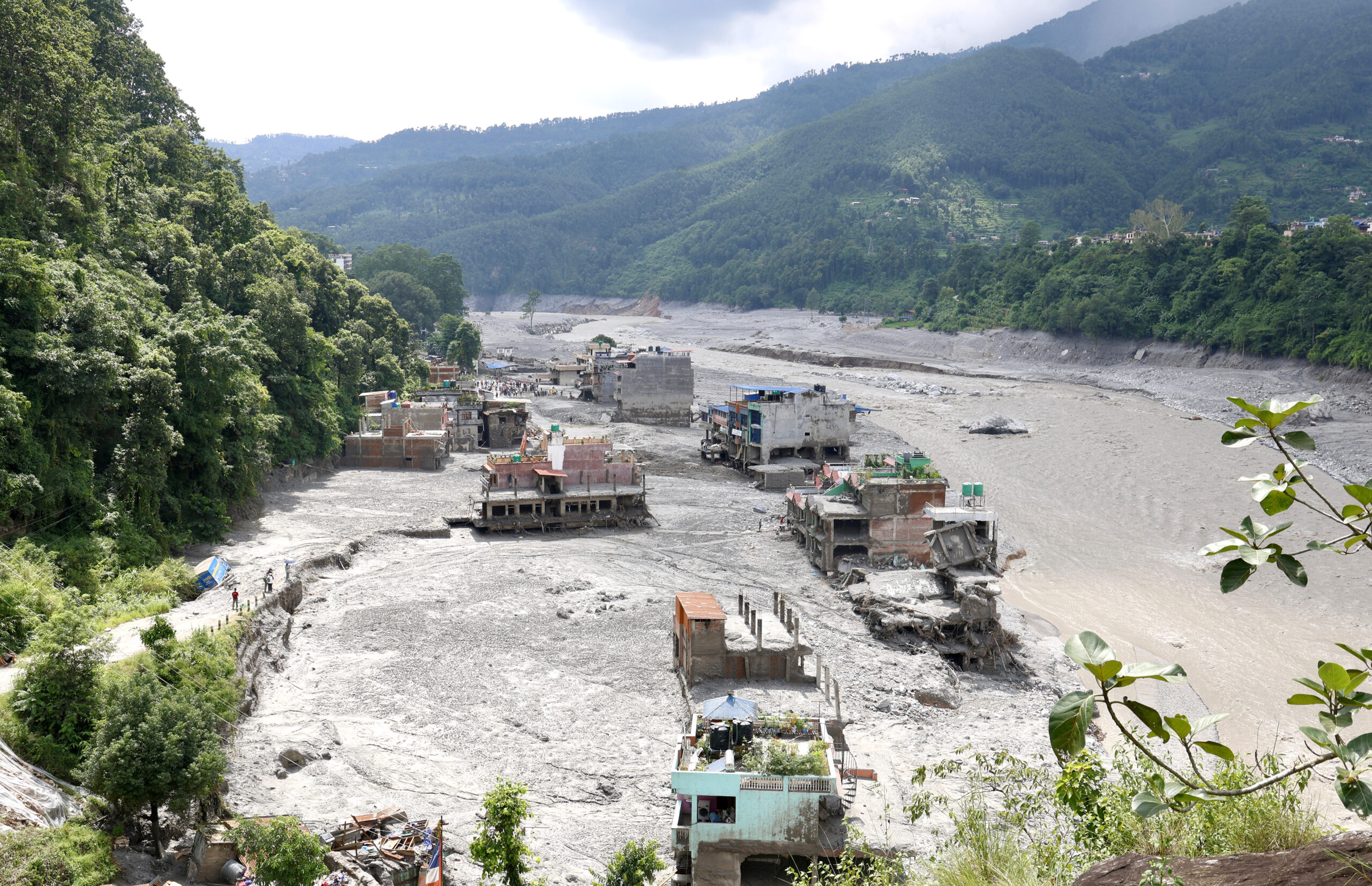
KATHMANDU: The official death toll from the catastrophic flooding triggered by the Bhote Koshi disaster has reached 987, with recovery teams retrieving human remains—including body parts—across multiple districts downriver.
According to the latest update released by the National Disaster Risk Reduction and Management Authority (NDRRMA) as of 9:00 AM today, the highest number of casualties has been recorded in Chitwan (321), Nawalparasi East (216), and Nawalparasi West (170), alongside recoveries in Tanahun (38), Rasuwa (27), Nuwakot (95), Dhading (55) and Gorkha (65).
Meanwhile, nearly 3,916 individuals remain missing, including 25 Nepal Police personnel, 45 Nepali Army personnel, 13 Armed Police Force personnel, 15 customs office staff, 3 immigration staff, 583 foreign nationals, 164 Nepali guides traveling with tourists and hundreds of residents across Rasuwa, Nuwakot, and local hydroelectricity project sites.
Emergency personnel have successfully rescued 11,814 people so far, with the Nepali Army executing 573 helicopter flights—including 12 today—rescuing 3,449 Nepalis and 253 foreign nationals, alongside 29 private sector flights from Kathmandu.
Relief operations are being aggressively expanded, with 50 Armed Police Force helicopter flights supplying emergency materials to Rasuwa and Nuwakot over the past two days, backed by ground transport comprising 37 trucks and 37 Bolero vehicles.
The government has mobilized 21,011 security personnel—including 7,912 Nepal Police, 8,896 Nepali Army, and 4,203 Armed Police Force members—to lead rescue, healthcare, and logistics efforts.
A total of 279 individuals are currently receiving medical treatment, while 168 have already been discharged from hospitals.
To support affected communities, temporary holding centers have been established, accommodating 2,466 people in Nuwakot, 25 in Dhading, 183 in Rasuwa, and 296 in Kathmandu.
The Government of Nepal has released cash relief allocations of Rs 10 million each to Rasuwa and Nuwakot, Rs 5 million to Dhading, and Rs 67.5 million distributed across 15 affected local municipalities.
Infrastructure restoration is also progressing rapidly: out of 110 damaged Nepal Telecom towers, all 110 have been brought back into operation, while 75 out of 78 damaged Ncell towers are now operational.
Fuel reserves in the affected regions stand at 42,000 liters of diesel, 18,000 liters of petrol, and 6,000 liters of aviation fuel.
Unidentified bodies have been placed across 21 hospitals nationwide, with authorities urging the public to check official police and NDRRMA portals for identification details.