

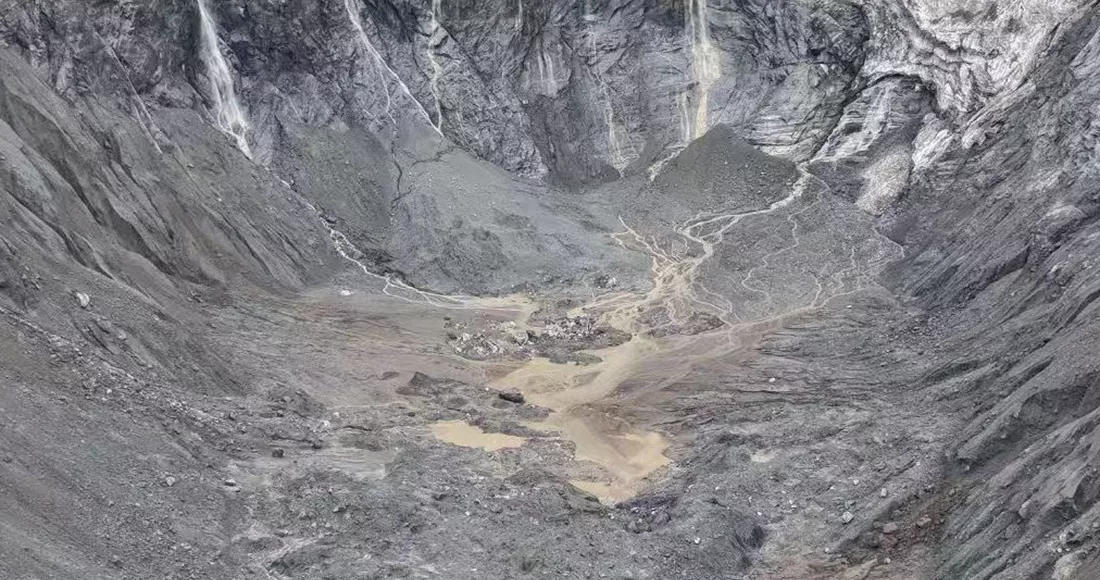
KATHMANDU: Chinese scientists have revealed how a massive ice and rock avalanche on the northern slope of Langtang Lirung in Nepal turned into a devastating debris flow that struck China’s Kerung Jilong Port, according to a recent study. The study, led by the Institute of Tibetan Plateau Research under the Chinese Academy of Sciences (CAS), analyzed the causes and mechanism behind the disaster that caused significant loss of life and destroyed critical infrastructure.
Researchers integrated remote sensing observations, satellite imagery, topographic data, seismic records, and video footage to reconstruct the event from its origin in the high Himalayas down to Kerung Port. The study concluded that the disaster was not triggered by short-term heavy rainfall, noting that the region experienced below-average precipitation in the months prior and no heavy rain immediately before the event. Instead, rising temperatures during spring and summer, accelerated glacier movement, and permafrost thawing weakened the interface between ice and rocks, destabilizing the glacier due to the long-term impacts of climate change.
A major finding of the study reveals that the immense destruction was caused not only by the initial size of the avalanche, but by the entrainment of debris along its path. As the ice and rock rushed down a 22-kilometer river gorge, it continuously scraped soil, stones, and debris from the streambed and banks, mixing with river water to create a massive mudflow. Furthermore, seismic monitoring recorded unusual signals hours prior to the main collapse, corresponding to small snow and ice movements. Experts emphasized that future hazard assessments in mountain regions must evaluate the full chain of potential debris accumulation and downstream risks rather than focusing solely on initial avalanche volume at the source.