

BHARATPUR: Four forensic teams have been deployed at Bharatpur Hospital to conduct autopsies and identify people killed in the recent floods and landslides, as authorities struggle with a surge in bodies recovered from rivers and affected areas.
Forensic specialists are conducting post-mortems while collecting DNA samples from the bodies to establish their identities and facilitate their handover to relatives.
According to Bharatpur Hospital Medical Superintendent Dr. Bishwabandhu Bagale, four teams led by forensic specialists Dr. Kashyap Shrestha and Dr. Suraj Sharma are working on the identification and post-mortem process. The hospital is coordinating continuously with police on the management and identification of the bodies.
The forensic workforce has been expanded as the number of bodies arriving at the hospital increased. Specialists from Lumbini Provincial Hospital and Bheri Hospital have been brought in, while additional forensic experts from Nepal Medical College have also joined the operation.
Bagale said DNA samples have been collected from 50 bodies so far. The samples will be preserved and used for identification where necessary.
The number of bodies has exceeded Bharatpur Hospital’s storage capacity. Bodies that have completed post-mortem examinations are therefore being moved to other government buildings for temporary and secure storage. Racks are also being installed to increase storage capacity.
When relatives claim a body, authorities follow the required forensic and legal procedures before confirming the identity and handing it over to the family.
More than 230 bodies recovered in Chitwan
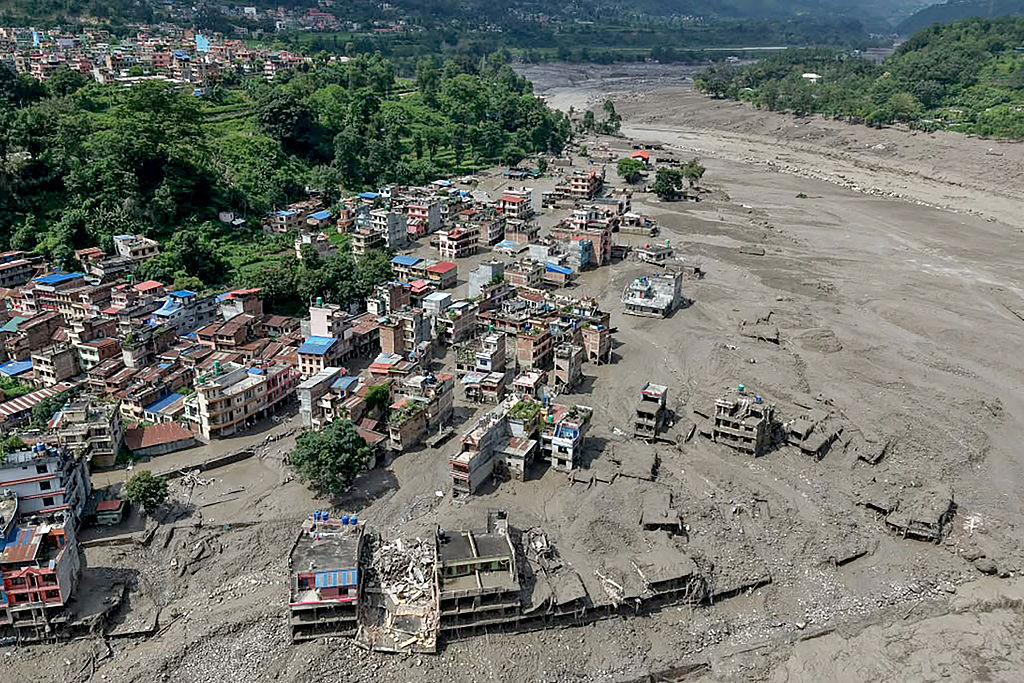
Bodies swept away by floods have been recovered along riverbanks in Rasuwa, Nuwakot, Dhading, Chitwan and Nawalparasi. The large number of recoveries has placed severe pressure on hospitals and mortuaries in the affected districts.
Chitwan Chief District Officer Ganesh Aryal said more than 230 bodies have been recovered in the district alone. Only two of them have so far been identified and handed over to relatives.
“We are cooling a government building to store the bodies,” Aryal said.
The district administration has been forced to use alternative facilities after existing mortuary capacity proved insufficient. Bharatpur Hospital can accommodate only 24 bodies at a time.
Aryal said the absence of relatives coming forward to identify victims has further complicated the process of identification and safe management.
134 bodies received in Nawalparasi
In eastern Nawalparasi, authorities have received 134 bodies so far. Because of limited storage capacity, some have been transferred to facilities outside the district.
Of the total, 41 bodies have been sent to Pokhara and eight to the district hospital. Health facilities under Gaindakot Municipality are storing 36 bodies, while 41 are at Madhyabindu Provincial Hospital and five at Madhyabindu Municipal Hospital. Three bodies reportedly remain at the recovery site.
Ashish Shrestha of the Eastern Nawalparasi Disaster Management Section said bodies were being distributed among available hospitals and health facilities according to their capacity.
As storage space became increasingly limited, bodies were also transferred to Gandaki Hospital in Pokhara and municipal hospitals in other localities.
The District Emergency Operations Centre said the shortage of dedicated mortuary space had forced authorities to use whatever suitable vacant facilities were available.
Pokhara faces mounting pressure
Pokhara is also facing increasing pressure as bodies recovered from several flood-affected districts are being brought there for post-mortem examinations and identification.
A large number of bodies recovered in Gorkha, Nawalparasi and Tanahun have been transported to Pokhara.
According to Kaski Assistant Chief District Officer Chitrangata Baral, 102 bodies have so far been brought to Kaski from different districts, including Nawalparasi, Gorkha, Tanahun and Dhading.
The bodies are being kept at Pokhara Academy of Health Sciences for post-mortem examinations. Baral said only one body had been identified so far.
Coordination becomes critical
With the number of recovered bodies continuing to rise, officials say the immediate priorities are to secure temperature-controlled storage, maintain accurate records, collect DNA and other identification samples, and establish contact with relatives.
Aryal said bodies can only be handed over or released for final rites after identification and completion of the required legal procedures.
The large number of unidentified victims has made coordination among police, district administrations, hospitals, health institutions and local governments essential.
The disaster has therefore created a second major humanitarian challenge beyond search and rescue: preserving the bodies safely, identifying victims scientifically and ensuring that families can recover their loved ones.