



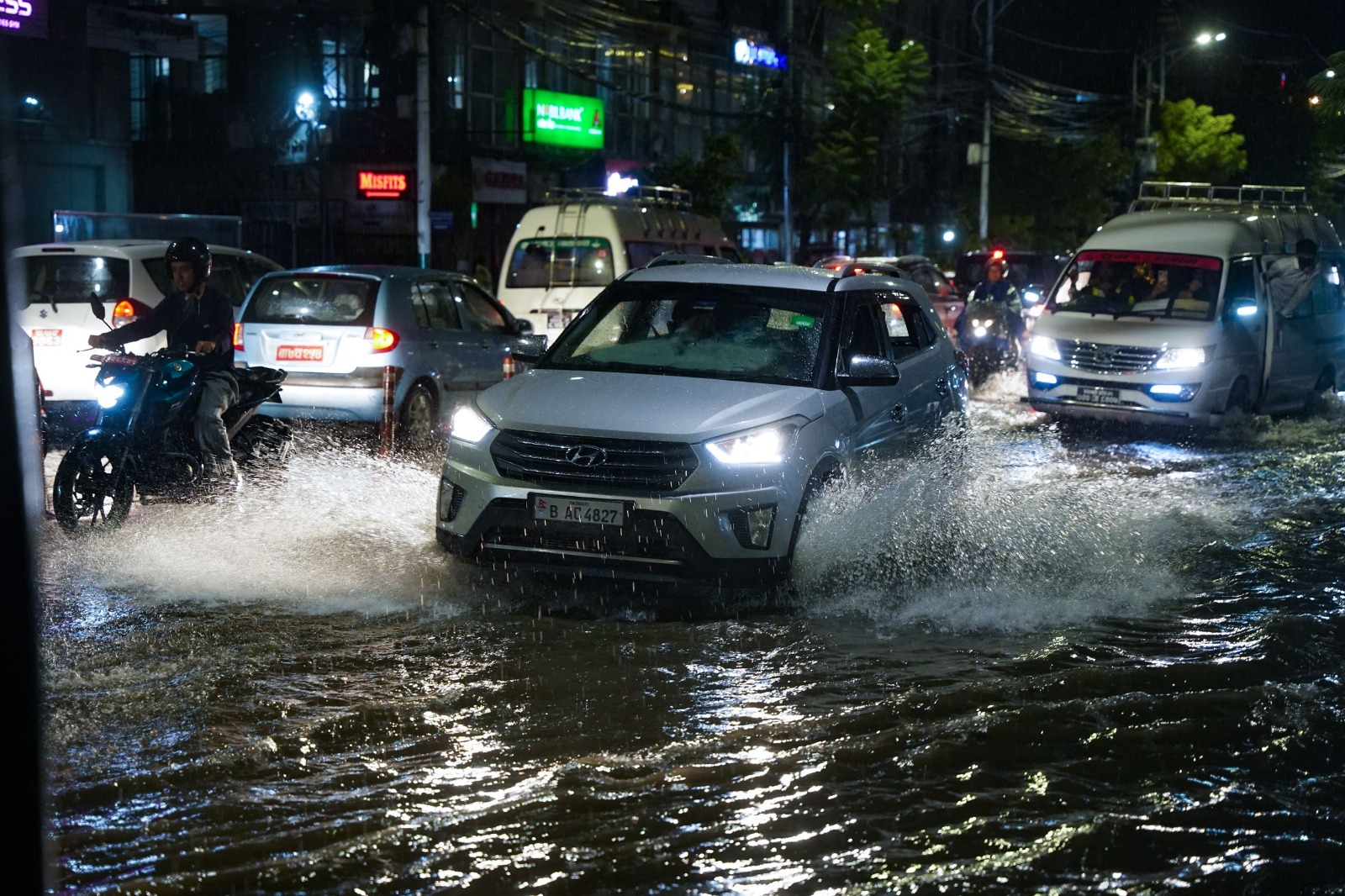
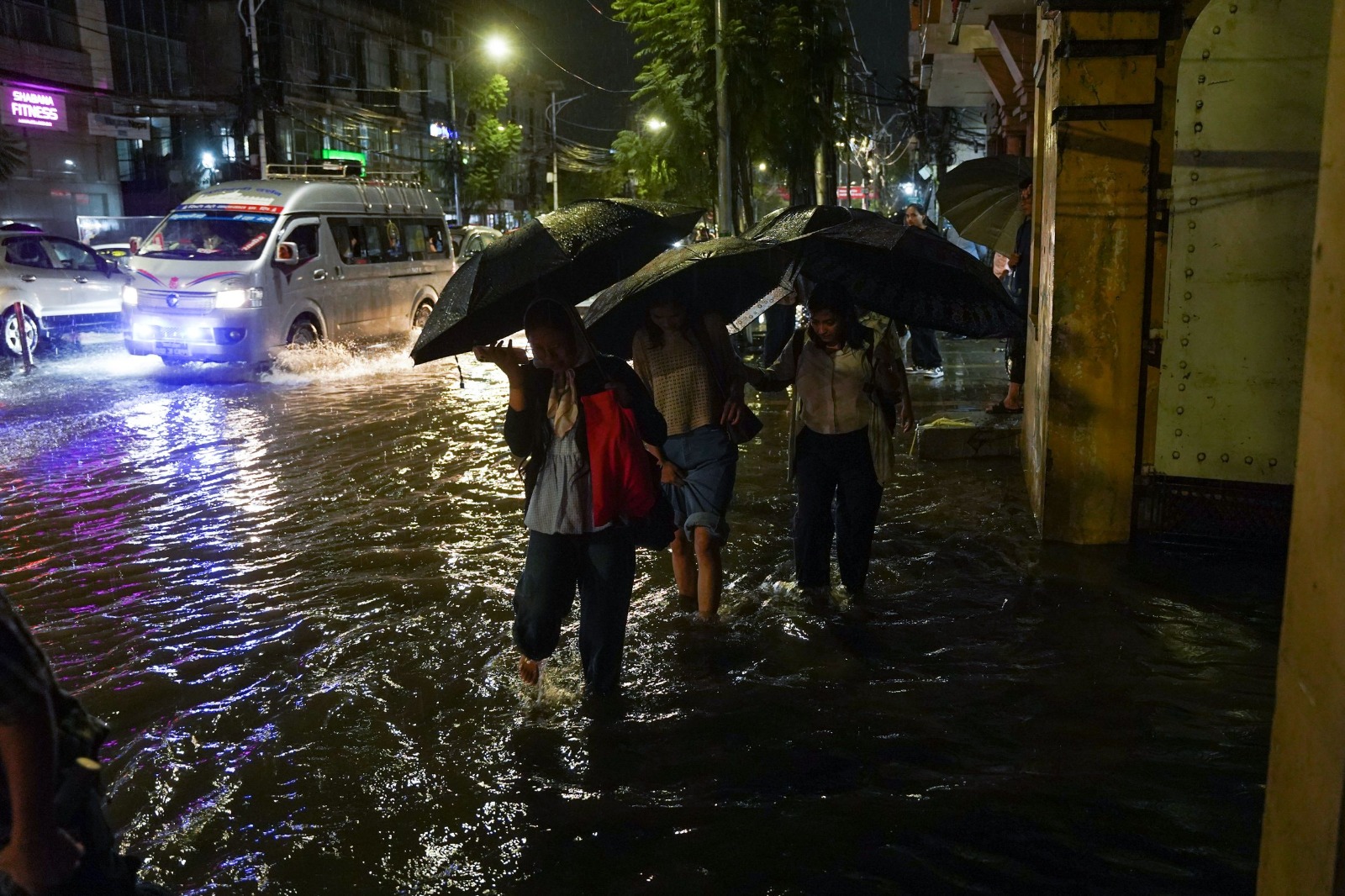
KATHMANDU: A joint team of government agencies has identified inadequate sewer capacity, rather than poor drainage cleaning, as the main reason behind the recurring monsoon flooding in Kathmandu’s Jamal area.
The field inspection was conducted, after Kathmandu Metropolitan City acting mayor Sunita Dangol directed concerned agencies to immediately study the technical causes of the flooding and submit a report with recommendations.
The team was led by the Disaster Management Department of Kathmandu Metropolitan City and included officials from the National Disaster Risk Reduction and Management Authority, Department of Roads, Kathmandu Upatyaka Khanepani Limited, the Melamchi Project Implementation Directorate, and local residents. Officials from the metropolitan public works department and metropolitan police were also present.
During the inspection, the team examined the drainage structures connected to Kantipath and reviewed the capacity of the sewer network carrying water into the Jamal area.
According to engineer Shreeyanka Rauniyar of the Division Road Office Kathmandu, stormwater reaches Jamal through four different sewer lines: a 60-centimeter diameter pipe from Jhyatha, a 90-centimeter pipe from the Election Commission area, a 45-centimeter pipe from the Yellow Pagoda area, and a 20-centimeter pipe from the Janaprasasan Campus side.
Together, these lines bring water from pipes with a combined diameter of 215 centimeters, but the accumulated flow is forced to exit through a sewer line with a capacity of only 60 centimeters.
“The water collected from the four directions cannot be discharged at once through a 60-centimeter outlet, and that is why flooding occurs,” Rauniyar explained during the inspection.
The findings challenge the common public complaint that the flooding is mainly caused by clogged drains. Technical officials said that if solid waste or other major obstructions were blocking the system, the water would not clear after rainfall subsides.
For Jamal’s drainage, there is an approximately one-kilometer-long sewer line running through Tridhara Pathshala, Tri-Chandra Campus, Kamaladi and finally to the Tukucha stream. During the inspection, officials opened manholes at Jamal, in front of Tri-Chandra Campus, and near Tukucha.
No significant solid waste was found inside the sewer line, although wastewater from surrounding areas was seen entering the system. Officials said this means that the drainage network built for Jamal is also being used to carry additional sewage, reducing its effective capacity and slowing the recession of floodwater.
Seventy-year-old local resident Purushottam Shrestha said the flooding problem has worsened over time. He recalled that a new drain was installed by the Department of Roads around five years ago, after which flooding stopped for two or three years. According to him, the problem returned after drains from the Jhyatha and Election Commission areas were connected to the same outlet.
Shrestha also said that in the past, Jamal’s stormwater used to drain through a separate route passing Janaprasasan Campus, Woodland Hotel and Mahendra Salik before reaching Tukucha, but later construction of large structures obstructed that system.
The deterioration of older drainage channels and the failure to increase the capacity of the remaining network have contributed to flooding in several parts of the city, officials said.
A visible example is Lhaku Bahi (Jamal Baha), where water has remained stagnant long enough for green algae to form, indicating that the accumulated water has not been able to drain properly.
Residents also reported similar pressure in the drainage network around Durbar Marg. Local resident Chitrashobha Tuladhar said that during heavy rainfall, water begins to surge upward through the manholes, and continued rainfall can even lift the covers.
Anirudra Nepal, chief of the Disaster Management Department, said recent technical assessments of Maitighar Mandala, Jamal and Durbar Marg point to the same underlying problem.
“The main cause of urban flooding is not the lack of cleaning. The major issue is the mismatch in flow capacity, where the downstream sewer pipes are weaker than the upstream drainage capacity,” he said.
According to Nepal, the same technical team that studied flooding in the Maitighar Mandala area will now conduct a detailed technical study of the Jamal area as well, with additional participation from Kathmandu Upatyaka Khanepani Limited and the project implementation directorate.