



KATHMANDU: The Internet Service Providers’ Association of Nepal (ISPAN) has requested a final 15-day extension to complete the management of tangled and abandoned internet, telephone and cable wires hanging from utility poles across the Kathmandu Valley after failing to meet the government’s deadline.
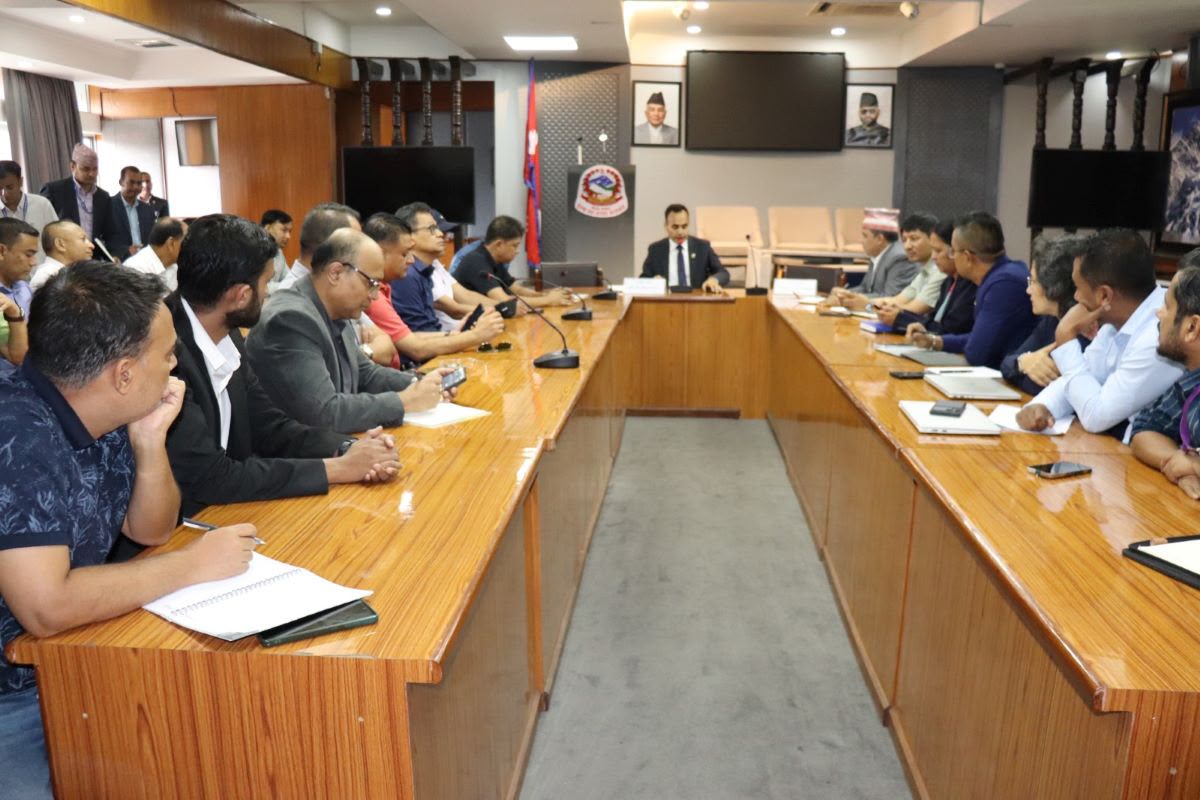
The request was made during a meeting of concerned stakeholders held at the Ministry of Communications and Information Technology on Friday. Representatives from the Ministry of Communications and Information Technology, the Ministry of Energy, Water Resources and Irrigation, the Nepal Telecommunications Authority, Nepal Telecom, ISPAN and other relevant agencies attended the meeting.
Minister for Communications and Information Technology Dr. Bikram Timsina reviewed the progress of the cable management campaign, challenges encountered during implementation and possible solutions. Expressing dissatisfaction over the failure to complete the work within the agreed deadline, he said the government is ready to address genuine operational difficulties but stressed that service providers must now deliver tangible results.
“The government is committed to bringing this cable management campaign to a conclusion. You should be clear about that,” Timsina told ISPAN representatives. “Some delays may occur during implementation, but the deadline cannot continue to be extended indefinitely.”
The minister also asked ISPAN to promptly inform the government of any obstacles that require policy or administrative intervention.
Timsina emphasized that proper cable management is both a legal and commercial responsibility of service providers. “This work should have been completed long ago. Had it been done on time, the current situation would not have arisen,” he said.
Although ISPAN had previously committed to completing the first phase of the project by July 30 (Shrawan 15), the deadline was missed. While seeking another 15-day extension, the association was asked to provide credible assurance that the work would be completed within the newly requested timeframe.
ISPAN Chief Executive Officer Subash Khadka said around 58 percent of the work has been completed on the six priority routes identified for the first phase in the Kathmandu Valley. He added that cable management work is also underway in other parts of the country.
ISPAN also argued that Nepal requires a dedicated infrastructure company to provide a long-term solution to the problem. The association further said that when the Nepal Electricity Authority undergrounds power lines, sufficient infrastructure for internet and cable networks has not been developed alongside the electricity system.
According to ISPAN, service providers have already begun installing underground internet cables under pilot projects in areas including Kalanki–Thankot and Chabahil–Bouddha, while preparations are underway to deploy additional manpower.
The association, however, complained of several operational challenges, including the lack of field-level support from the Nepal Electricity Authority and the Nepal Telecommunications Authority, workers being stopped by police, traffic police removing ladders during operations, and shortages of skilled technicians.
To accelerate progress, ISPAN said it will abandon its earlier approach of spreading resources across multiple locations and instead concentrate available manpower in individual areas to complete the work more quickly.
At a high-level inter-agency meeting held on July 15 (Asar 31) in the presence of Communications Minister Timsina and Minister for Energy, Water Resources and Irrigation Biraj Bhakta Shrestha, ISPAN had pledged to complete cable management along six designated routes in the Kathmandu Valley by July 30 (Shrawan 15).
The meeting had also decided that the Nepal Telecommunications Authority would lead the regulatory and coordination process, all service providers would be required to place clear identification tags on their cables, agencies would strengthen inter-agency coordination, and progress would be reviewed regularly to ensure the public sees visible improvements.
The first phase covers six routes: Tripureshwor-Kalimati–Kalanki, Jadibuti–Pepsicola, Tripureshwor–Lazimpat, Samakhushi–Town Planning–Gongabu, the Kirtipur area, and Old Baneshwor–Gaushala–Chabahil.