

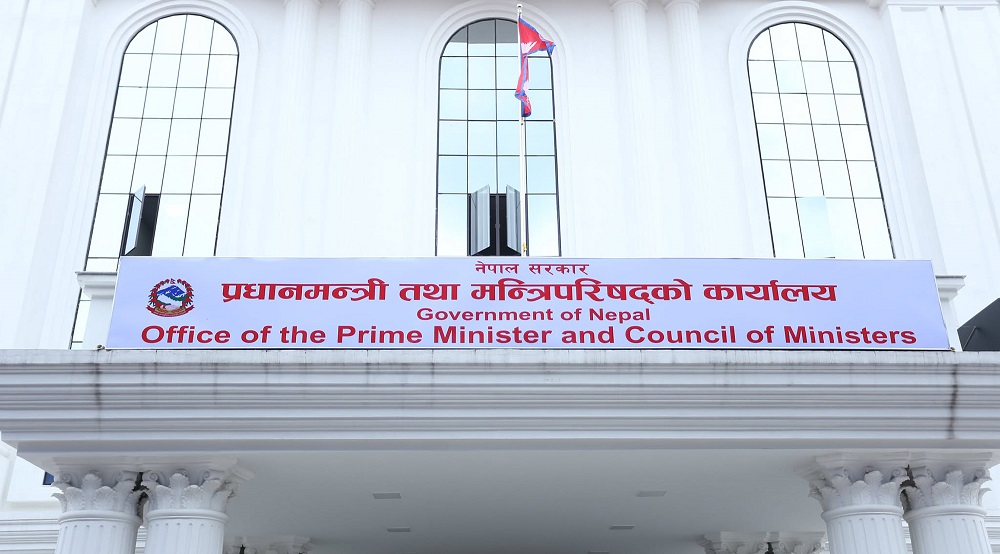
KATHMANDU: Incorporating the plans and policies of the manifestos, pledges and commitments of the six major political parties participating in the election held in March this year, the government has formulated a 18-pooing National Commitment for reforms in governance to make the economy more competitive, inclusive and resilient.
It said that the economy will be driven by private sector, governance efficiency, digital transformation and global information while ensuring social equity and environmental sustainability.
According to the document made public on Monday evening, for the economic stability and reforms, the government aims to harness Nepal’s youth-centred demographic dividend to drive structural transformation and achieve middle-income status through production-led growth.
Private sector will act as the engine of the growth while the government’s role will be limited to regulation, facilitation and policy stability.
The government also said that it will eliminate rent-seeking, policy capture, cartels and artificial shortages to ensure fair competition, entrepreneurship and business-friendly environment. It is set to introduce predictable tax policies (at least 10-year stability) and simplify procedures through paperless digital systems, improving investor confidence.
“For economic transformation, a time-bound Economic Charter will be established with national consensus among major political parties. Through the formulation and implementation of national and sectoral policies aimed at capital formation, job creation, export growth, and overall macroeconomic stability, Nepal will be positioned as a respectable middle-income country,” read the document.
Over the next five years, an average economic growth rate of 7 per cent will be achieved, raising per capita income to US$ 3,000 and bringing the gross domestic product close to US$ 100 billion.
To increase tourism arrivals, length of stay and per capita spending, the sector will be diversified through nature, culture, community-based and wellness tourism ecosystems to offer better local experiences.
30,000 MW electricity in a decade
In order to achieve a target of 30,000 MW of electricity generation capacity over the next decade, legal revisions and policy reforms will be undertaken in areas such as land, forests, and the environment. The government will provide viability gap funding and prioritise the construction of large reservoir and semi-reservoir projects such as Budhigandaki and Dudhkoshi, read the document.
Likewise, energy-based large industries—such as steel, cement, herbal processing, data server stations, and chemical fertiliser plants—will be promoted. Alongside electricity generation, private sector participation will also be encouraged in storage, transmission, and distribution systems through investor-friendly policies and legal frameworks.
An integrated plan for energy development will be formulated, and energy production and resource mobilisation will be carried out through public–private partnerships.
“Through energy diplomacy, bilateral and regional cooperation will be strengthened, and energy trade will be expanded with neighbouring countries such as India and Bangladesh,” read the document.
PPP to get priority
The government is also set to develop an investment-friendly mining policy framework including public-private partnership models. Scientific and exploration will be conducted to attract investment in high-value mineral extraction and procession while extraction of construction materials will be regulated in line with environmental safeguards and export potential.
Likewise, the government stated that it will prevent staff transfers until project completion to implement result-based implementation of development projects. It will prioritise high-impact national projects aligned with development goals avoiding politically driven allocation and incorporate climate resilience and environmental sustainability into all development projects.
It said that it will launch large-scale green infrastructure projects to generate employment, and create jobs in IT, tourism, construction and commercial agriculture. The government aims to crate 1.5 million jobs within five years.
Good governance and corruption control
An aspect of the draft focuses on strengthening good governance and curbing corruption. It proposes a transparent investigation of the assets of public office holders in accordance with legal procedures, alongside institutional strengthening of constitutional bodies. The Cabinet’s policy decision-making process is also expected to be more clearly defined.
To encourage accountability, the government plans to introduce legislation on whistleblower protection and conflict of interest. These measures aim to safeguard individuals who report corruption and promote ethical conduct in public office.
The draft further outlines efforts to depoliticise the civil service. It proposes abolishing party-affiliated trade unions within government service and establishing a professional, impartial, and accountable public administration. Recruitments and appointments, including those of judges, would be based on merit and competitive processes.
In a bid to modernise governance structures, the government intends to strengthen investigative and regulatory bodies, empower the National Vigilance Centre, and eliminate intermediary influence in policymaking and decision-making processes.
Structural reforms are also proposed, including limiting the number of federal ministries to 17 and transforming the Office of the Prime Minister into a central hub for inter-ministerial coordination and project monitoring. The National Planning Commission would be restructured into a data-driven think tank.
The draft calls for the formation of a high-level administrative reform commission to streamline governance across federal, provincial, and local levels, reduce duplication, and promote efficiency. It also envisions inducting 25 per cent of new skilled personnel into public service within five years.
Further proposals include the introduction of a civil service law with clear performance indicators, regular salary revisions, and a shift towards digital and time-bound administrative processes. The government aims to eliminate bureaucratic delays and reduce the need for citizens to navigate intermediaries when accessing public services.
The government has urged political parties and stakeholders to submit their suggestions, stating that the final national commitment will reflect a collective vision for governance reform and improved public service delivery.
Education and health
Public education will be improved through long-term investment, making schooling gradually free and compulsory with equal access for all children. Mother-tongue and moral education will be promoted, while government schools will receive increased funding, with teacher performance linked to student outcomes, according to the document.
The gap between public and private schools will be reduced, and at least one model inclusive school will be established in each province. Practical, skill-based learning will be prioritised.
Higher education will be restructured to be research- and employment-focused, with programmes such as “earn while you learn” to reduce student outmigration. Tribhuvan University will be developed as a centre of excellence, with universities granted autonomy and kept free from political influence.
Forest, environment and climate change
The national commitment document said that forests and natural resources will be conserved and used sustainably to support national prosperity, with a focus on intergenerational responsibility. Modern technology and digital systems will improve forest management, while a green economy will be promoted.
Biodiversity conservation will be prioritised alongside public needs, with forest products such as timber and medicinal herbs used to expand economic activities. Environment-friendly practices will be encouraged in industries and businesses.
A Forest Fire High Alert Centre will monitor forests in real time using drones and satellites. Legal reforms will support the commercial use of forest resources, reducing timber imports, it said.
Watersheds and water resources will be protected to ensure climate-resilient development. Water collection ponds will be built in the mid-hills and Chure to manage floods and droughts. Extraction of stones, sand and gravel in the Chure will be regulated, and the Integrated Chure Conservation Authority strengthened.
Balanced foreign policy
The government has prioritised a balanced and dynamic foreign policy, emphasising Nepal’s sovereignty, territorial integrity, and national interest. The document read that shifting global geopolitics and the rise of neighbouring powers will be leveraged as opportunities for development. A new performance audit system will be introduced to evaluate the effectiveness of diplomatic missions, ensuring accountability and result-oriented engagement.
Likewise, transforming Nepal from a traditional ‘buffer state’ into a ‘vibrant bridge’ that facilitates regional connectivity and trilateral economic partnerships has gained priority. Maintaining neutrality, Nepal will continue to avoid military alliances while promoting peace and cooperation.
Protection of Nepali migrant workers’ rights, safety, and social security will also remain a priority. Economic diplomacy and international platforms like Sagarmatha Dialogue will be accorded priority.
Similarly, the government aims to harness the potential of the Nepali diaspora. Legal provisions will ensure citizenship continuity, property rights, and voting rights for Non-Resident Nepalis