


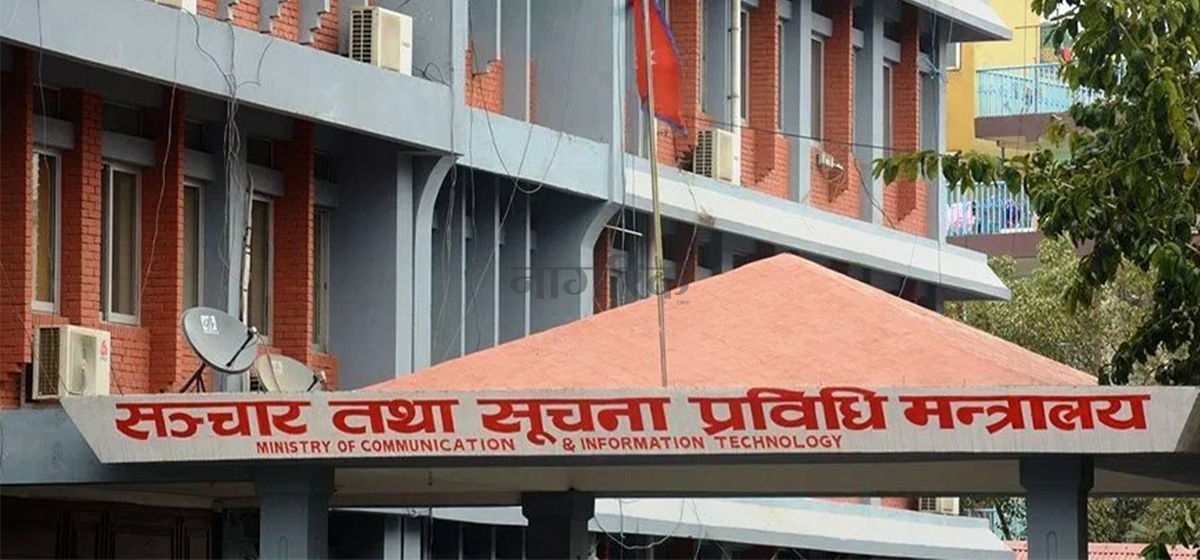
KATHMANDU: Nepal has opened the way for the operation of satellite teleport services, allowing companies to provide the service under a licence issued by the telecommunications regulator. The government has amended the Telecommunications Regulation, 2054, following a recommendation from the Nepal Telecommunications Authority (NTA), and introduced separate licence and renewal fees for teleport services.
Under the amended rules, the licence fee for teleport services has been set at Rs 60 million, while the renewal fee has been fixed at Rs 54 million. The Ministry of Communication and Information Technology published the amendment in the Nepal Gazette on Bhadra 8, adding new provisions to Schedules 6 and 7 of the regulation. Schedule 6 covers licence fees, while Schedule 7 sets out renewal charges.
The NTA had recommended opening Satellite Earth Station Gateway (SESG) and teleport services after determining the applicable licence and renewal fees. The regulator announced the decision last week while presenting its progress for the month of Shrawan, saying it had recommended the ministry introduce the necessary regulatory provisions.
A satellite teleport is a ground-based communications facility that acts as a link between satellites and terrestrial telecommunications, internet and broadcasting networks. It typically includes large satellite antennas, transmitters, receivers, amplifiers, modems and networking equipment. Data can be transmitted from a satellite to a teleport and then into terrestrial networks, or in the reverse direction.
The new framework could allow telecommunications and internet companies to access satellite capacity through a shared gateway or teleport, reducing the need for each operator to establish its own large satellite ground station. Such infrastructure can support broadband, telecommunications, television, radio and other satellite-based communication services.
Nepal’s existing legal framework refers to the related concept as a satellite earth station. The National Broadcasting Act, 2049 defines an earth station as a facility established on Earth for exchanging broadcasting programmes through satellites, while the Radio Communications (Licence) Regulations, 2049 recognise satellite communication systems using one or more satellites for radio communications.
The regulatory change creates, for the first time, a clearer licensing framework for commercial teleport operations in Nepal, potentially opening a new infrastructure segment for private-sector investment in satellite-based connectivity.