


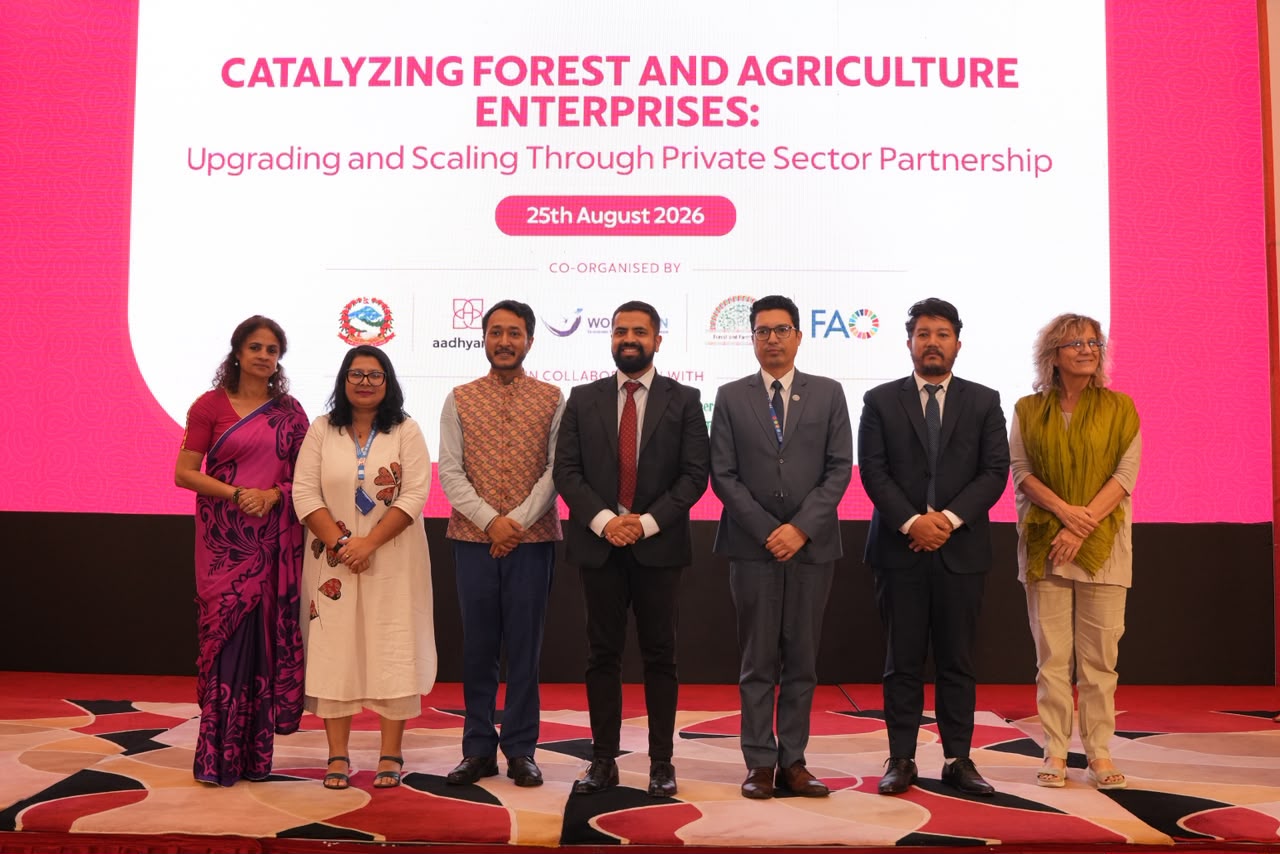
KATHMANDU: Nepal needs stronger collaboration among the government, private sector and financial institutions to turn its forest and agricultural resources into businesses, jobs and economic opportunities, stakeholders said at a Kathmandu forum.
Speaking at a programme titled ‘Catalyzing Forest and Agriculture Enterprises: Upgrading and Scaling Through Private Sector Partnership,’ participants said gaps in production, markets, finance and policy were limiting the growth of forest- and agriculture-based enterprises.
Agriculture, Forest and Environment Minister Geeta Chaudhary said the government was ready to address legal barriers facing entrepreneurs. She urged businesses to submit specific recommendations on laws and regulations that need reform.
Chaudhary said Nepal’s forests should not be viewed only from a conservation perspective but also as resources for production and enterprise. Nepal has forest cover of around 46 percent of its land area, but much of its economic potential remains underutilized.
She said the government wanted to create an environment where private investors could be confident that investment in agriculture would be secure and generate returns.
National Planning Commission member Dr Pukar Malla said Nepal’s priority should be to convert its existing potential into jobs and economic opportunities.
With 46 percent forest cover and around 23,000 community forest user groups, Nepal has significant resources that could be linked to enterprise and markets, he said.
Malla said financing challenges should not prevent businesses from growing. Investment should instead be tailored to different stages of an enterprise, including seed, pre-seed and growth financing.
He said the government was working toward a target of creating six million jobs by 2050 and urged the private sector to present evidence-based proposals to policymakers.
Aadhyanta Fund Management Chairman Manoj Paudel said the programme aimed to turn potential into opportunities, businesses and scalable enterprises. He said the fund had invested Rs4 billion during its five years of establishment and three years of active operations.
Entrepreneur Bhuwan KC said a gap remained between government policies and the realities faced by entrepreneurs. He called for greater trust, financial discipline and stronger attention to product quality.
Six enterprises receive awards
Six forest and agriculture enterprises presented their products, market opportunities, expansion plans and investment needs.
Northern Fungi won the Best Presentation Award, Sana Kisan Agriculture Cooperative the Best Innovation Award, Kodali Ventures the Best Growth Potential Award, Binayi Bio-Fertilizer Enterprise the Best Sustainability Impact Award, Sindhu Coffee the Best Market Opportunity Award, and Jadibuti Conservation and Utilization Cooperative the Community Impact Award.
A panel discussion also focused on business development support, financing, market access and linking farmers with enterprises.
Participants said stronger coordination among government, investors, financial institutions and entrepreneurs could help turn Nepal’s forest and agriculture sectors into a major source of rural jobs, investment and green economic growth.