

KATHMANDU: Nepal is preparing to turn an unprecedented natural disaster into a broader diplomatic campaign at the United Nations, arguing that the crisis should not be treated simply as a national emergency requiring short-term rescue and relief.
The government wants to use the international goodwill generated by the disaster to build a longer-term case around climate change, Himalayan vulnerability, Loss and Damage, reconstruction financing and the need for stronger international support mechanisms.
That strategy is expected to be a central element of Nepal’s engagement at the upcoming United Nations General Assembly, where Prime Minister-level participation has gained greater importance following the disaster.
The thinking inside the government is straightforward: international attention after a disaster is powerful, but temporary. The first 10 to 15 days usually generate intense global attention. Then that attention begins to fade.
Nepal therefore wants to institutionalise the issue before the window closes.
“We have to continue raising these issues in international forums, but we also need mechanisms to carry the issue forward,” the Foreign Minister said in the conversation. The government is already discussing the need for an institutional structure for climate diplomacy within the Foreign Ministry.
From disaster response to climate diplomacy
The first priority after the disaster was rescue and response. The government says neighbouring and friendly countries began offering search-and-rescue assistance, relief supplies, financial support and technical expertise from the first day. India emerged as an important early responder, while assistance and communication also came from a wider group of countries.
But the government now sees the disaster as a much larger diplomatic opportunity. The immediate question is reconstruction. The longer question is how Nepal can avoid financing reconstruction almost entirely through debt.
The country already faces pressure from debt servicing and capital expenditure. A major reconstruction programme financed predominantly through loans could further constrain resources available for economic development.
That is why Nepal intends to argue for forms of international support that go beyond conventional debt financing.
The government is considering a push for predictable grant mechanisms and broader global support for countries facing climate-related disasters.
This would represent a significant shift in the way Nepal presents itself internationally: from a country seeking assistance after a disaster to a vulnerable country demanding a more predictable international financing architecture.
The Loss and Damage case
At the heart of Nepal’s international campaign will be the question of Loss and Damage.
Nepal has already made an initial claim of $20 million for immediate support. But officials view that figure as an initial requirement, not a comprehensive valuation of the country’s losses.
A more detailed assessment is expected through post-disaster needs assessment and evaluation of both loss and damage.
The government recognises that the existing Loss and Damage Fund does not have sufficient resources to meet the scale of global demand. According to the discussion, applications already amount to more than $2 billion, while the fund has only around $250 million in resources currently available.
That gap is central to Nepal’s argument. Nepal does not intend to limit its campaign to securing its own allocation. It wants to push for stronger international mechanisms capable of delivering meaningful resources to vulnerable countries.
The government’s position is that such international outcomes may take years, even decades, to achieve.
That makes coalition-building essential.
Nepal plans to work with other vulnerable countries, use bilateral diplomacy, engage international organisations and maintain pressure through multilateral forums including the UN and the climate negotiations.
Why the Prime Minister is going to the UN
The decision to have the Prime Minister lead Nepal’s delegation has acquired additional significance following the disaster.
The government’s reasoning is that the presence of a head of government creates a different level of political value and visibility at an international forum.
The disaster has also changed the urgency of Nepal’s climate message. The Prime Minister can present the issue not simply as a disaster that has already happened, but as a warning of what could happen again.
Glacier melt, permafrost-related risks and the vulnerability of fragile Himalayan ecosystems are becoming part of Nepal’s international narrative.
The central argument will be that Nepal’s vulnerability is structural, not temporary. If climate-related disasters continue, countries such as Nepal will need resources not only to respond to emergencies but also to adapt, protect infrastructure, rebuild communities and maintain economic development.
Reframing the disaster
One of the most striking elements of the government’s thinking is the effort to find language capable of communicating the scale of the disaster internationally.
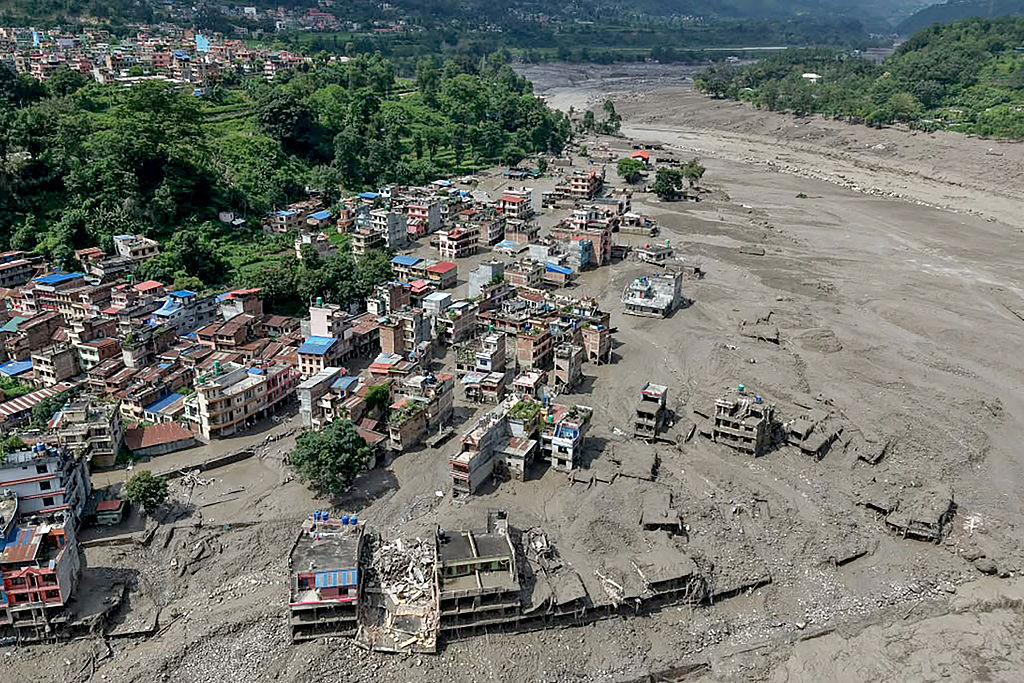
After visiting affected areas, the Foreign Minister said the conventional term “flood” did not adequately describe what he saw.
In some areas, homes several storeys high were buried by massive quantities of rock, mud and debris. The scale and speed of the water flow appeared dramatically different from the conventional understanding of flooding.
The Foreign Minister compared the visual impact with the aftermath of a tsunami and began referring to the event as a “Himalayan tsunami.”
The terminology is intended to communicate scale. For the government, disaster communication is not simply about describing what happened. It is also about ensuring that the international community understands the magnitude of the consequences and the vulnerability that produced them.
That matters because Nepal is trying to build international support around the disaster.
The China question: data before disaster
The disaster has also exposed weaknesses in cross-border information sharing. Nepal and China have some arrangements for sharing hydrological and meteorological data, but the government acknowledges that there is no comprehensive data-sharing mechanism.
The two countries had already agreed to work toward building such a mechanism. Drafts had been exchanged and discussions were underway before the latest disaster struck.
The crisis has made the issue more urgent. For Nepal, the lesson is clear: climate and disaster risks do not respect political borders.
A major event originating or developing in the Himalayan region can rapidly affect communities downstream. Early warning, hydrological information, meteorological data and rapid communication therefore need to become part of a more comprehensive bilateral mechanism. Connectivity is another immediate concern.
The disaster severely affected the Rasuwagadhi-Kerung corridor. Nepal has asked China to help restore at least temporary connectivity because heavy equipment cannot be moved easily from the Nepali side to the affected areas.
China has already established a temporary structure on its side up to the border area, according to the discussion.
India and the international response
India has also played a significant role in the emergency response. The government says India responded quickly, provided relief materials and technical assistance, and sent teams for specialised rescue operations.
Seven aircraft brought hundreds of tonnes of relief materials, according to the Foreign Minister. India was also approached for specialised technical support after the scale of the disaster became clearer, including tunnel rescue and assistance related to the management and preservation of bodies.
The latter became a particularly difficult issue because Nepal’s existing freezing capacity was overwhelmed. The government sought assistance not only from India but also through international channels, including the International Red Cross and other countries.
The United States also announced emergency assistance, including more than $3 million in support and relief supplies, according to the Foreign Minister.
Meanwhile, Nepal’s diplomatic outreach expanded considerably. The Foreign Minister said he had spoken with foreign ministers across South Asia as well as counterparts from countries including China, South Korea, Japan, Britain and Australia.
The conversations reflected two parallel concerns: international solidarity with Nepal and concern for foreign nationals missing in the disaster.
According to the discussion, nationals from more than 34 countries were among an estimated 500-600 people listed as missing at the time of the conversation.
Building a climate coalition
Nepal’s UN strategy therefore goes beyond asking for money. It wants to build political support around a wider principle: countries with fragile ecosystems and high climate vulnerability should not be forced to choose between reconstruction and development.
The government wants vulnerable countries to work together and build a coalition capable of keeping Loss and Damage, climate finance and predictable grant mechanisms on the international agenda. That will require sustained lobbying.
Diplomacy alone will not be enough. The Foreign Minister identified media, bilateral engagement and multilateral institutions as parts of the same broader lobbying effort.
The objective is not necessarily an immediate victory. Some international mechanisms take years to negotiate and strengthen. The government therefore wants Nepal to treat climate diplomacy as a long-term state project rather than an issue that appears only after a disaster.
Nepal’s own institutional weakness
Perhaps the most important admission from the conversation is that Nepal’s problem is not simply the absence of international goodwill.
It is also the absence of sufficient institutional mechanisms at home to sustain international campaigns.
The government wants to address that weakness through a stronger climate diplomacy structure within the Foreign Ministry.
The idea is to create institutional memory and continuity so that the issue does not disappear once the immediate disaster fades from global headlines.
That would allow Nepal to keep working on the same agenda across UN General Assembly sessions, climate conferences, bilateral meetings and other international forums.
From Everest to the sea
Nepal is also preparing to host a UN side event under the theme “Sagarmatha to Sea”, linking the Himalayan climate crisis with the wider global climate system.
The message is designed to move beyond the conventional image of Nepal as a mountainous country.
The Himalaya is not isolated. Changes in the mountains affect water, ecosystems, communities and economies far beyond the immediate location of the disaster.
By taking the issue from Sagarmatha to the sea, Nepal wants to frame the Himalaya as part of a global climate story.
The real test begins after the UN
The coming UN General Assembly could give Nepal an important international platform. But the more difficult task will begin after the speeches and diplomatic meetings end.
Can Nepal convert international goodwill into long-term reconstruction support?
Can it secure meaningful access to Loss and Damage financing?
Can it build a coalition with other vulnerable countries?
Can it persuade major developed countries to support stronger and more predictable grant mechanisms?
And, perhaps most importantly, can Nepal maintain the campaign after the disaster disappears from international headlines?
The government appears to recognise that this will not be achieved in a single UN session.
The immediate disaster has created an opening. Nepal now wants to turn that opening into a sustained diplomatic campaign.
Its argument is increasingly clear: the disaster was not simply a flood, and Nepal is not simply asking the world to help rebuild what was destroyed.
It is asking the international community to recognise that a country sitting on one of the world’s most fragile ecosystems cannot be expected to repeatedly borrow its way out of climate disasters.
The question Nepal is preparing to take to the United Nations is therefore larger than the cost of reconstruction. If the Himalaya is becoming increasingly vulnerable to a crisis driven by a changing climate, who should pay for the damage – and who will pay to prevent the next disaster?