

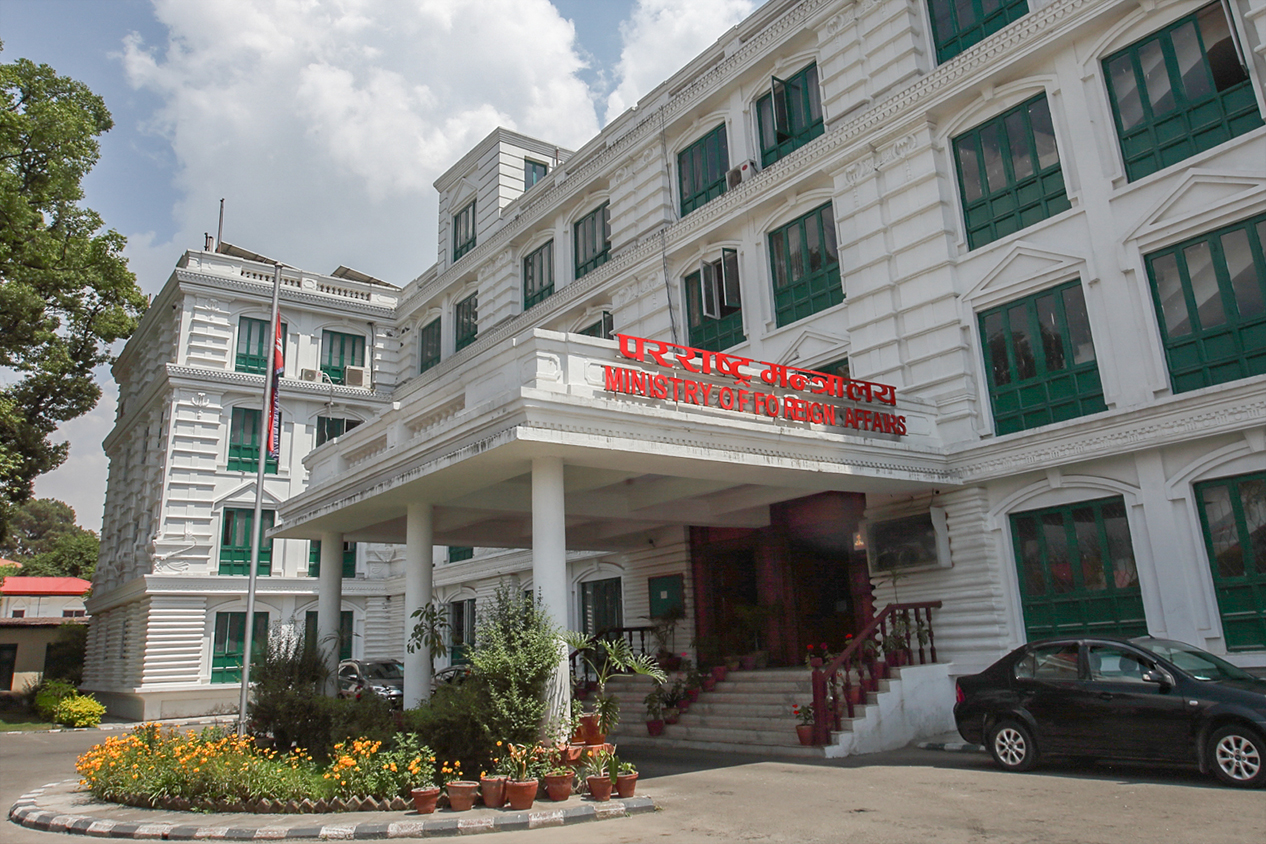
KATHMANDU: The government has delayed the appointment of ambassadors despite calling for applications through open competition, raising concerns over the effectiveness of Nepal’s foreign policy, international relations and diplomatic representation.
Nearly five months after the government was formed, the process of appointing ambassadors to vacant diplomatic missions abroad remains incomplete.
The government had invited applications to select ambassadors on a competitive basis for 13 countries but has yet to make a decision.
The appointment process for another seven countries is also stalled. Of Nepal’s 31 diplomatic missions abroad, including its permanent missions to the United Nations, 21 are currently without ambassadors. Several missions that have remained vacant for an extended period are being run by acting officials.
Experts say the absence of permanent leadership is weakening Nepal’s foreign-policy delivery and diplomatic representation.
They warn that the prolonged delay in ambassadorial appointments could have structural consequences for Nepal’s international relations and foreign policy. Extended vacancies in strategically important countries could weaken Nepal’s diplomatic presence and affect bilateral relations, high-level engagement and the promotion of national interests.
Nepal currently has 31 embassies, including permanent missions to the United Nations, and eight consulates general. Until the last fiscal year, Nepal had 34 embassies and 10 consulates general.
Three embassies and two consulates general are now in the process of being closed. Excluding the embassies in South Africa, Denmark and Brazil, which are being closed, as well as the consulates general in Chengdu, China, and San Francisco, the ambassadorial posts at 21 of the remaining missions are vacant.
Eleven embassies have been without ambassadors since late October last year, while six have remained vacant since March 27 this year. Six career diplomats—joint secretaries at the Ministry of Foreign Affairs—who have completed their terms and are due to return to Nepal are also waiting for government instructions.
Nepal maintains embassies in neighbouring India and China, as well as the United States, the United Kingdom, Bahrain, Bangladesh, Belgium, Canada, Egypt, France, Germany, Israel, Japan, South Korea, Kuwait, Malaysia, Myanmar, Oman, Pakistan, Portugal, Qatar, Russia, Saudi Arabia, Sri Lanka, Thailand, the United Arab Emirates and Spain.
Nepal also has permanent missions to the United Nations in New York, Geneva and Vienna. Its consulates general are located in Kolkata, India; Lhasa, Hong Kong and Guangzhou in China; New York and Dallas in the United States; Dubai in the UAE; and Jeddah in Saudi Arabia.
Joint secretaries from the Ministry of Foreign Affairs are currently serving as ambassadors at 10 missions, including permanent missions to the United Nations.
Following the Gen-Z movement, the election government decided on October 16 last year to recall ambassadors serving in 11 countries. After the government led by Prime Minister Balen Shah was formed on March 27, another six ambassadors were recalled. All of them had been appointed under the political quota-sharing arrangements among the Nepali Congress, CPN-UML and CPN (Maoist Centre).
Two of the missions affected are now being closed. No recommendations have yet been made for ambassadorial appointments in the remaining 15 countries. In addition, Nepal’s embassy in Brazil, where career diplomat Nirmal Raj Kafle is serving as ambassador, is also being closed.
In October last year, the government led by Sushila Karki recalled ambassadors Chandra Kumar Ghimire from the United Kingdom, Lok Darshan Regmi from the United States, Krishna Prasad Oli from China, Ramesh Chandra Paudel from Qatar, Naresh Bikram Dhakal from Saudi Arabia, Dhan Prasad Pandit from Israel, Sunil Nepal from Spain, Dr. Shail Rupakheti from Germany, Dr. Netra Prasad Timalsina from Malaysia, Jung Bahadur Chauhan from Russia and Dr. Durga Bahadur Subedi from Japan.
These 11 ambassadors comprised 10 nominees recommended by the government led by UML chair KP Sharma Oli on July 29, 2024, and one nominee recommended by the previous government.
On March 28, the current government recalled six ambassadors appointed under the power-sharing arrangement between the UML and Nepali Congress: Dr. Shankar Prasad Sharma from India, Chitralekha Yadav from Australia, Dr. Purna Bahadur Nepali from Sri Lanka, Dr. Shivamaya Tumbahangphe from South Korea, Sumnima Tuladhar from Denmark and Kapil Shrestha from South Africa.
Five ambassadors whose terms expired in July are still in place pending further government decisions. They are Ghanshyam Bhandari in Bangladesh, Tirtha Raj Wagle in Bahrain, Harish Chandra Ghimire in Myanmar, Bharat Regmi at Nepal’s permanent mission to the United Nations in Austria, and Sushil Lamsal in Egypt. They are preparing to return to Nepal after completing their terms.
Ambassador Nirmal Raj Kafle in Brazil has also been instructed to facilitate the closure of the embassy and remains in place pending the government’s decision. The government has instructed the ambassadors not to return to Nepal until further notice.
Oman’s ambassador, Dornath Aryal, has already returned to Nepal after completing his term.
The government has meanwhile invited applications from outside the foreign service for ambassadorial positions in Bangladesh, Bahrain, Austria and Oman, despite career diplomats currently serving in those missions.
Former foreign secretary Madhu Raman Acharya said the government should move quickly to recommend ambassadors.
“Not engaging with countries at the highest level and not sending ambassadors creates a diplomatic vacuum. The government was in a hurry to recall ambassadors but has been slow to send replacements, and that is not good,” Acharya said.
He said the current government appeared to be relying heavily on the foreign minister while Prime Minister Balen Shah had yet to visit Nepal’s important neighbours and other key countries.
“The government says it wants to focus on internal reforms, but that is not possible without engaging with the outside world. Where will the money come from? Where will the investment come from?” he said.
Acharya said foreign relations did not appear to be a priority for the government.
“It appears that the prime minister’s advisers have become dominant in foreign affairs. That should not happen,” he said.