

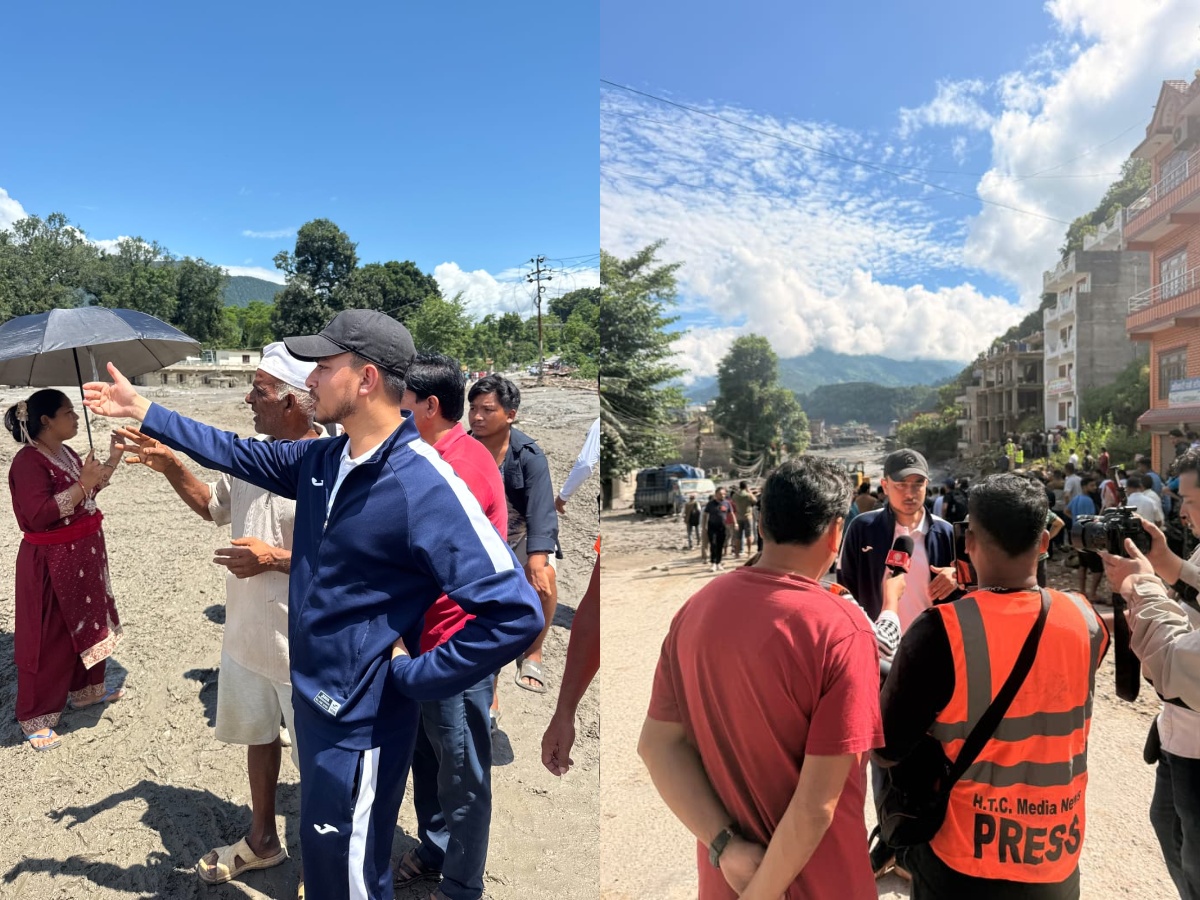
RASUWA: Gen-Z activist Rabi Kiran Hamal, who reached the disaster-affected areas from the very day the floods struck, has urged the government to accelerate disaster response in Rasuwa on a war footing. He stressed that, alongside immediate rescue efforts, the government must take systematic measures to ensure public health and the long-term rehabilitation of displaced citizens.
Hamal reached the affected areas together with local resident Menald Lamichhane and his friend Sachin, carrying food supplies and some medical materials. After observing the situation on the ground, Hamal said rescue operations were being delayed due to a lack of adequate equipment and technology.
Expressing concern over the delay, he urged the government to immediately seek international assistance and deploy advanced technology and specialized equipment to rescue citizens trapped inside tunnels, along riverbanks and in remote areas. He said there should be no hesitation in seeking assistance from friendly countries and international rescue mechanisms if Nepal’s available resources are insufficient.
Hamal also expressed concern that the actual extent of the disaster remains unclear and suspected that as many as 4,000–5,000 people could be missing. Given the situation, he called for a broader and more intensive search-and-rescue operation involving all available state mechanisms.
He further stressed the urgent need to manage the bodies of people and animals killed in the floods and landslides. Warning that prolonged failure to manage human and animal remains could create a serious public-health crisis and increase the risk of infectious diseases, he urged the concerned authorities to act immediately.
Hamal also called for the immediate management and distribution of relief materials, with local governments, residents, volunteers and civil-society organizations mobilized effectively. He said local governments should be provided with adequate resources, manpower and authority to deliver relief and rescue assistance according to the needs of affected communities.
According to Hamal, immediate rescue and relief must be accompanied by a broader, well-planned long-term rehabilitation programme for people displaced by the disaster. Families who have lost their homes, infrastructure and livelihoods should not be limited to emergency relief; they should be supported through a comprehensive rehabilitation plan covering housing, employment, education, healthcare and other basic services.
During his interactions with affected residents, Hamal said people had raised several concerns about the government’s response. In particular, residents complained about weaknesses in information dissemination and the one-door system adopted for relief and rescue, which they said had prevented essential assistance from reaching them on time. He also said some residents expressed dissatisfaction over certain government activities that they felt were contrary to religious and social values.
Hamal urged the government to immediately accept international assistance where necessary, bring in advanced rescue technology, intensify the search for missing people, manage human and animal remains, and establish special mechanisms to prevent a public-health crisis in the affected areas.
He said his team would remain in continuous communication with affected communities and would work systematically not only on immediate relief but also on the rehabilitation of displaced families and long-term support.
His message is clear: rescue trapped citizens without delay; use international assistance and advanced technology where necessary; prevent a public-health crisis; mobilize local governments and citizens in relief efforts; and ensure the dignified rehabilitation of displaced families.