

KATHMANDU: For generations, Mount Everest has stood as Nepal’s most powerful symbol of national pride-and one of the world’s most enduring cinematic obsessions. Yet while international filmmakers have repeatedly returned to Everest to tell stories of triumph, tragedy, survival and sacrifice, Nepal itself has produced surprisingly few ambitious, technically demanding films capable of capturing the mountain on its own terms.
The reasons are familiar: the extraordinary cost of filming at extreme altitude, limited access to high-end equipment, the technical complexity of mountain cinematography, long research cycles and the sheer physical and logistical demands of working in one of the most hostile environments on Earth.
‘Road to Everest’ is an attempt to change that.
Built over two years of research, filming and production, the 50-minute documentary seeks to place a distinctly Nepali production at the centre of Everest’s global cinematic story. It is not simply a film about reaching the summit. It is an attempt to document the journey to it—from sea level to the roof of the world—and to examine what Everest means to those who climb it, work on it and live in its shadow.
The film’s official trailer has now been released, offering the first substantial look at a project that its producers believe could represent a significant step forward for Nepal’s documentary filmmaking.
Directed by filmmaker and journalist Nirmal Shrestha, Road to Everest combines an expedition narrative with human drama, high-altitude adventure and an increasingly urgent environmental question: what is happening to the Himalayas as the climate changes?
The mountain that cinema keeps returning to
Everest has always offered filmmakers something more than spectacular scenery.
At 8,848.86 metres, it is the highest point on Earth, but its real cinematic power lies in the contradiction it represents. From a distance, the mountain appears majestic and almost untouchable. Up close, it becomes a place of exhaustion, oxygen deprivation, extreme cold, avalanches, disorientation and death.
The most compelling Everest films have understood that distinction.
The 2015 feature Everest, directed by Baltasar Kormákur, revisited the catastrophic 1996 climbing season, when a violent storm trapped multiple expeditions near the summit. With Jason Clarke, Jake Gyllenhaal and Josh Brolin among its principal cast, the film brought the physical danger and psychological pressure of high-altitude climbing to a global audience.
Into Thin Air: Death on Everest, based on Jon Krakauer’s account of the same disaster, explored the decisions that placed climbers in an increasingly dangerous situation as weather deteriorated.
Beyond the Edge returned further into history, reconstructing the 1953 expedition of Sir Edmund Hillary and Tenzing Norgay. The film combined archival material, interviews and dramatic reconstruction to revisit one of mountaineering’s defining achievements.
Then came films that began shifting the perspective.
Jennifer Peedom’s Sherpa placed Sherpa climbers at the centre of the story, examining their culture, risks and relationship with Everest, particularly following the 2014 avalanche that killed 16 Sherpas.
The Wildest Dream explored the mystery surrounding George Mallory and Andrew Irvine, who disappeared on Everest in 1924, while Everest: IMAX brought audiences extraordinarily close to the mountain through large-format cinematography.
More recently, 14 Peaks: Nothing Is Impossible transformed Nepal’s mountaineering story into a global phenomenon through the extraordinary campaign of Nirmal “Nimsdai” Purja, who climbed all 14 of the world’s 8,000-metre peaks in a record period.
The message from these films is clear: Everest is never simply a mountain story.
It is a story about human limits.
A Nepali story, told from sea level to the summit
Road to Everest takes a different route.
Rather than beginning with the familiar spectacle of Everest Base Camp, the documentary follows a journey that starts at sea level and moves gradually toward the summit.
At its centre is Raj Gurung, a man over 50 who pursues the dream of climbing Everest while confronting age, physical limitations and the enormous demands of the mountain.
His journey gives the film its human core.
This is not merely a question of whether a climber can reach the summit. It is a story about why people continue to pursue seemingly impossible goals—and what they are willing to sacrifice in the process.
Gurung’s expedition becomes a broader meditation on ambition, resilience, self-belief and the human desire to push beyond perceived limits.
That personal story is then placed against the much larger forces of Everest itself.
The reality of the Death Zone
Any serious Everest film eventually arrives at the mountain’s most unforgiving reality: the Death Zone.
Above 8,000 metres, the human body is operating far beyond the environment for which it was designed. Oxygen levels are dangerously low. Exhaustion becomes overwhelming. Cold can become fatal. Decision-making deteriorates. A mistake that might be manageable at lower altitude can become irreversible.
This is where Everest stories cease to be conventional adventure narratives.
The mountain does not negotiate.
There is no guarantee that experience, money, technology or determination will be enough.
Some of the most haunting images associated with Everest come from this region, including the so-called Rainbow Valley near the summit, where bodies of climbers who died on the mountain remain because recovery can itself be too dangerous.
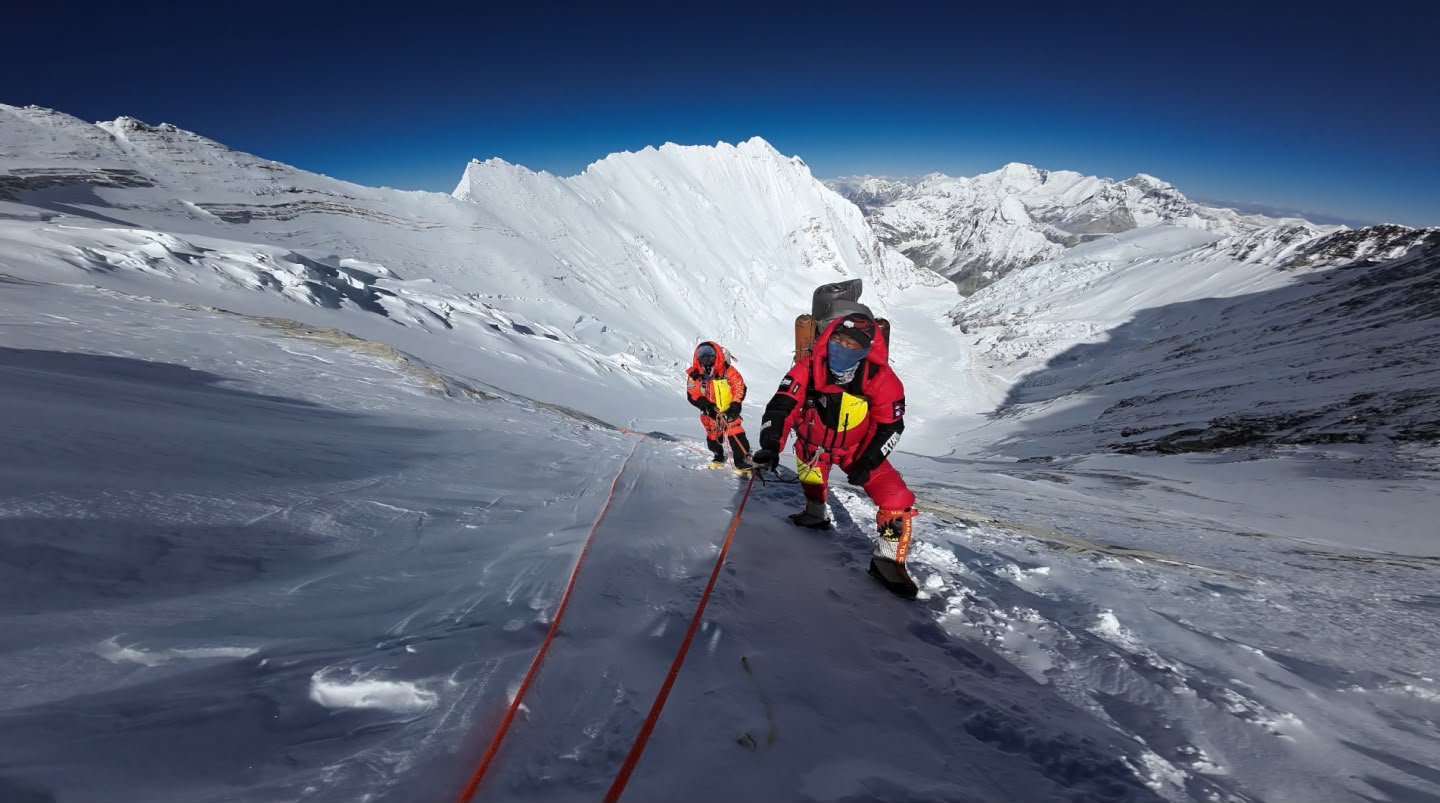
Road to Everest approaches this reality through actual expedition footage rather than fictional reconstruction.
The producers say the documentary contains no artificial or computer-generated imagery. What viewers see is intended to be the mountain as it was encountered by the production team.
That distinction matters.
When the Sherpa story becomes the Everest story
No modern Everest documentary can be complete without confronting the role of the Sherpa community.
The commercial image of Everest often focuses on foreign climbers reaching the summit. Behind almost every successful expedition, however, are highly experienced Nepali mountain workers carrying loads, fixing ropes, preparing camps, navigating dangerous terrain and repeatedly entering areas where a single mistake can cost a life.
Road to Everest gives that reality significant space.
Among the expedition figures featured in the documentary are record-setting climbers Phurba Tenzing Sherpa and Nima Gyalzen Sherpa.
According to the production team, Phurba has successfully climbed Everest 18 times. Nima has reached the summit 10 times and has also successfully climbed all 14 of the world’s mountains above 8,000 metres.
Their presence adds a dimension that goes beyond the experience of a single expedition.
They represent the accumulated knowledge of people whose relationship with Everest is measured not in one attempt, but in years of repeated exposure to its dangers.
Vinod Gurung, Suraj Gurung and director Nirmal Shrestha also appear as fellow travellers in the expedition.
The mountain is changing
Perhaps the most consequential element of Road to Everest is not the summit itself.
It is what is happening to the mountain.
Climate change is reshaping the Himalayan environment. Glaciers are retreating, weather patterns are becoming increasingly unpredictable and changes in snow and ice conditions are creating new challenges for climbers and mountain communities.
Everest is therefore no longer simply a symbol of adventure.
It is also a frontline for understanding the consequences of a warming planet.
By incorporating climate change into an expedition narrative, Road to Everest attempts to move beyond the conventional Everest formula of danger, conquest and spectacular scenery.
The question is no longer only whether humans can conquer Everest.
It is whether the Everest we know today will remain the same mountain for future generations.
Why the production itself matters
There is another story behind Road to Everest: the story of making an ambitious mountain documentary from Nepal.
Everest has been filmed countless times, but many of the most technically sophisticated productions have come from outside Nepal. The mountain may be Nepal’s most recognisable global asset, yet the resources required to tell its story at an international cinematic standard have historically been difficult to assemble locally.
High-altitude filmmaking is expensive.
It requires specialised cameras, expedition logistics, experienced mountain crews, insurance, permits, transport, safety systems, data management and post-production capabilities. Every additional day in the mountains increases both financial and physical risk.
Against that backdrop, Road to Everest represents an important experiment in Nepali production capacity.
The project has been developed over two years, with Nepali technicians involved throughout the production. The filmmakers are betting that local expertise, access to the mountain and a distinctly Nepali perspective can produce something capable of travelling well beyond Nepal.
Its ambition is therefore larger than the documentary itself.
It is a test of whether Nepal can increasingly tell its own Himalayan stories at an international level.
Beyond a tourism film
There is an obvious tourism dimension to Road to Everest.
Few images sell Nepal more powerfully than Everest. A well-made international documentary can introduce the country not simply as a destination for climbers, but as a landscape of culture, adventure, spirituality and extraordinary natural beauty.
But reducing the film to tourism promotion would miss its larger purpose.
The documentary is also about ageing and ambition, the economics and risks of mountaineering, the invisible labour of Sherpa communities, the psychology of extreme adventure and the environmental transformation of the Himalayas.
That gives it the potential to function simultaneously as an adventure film, human-interest documentary and environmental story.
The next Everest film may come from Everest itself
The global history of Everest cinema is already extensive.
There are disaster films, survival stories, historical documentaries, expedition films, Sherpa narratives and record-breaking mountaineering documentaries. Each has found a different way into the same mountain.
What has remained comparatively rare is a large-scale Nepali production that attempts to bring those perspectives together while maintaining a distinctly local voice.
That is the space Road to Everest is entering.
The documentary does not need to compete with Hollywood on budget. Nor does it need to replicate the formula of earlier Everest films.
Its strongest proposition is authenticity.
A real journey.
Real climbers.
Real mountain conditions.
Real Nepali technicians.
And a story told by people who live much closer to Everest than most of the audiences who have watched it from a cinema seat.
From Nepal to the world
Produced by We Will Rise Foundation, Road to Everest runs for approximately 50 minutes.
According to the production team, its Nepal premiere is scheduled for Bhadra 6 in Kathmandu, followed by an international premiere in Hong Kong on Bhadra 28. The documentary is then expected to travel to different locations in Nepal as well as international film festivals, platforms and cinemas.
The filmmakers say the broader ambition is to inspire audiences, promote Nepal internationally and draw global attention to the impact of climate change on the Himalayas.
That makes the film’s journey potentially as important as the expedition it documents.
Everest has spent decades being one of the most filmed mountains on Earth.
The challenge now is not finding another story to tell about Everest.
It is finding a new way to tell it.
‘Road to Everest’ is Nepal’s attempt to do exactly that-using its own people, its own mountain and its own perspective to take one of the world’s oldest mountain stories into a new cinematic era.
The mountain on screen: why Everest remains cinema’s ultimate test
Everest has long been Nepal’s greatest symbol of pride. Yet for decades, while filmmakers from around the world have travelled to the Himalaya to tell stories about the world’s highest mountain, Nepal has rarely had the financial muscle, technical infrastructure, specialised expertise or sustained cinematic ambition to make the definitive Everest film of its own. That may finally be changing.
Few places on Earth carry the cinematic power of Mount Everest.
At 8,849 metres, Everest is more than a mountain. It is an idea: the ultimate vertical frontier, a place where ambition collides with nature and where human endurance is measured not in kilometres but in breaths. For generations, climbers have travelled to Nepal with the same improbable objective—to stand on the highest point on Earth. For filmmakers, however, Everest presents an equally formidable challenge: how do you turn one of the planet’s most extraordinary real environments into a story that feels as vast, dangerous and emotionally overwhelming as the mountain itself?
That challenge explains why there have been surprisingly few major Everest films—and why the films that have succeeded have often come from filmmakers outside Nepal.
Hollywood, European cinema, documentary crews and international mountaineers have repeatedly returned to Everest. They have reconstructed historic expeditions, followed contemporary climbers, documented disasters and explored the lives of the Sherpas whose labour makes many expeditions possible. Their cameras have captured avalanches, blizzards, exhaustion, death, rescue and triumph.
But Everest has remained an unfinished cinematic story for Nepal itself.
The irony is difficult to miss. Nepal owns the southern gateway to Everest, lives alongside the mountain, has produced generations of elite high-altitude climbers and Sherpas, and has become inseparable from the global mythology of Everest. Yet the country has struggled to translate that extraordinary inheritance into a large-scale cinematic language capable of competing internationally.
The obstacles are obvious. A serious Everest production is extraordinarily expensive. Cameras, helicopters, high-altitude crews, safety teams, permits, insurance, logistics, specialised equipment and months of preparation can turn a film into a multimillion-dollar undertaking before the first scene is even completed. At extreme altitude, conventional filmmaking becomes almost impossible. Batteries fail. Weather changes without warning. Human performance deteriorates. Equipment has to be carried through terrain where simply walking is an achievement.
Then there is the mountain itself.
Everest does not cooperate with production schedules.
A filmmaker cannot simply call for better weather, move a camera into position or ask an actor to repeat a dangerous sequence. At the highest elevations, oxygen becomes scarce and every decision has consequences. The environment that makes Everest spectacular is precisely what makes it so difficult to film.
That is why the history of Everest cinema is, in many ways, also a history of technological courage.
The mountain that became a movie
The most successful Everest films have understood that the mountain itself cannot be the only character.
The great Everest stories are about people confronting the limits of their own ambition.
They begin at Base Camp, where excitement and uncertainty coexist. They move upward through the Khumbu Icefall, across camps carved into hostile terrain and toward the South Col. Then comes the summit push—and the notorious Death Zone, where the human body begins to fail simply because it is not designed to live at such altitude.
At that elevation, exhaustion becomes a threat. Hypoxia distorts judgement. Cold becomes potentially fatal. A small mistake can become irreversible.
And then there is the descent.
Many Everest stories are ultimately decided not on the summit but on the way down.
That tension has produced some of the most compelling mountain films ever made.
Everest – 2015
Baltasar Kormákur’s Everest remains one of the most ambitious dramatic portrayals of the mountain.
Inspired by the catastrophic 1996 climbing season, the film follows two expedition teams caught in a devastating storm. Jason Clarke, Jake Gyllenhaal, Josh Brolin and Keira Knightley lead a cast that brings the human consequences of the disaster into focus.
The film cost an estimated $55 million and eventually earned more than $200 million worldwide, demonstrating that Everest could become a major international theatrical spectacle.
Its greatest strength is visual scale.
The mountain is not presented simply as scenery. It becomes an antagonist-beautiful, indifferent and relentlessly dangerous.
The film recreates the brutal transition from ambition to survival as climbers confront deteriorating weather, exhaustion and impossible choices near the summit.
Although much of the production was filmed away from the actual summit environment, including locations in the Italian Alps, the filmmakers used the landscape, visual effects and high-altitude photography to create an imposing representation of Everest.
The result is less a conventional adventure film than a meditation on how quickly confidence can collapse when nature changes the rules.
Into Thin Air: Death on Everest – 1997
Before the large Hollywood production, television had already attempted to dramatise the 1996 disaster.
Into Thin Air: Death on Everest, based on Jon Krakauer’s bestselling account, reconstructs the expedition disaster involving the teams led by Rob Hall and Scott Fischer.
The story is especially powerful because it focuses on decisions.
When should climbers turn around? How much risk is acceptable? What happens when professional guides, experienced climbers and exhausted clients are trapped by circumstances beyond their control?
The film explores the devastating consequences of pushing beyond safe limits.
The 1996 disaster became one of the defining tragedies in modern Everest history, and its story continues to influence discussions about commercial expeditions, leadership, risk management and the ethics of climbing.
For cinema, it offered something almost too powerful to invent: a real-life survival story in which the outcome was already written.
Beyond the Edge -2013
If the 1996 disaster represents Everest at its most tragic, Beyond the Edge looks toward the mountain’s most celebrated achievement.
The documentary recreates the 1953 expedition of Edmund Hillary and Tenzing Norgay—the first confirmed successful ascent of Everest.
Using archival material, interviews and dramatic reconstruction, the film returns to an era when Everest was still largely unknown territory.
There were no modern commercial expedition infrastructures. No satellite phones in every climber’s pocket. No sophisticated GPS tracking. No social-media audience waiting for updates from Base Camp.
There was simply a mountain, an expedition and an extraordinary level of uncertainty.
The story of Hillary and Tenzing therefore carries a different cinematic quality. It is not primarily about disaster. It is about exploration, partnership and the audacity of attempting something that had never been done.
For Nepal, it is also part of the foundational mythology of the modern Everest era.
Sherpa- the story behind the summit
Perhaps the most important shift in Everest cinema came when filmmakers began asking a different question:
Who actually makes Everest expeditions possible?
Jennifer Peedom’s Sherpa provides one of the strongest answers.
The 2015 documentary follows Phurba Tashi, one of the most accomplished Everest Sherpas of his generation, and examines the culture, spirituality and extraordinary risks associated with Sherpa work.
The film was made around the 2014 climbing season, when an avalanche in the Khumbu Icefall killed 16 Sherpas—the deadliest disaster on Everest at that point.
The tragedy transformed the expedition season.
Sherpas collectively questioned whether they should continue working in an environment where the risks were borne disproportionately by them while the rewards of climbing were often enjoyed by foreign clients.
The film therefore goes beyond adventure.
It examines labour, dignity, economic inequality, cultural identity and the complicated relationship between climbers and the people who guide them through the mountain.
That is an important evolution in Everest cinema.
The mountain is no longer simply a playground for wealthy adventurers.
It is a workplace.
It is a sacred landscape.
It is a source of livelihood.
And for many Sherpas, it is part of a cultural world that cannot be reduced to the phrase “conquer Everest.”
The Wildest Dream- the mystery that refused to die
Few Everest stories possess the mystery of George Mallory.
In 1924, British climber George Mallory and Andrew Irvine disappeared high on Everest. For decades, the world was left with one haunting question:
Did they reach the summit before they died?
Anthony Geffen’s The Wildest Dream revisits Mallory’s story while following modern climber Conrad Anker, who became involved in the search for answers after Mallory’s body was discovered in 1999.
Archival photographs, letters and historical footage are combined with modern expedition sequences to connect two eras of mountaineering.
The result is a film about more than Everest.
It is about obsession.
About why humans continue to pursue goals that may have no rational reward.
About whether reaching the top is more important than surviving the journey.
And about how some mysteries become larger precisely because they are never completely solved.
Everest in IMAX
Some films attempted not merely to tell the story of Everest but to make audiences feel as though they were standing on it.
Everest: IMAX was one of the landmark attempts.
Released in 1998, the documentary used the enormous visual canvas of IMAX 70mm photography to bring viewers into the high-altitude environment.
David Breashears and climber Ed Viesturs were among those involved in the expedition depicted in the film.
The production became even more significant because the filmmaking team found itself close to the unfolding tragedy of the 1996 disaster and participated in rescue efforts.
The film therefore sits at the intersection of filmmaking and mountaineering.
Its achievement was technological as much as cinematic: it demonstrated how a mountain could be transformed from a distant image on a screen into an immersive physical experience.
For modern filmmakers contemplating an Everest feature, that lesson remains relevant.
The audience no longer wants simply to see the mountain.
It wants to feel the altitude.
Hear the wind.
See the ice moving.
Experience the thinness of the air.
And understand what it means to make a decision when the margin between life and death is measured in seconds.
Storm over Everest
David Breashears returned to the 1996 disaster with Storm Over Everest, examining the storm through the testimony of climbers and Sherpas who experienced it.
Rather than relying entirely on dramatic reconstruction, the documentary gives survivors a chance to revisit their decisions and losses.
That makes the film valuable not only as cinema but as historical testimony.
The Everest disaster is often remembered through a few famous names. But the larger story is about dozens of people confronting an environment that suddenly became almost impossible to survive.
The film captures the terrifying combination of exhaustion, frostbite, disorientation, darkness and deteriorating weather that turns a familiar route into a maze.
14 Peaks: Nothing is impossible
Then came a story that changed the global image of Nepali mountaineering.
14 Peaks: Nothing Is Impossible, released in 2021, follows Nepali climber Nirmal “Nimsdai” Purja and his attempt to climb all 14 of the world’s mountains above 8,000 metres.
His objective sounded almost absurd: complete the challenge in a fraction of the time previously considered possible.
What followed became one of the most remarkable mountaineering achievements of the modern era.
The documentary is important for another reason.
For perhaps the first time, a major international audience was presented with a contemporary Nepali climber not merely as a supporting figure in someone else’s Everest story, but as the central protagonist.
Purja’s project placed Nepali mountaineering expertise at the centre of the narrative.
The mountain was no longer being explained to the world exclusively through foreign climbers.
Nepal had a protagonist of its own.
And that matters.
Everest: The South Col- before the modern spectacle
Long before drones, IMAX cameras and digital visual effects, filmmakers were already attempting to document the physical reality of Everest.
Everest: The South Col, released in 1969, focused on the South Col route and the practical realities of high-altitude climbing.
The documentary is a reminder of how primitive expedition filmmaking once was.
Crews had to carry equipment through terrain that was difficult enough without cameras. Film stock, power and weather presented enormous technical obstacles.
Yet the footage created something invaluable: a visual record of Everest before the age of mass commercial expeditions.
The South Col itself remains one of the defining locations on the mountain, serving as the final major staging point for many climbers attempting the summit from the Nepal side.
It is also tied to the historic 1953 ascent by Hillary and Tenzing.
Why Everest is so difficult to film
The Everest story is easy to describe.
Filming it is another matter.
At sea level, a production can take hundreds of people, tonnes of equipment and a fleet of vehicles to a location.
On Everest, every kilogram matters.
A camera must be transported by people or carried through difficult terrain. Batteries behave differently in extreme cold. Communication becomes more complicated. Weather can shut down an entire operation.
At high altitude, even professional crew members are vulnerable.
Then comes the question of safety.
A major production cannot reasonably ask actors to reproduce dangerous climbs simply for authenticity. The solution is therefore a combination of real high-altitude photography, specialised mountaineering teams, controlled sets, visual effects and carefully choreographed sequences.
The most sophisticated productions increasingly combine these techniques.
A helicopter can capture the geography.
A specialist high-altitude unit can film real environments.
Actors can perform controlled sequences on purpose-built sets.
Visual effects can extend the landscape.
Virtual production can recreate dangerous sections.
High-resolution cameras can capture details that older film technology could never record.
The result can be more convincing precisely because no single technique is responsible for the illusion.
Nepal’s unfinished Everest story
For Nepal, the question is no longer whether Everest can be filmed.
It is whether Nepal can make the Everest film.
The country has the raw material.
It has the mountain.
It has the climbers.
It has Sherpa communities whose knowledge of the Himalaya is unmatched.
It has the history.
It has the locations.
It has generations of stories that have never been adequately transferred to the international screen.
What has been missing is scale.
A truly ambitious Everest feature requires international financing, specialised production expertise, advanced cinematography, international distribution and a development process measured in years rather than months.
It requires writers who understand both dramatic storytelling and the realities of mountaineering.
It requires filmmakers who know the difference between spectacular imagery and authentic mountain culture.
Most importantly, it requires Nepal to tell the story from its own perspective.
For decades, international cinema has often approached Everest from the outside.
The next generation of Everest cinema could approach it from within.
That does not mean rejecting international collaboration. Quite the opposite.
The most ambitious Everest production would likely need global expertise—from cinematography and visual effects to insurance, distribution and post-production—combined with Nepali mountaineering knowledge, locations, talent and storytelling.
The opportunity is enormous.
The next Everest film may need to be different
The definitive Everest film should not simply be another story about foreigners trying to reach the summit.
The mountain is far more complicated than that.
It should explore the people who live beneath it, the Sherpas who work on it, the climbers who dream about it, the families who wait for them and the economic system that has grown around one of the world’s most dangerous destinations.
It should confront the uncomfortable questions.
Who owns the Everest story?
Who benefits from the mountain?
Who takes the greatest risks?
What does “conquering” a mountain actually mean?
And what happens when a place regarded as a symbol of human triumph becomes a workplace where people die?
These questions can turn an adventure film into something much larger.
They can make Everest relevant beyond mountaineering.
A mountain-and a national cinematic opportunity
There are relatively few films that can justify enormous production budgets simply because their setting is inherently extraordinary.
Everest is one of them.
The mountain offers a combination of scale, danger, history and human drama almost impossible to manufacture.
That is precisely why it has repeatedly attracted filmmakers.
But the next chapter may belong to a different kind of Everest film.
One built with Nepalese knowledge.
One supported by international technical expertise.
One ambitious enough to use the latest cinematography, virtual production, visual effects and sound design.
And one confident enough to understand that Everest does not need to be exaggerated.
The reality is already extraordinary.
For Nepal, the challenge is not inventing an Everest story.
It is finally telling one at the scale the mountain deserves.
Everest has spent more than a century inspiring explorers, climbers, writers and filmmakers from around the world.
It has made careers, created legends and produced tragedies that continue to haunt the public imagination.
Now, after decades in which others have repeatedly pointed their cameras toward Nepal’s highest mountain, the country has an opportunity to turn the lens around.
To tell the story from home.
To combine Nepal’s mountain expertise with modern filmmaking technology.
And, perhaps for the first time, to create an Everest film that is not merely about Nepal, but is unmistakably of Nepal.
The mountain has been waiting.
The question is whether Nepal is ready to put it on the world’s biggest screen.