

Climate change is often framed as a story of melting glaciers, rising seas, and stronger cyclones. Less visible, but just as critical, is what it is doing to the rivers, wetlands, and aquifers that support everyday life, particularly in the Global South, where livelihoods, food systems, and energy production remain closely tied to local water availability.
Our recent review of climate change impacts on freshwater systems brings together data from mountain catchments, floodplains, deltas, and drylands all over the world. The conclusion is depressing. Changes in temperature, precipitation, and extreme events caused by climate change are making water security and ecosystem health worse in ways that traditional, infrastructure-based methods can’t fully fix. The review also points out a way forward that focuses on working with freshwater systems instead of trying to completely control them.
One clear sign is that things are getting warmer. Lake surface water temperatures have risen by about 0.3°C per decade around the world, altering stratification, reducing oxygen availability, and increasing risks to aquatic life and water quality. Similar climate pressures are now evident across rivers, wetlands, and groundwater systems.
Water resilience
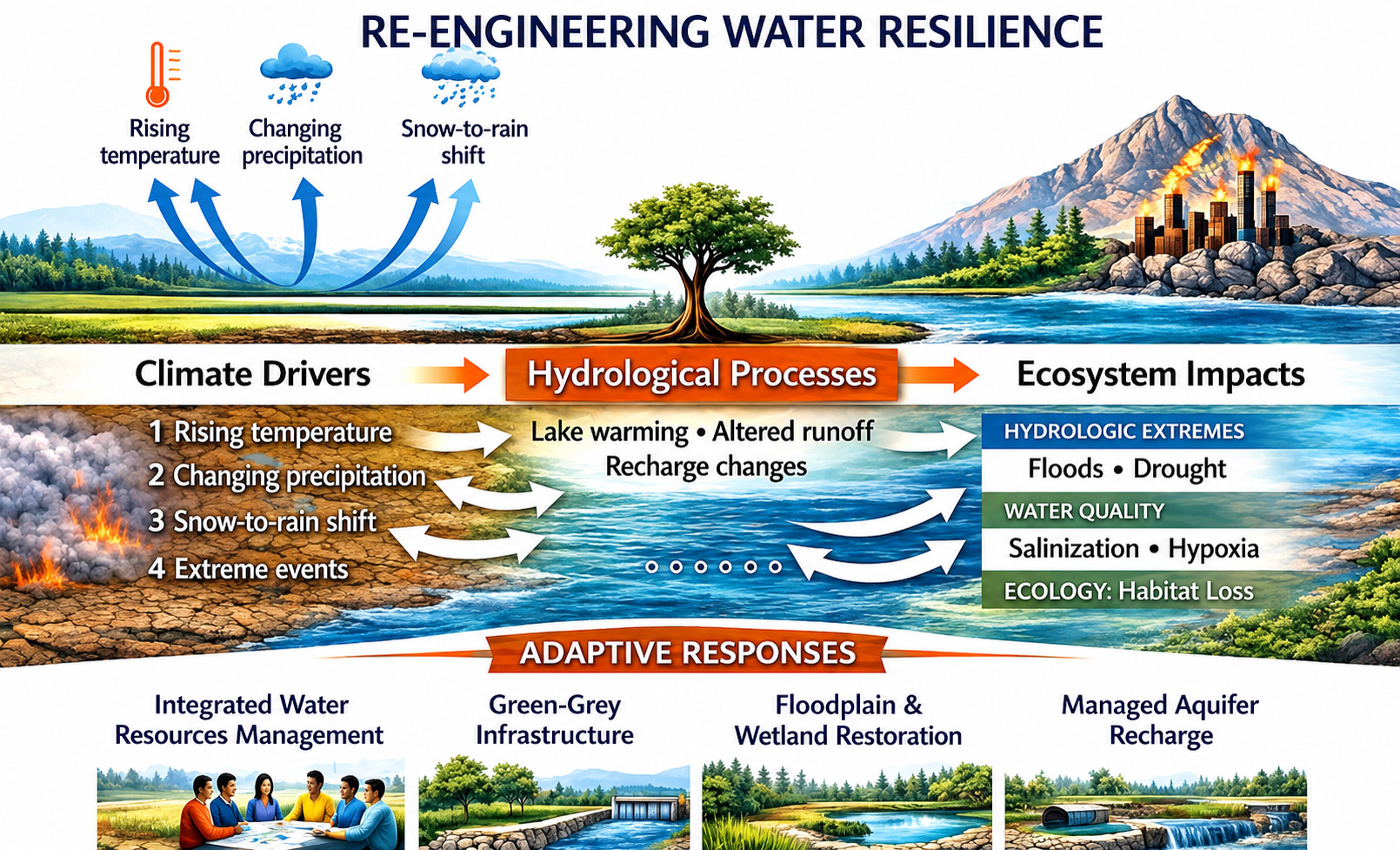
Climate change affects freshwater through a cascade of interconnected processes rather than isolated impacts. As the air warms, evapotranspiration increases, and surface waters also warm. Changes in the timing of the monsoon change the way runoff happens. Systems that obtain their water from snow and glaciers tend to experience earlier snowmelt and lower flows later in the season. Heavy rain makes flooding and erosion more likely, while long dry periods make drought and stress on groundwater worse.
Our synthesis follows the path of these cascades from climate drivers to hydrological processes and then to their effects on lakes, ponds, rivers, wetlands, and aquifers. Increased flood peaks, decreased summer baseflows, hypoxia, salinization, and habitat loss frequently occur concurrently. Because of this, freshwater systems work as tightly linked networks, making piecemeal or single-sector responses increasingly inadequate.
Engineered solutions like embankments, levees, dams, and bypass channels have been used for a long time to deal with water risk in South Asia and many other places. These buildings have helped people live and grow. But most were made for historical hydrological conditions that don’t work anymore because of climate change.
The review shows cases where relying heavily on grey infrastructure has made people more vulnerable. Reservoirs built using past flow records are now having trouble balancing flood control and water supply. Embanked floodplains that once stored excess water can experience catastrophic flooding when failures occur, because now there isn’t enough space for the floodwaters to spread.
This doesn’t mean giving up on infrastructure. Instead, it shows how important it is to add ecological functions to engineered systems that make them more flexible and less risky in uncertain future conditions.
The literature consistently identifies nature-based solutions as effective, low-risk adaptation strategies. Wetland conservation and restoration, reconnection of floodplains, protection of groundwater recharge zones, and sustainable headwater management all have many benefits at the same time. These benefits include less flooding, more water flow during the dry season, better water quality, and protection of biodiversity.
The review’s evidence shows that restored wetlands and floodplains can lower flood peaks downstream while also improving habitat connectivity and groundwater recharge. Bioswales and permeable pavements are examples of urban green infrastructure that can cut down on storm runoff and pollution. Managed aquifer recharge helps stabilize groundwater levels in over-exploited basins.
These methods are especially useful in the Himalayan and South Asian basins, where the wet seasons are getting shorter and more intense and the dry seasons are getting longer. Floodplains, wetlands, and aquifers can be restored to their natural state, which can help with variability without having to rely on bigger reservoirs or higher embankments.
Policy pathways
Putting these solutions into action is not just a technical problem. It is also a problem with governance that affects many areas. Water allocated for agriculture, hydropower, industry, and cities often competes with the flow and space required to sustain rivers and wetlands.
This is why the review uses the water–energy–food–ecosystem nexus as a guiding framework. Choices made in one area often change the results in other areas. Developing hydropower can change the reliability of irrigation and fisheries downstream. Pumping groundwater for farming during the dry season can lower the baseflow of rivers and degrade wetlands. To deal with these trade-offs, we need to include climate-informed water planning in policies for energy, agriculture, and cities. We also need to involve local communities in planning for adaptation and understand that rivers and wetlands need minimum flows and space to work.
These problems are most serious in South Asia. Water systems from the Himalayas to the coast are already under a lot of stress because of things like glaciers melting, monsoons coming and going, cities growing quickly, and too much groundwater being taken out.
In the Hindu Kush Himalaya, temperatures have been rising by about 0.2 to 0.4°C per decade. This has sped up the melting of glaciers and changed the way water flows, which affects hundreds of millions of people downstream. Investing in river health, wetlands, and aquifers is therefore not a luxury, but a prerequisite for long-term resilience.
The choice facing water policy is increasingly clear. Societies can continue responding to climate-intensified extremes with higher walls, deeper canals, and larger reservoirs. Or they can rebuild resilience by giving rivers, wetlands, and aquifers the space and governance they need to function as natural allies in adaptation.
The evidence synthesized in our review shows that long-term water security will depend less on controlling freshwater systems and more on working with their natural dynamics in a changing climate.
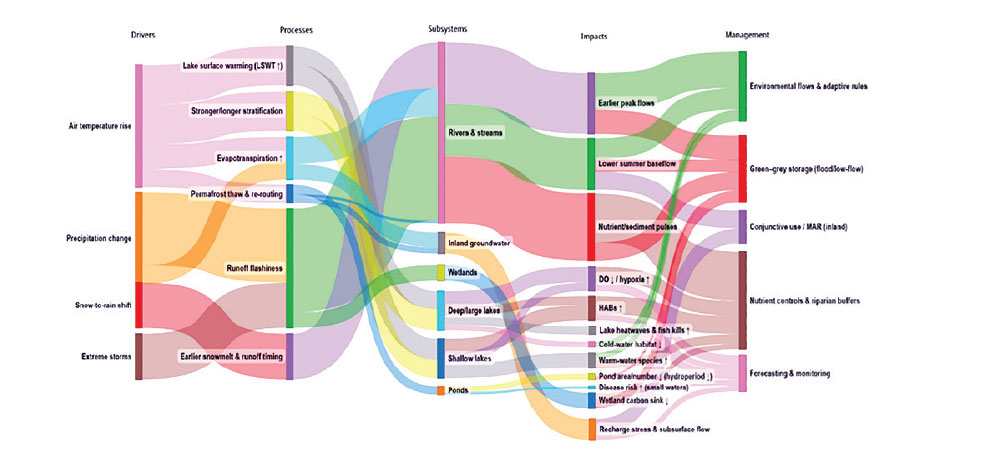
The above Sankey diagram shows how climate change drivers affect freshwater systems. Changes in temperature, precipitation, snow-to-rain shifts, and extreme weather events affect hydrological processes like warming lakes, changing runoff, stratification, and recharge. These processes change rivers, wetlands, lakes, ponds, and groundwater, which in turn changes the quality, quantity, and ecosystems of the water. Adaptive responses encompass integrated water resources management, green–grey infrastructure, ecosystem-based strategies, and managed aquifer recharge.