

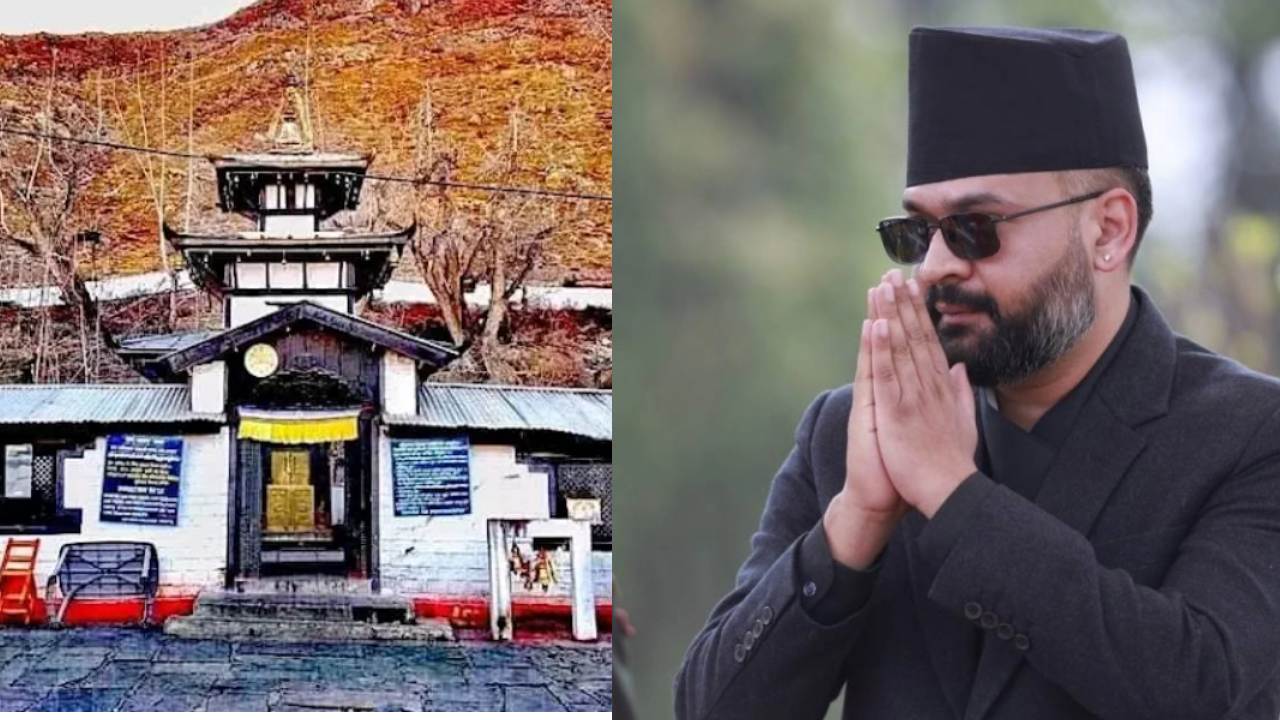
KATHMANDU: Prime Minister Balendra Shah travelled from Pokhara to Mustang early Saturday, accompanied by Tourism Minister Khadga Raj “Ganesh” Kandel.
The government has not disclosed detailed information about the prime minister’s visit, describing it as a private trip.
Administrative and security officials said the Nepal Army was responsible for arrangements for the visit. Shah’s journey has nevertheless renewed public interest in Mustang—a district whose significance extends well beyond its tourism appeal.
Mustang has long been associated with Hindu and Buddhist pilgrimage. On May 12, 2018, Indian Prime Minister Narendra Modi visited the Muktinath temple in Mustang during his Nepal trip. He spent around 20 minutes performing worship at the temple and told priest Krishna Prasad Subedi that he had visited Muktinath many years earlier.
Modi had made a similar reference during his first official visit to Nepal, when he addressed a joint sitting of the Federal Parliament.
“Many, many years ago, I came here as a traveller and a pilgrim,” Modi said.
Modi, a member of the Rashtriya Swayamsevak Sangh (RSS), the ideological parent organisation of India’s Bharatiya Janata Party, left his family home as a young man. His earlier association with Muktinath has contributed to long-standing interest in the pilgrimage site among Indian devotees.
Muktinath is also associated with the Hindu ascetic Swaminarayan, who is believed to have undertaken prolonged spiritual practice there. The Swaminarayan tradition has a particularly strong following in Modi’s home state of Gujarat, adding to the religious attraction of Mustang for Indian pilgrims.
But Mustang’s significance does not end with religion.
A Cold War frontier
The trans-Himalayan district is also deeply connected to the history of the Khampa rebellion in Tibet and the strategic interests of China, India and the United States.
After the Chinese takeover of Tibet, an armed resistance movement emerged among Tibetan groups in the mid-1950s. The Khampa fighters resisted the Chinese People’s Liberation Army, eventually establishing bases in parts of Nepal, including Mustang.
Following the Dalai Lama’s exile to India in 1959, Tibetan resistance fighters also moved into Nepal. Khampa groups operated not only in Mustang but across areas including Manang, Darchula and the northern Himalayan belt.
According to retired Nepal Army officer Prem Singh Basnyat’s book Nepali Army in Tibetan Khampa Disarming Mission, the CIA worked with Indian intelligence agencies, including the Intelligence Bureau and later the Research and Analysis Wing, to train Khampa fighters. A training facility known as “Establishment 22” operated in Chakrata, Dehradun.
The book says the CIA provided around $1.7 million annually for training, weapons and other expenses associated with the Tibetan resistance.
The US support ended after Richard Nixon became president in 1972. Before that, Khampa groups had established camps in areas including Kagbeni, Thini, Chhusang, Samar, Dhiling, Dhami, Samda, Charang, Pangga and Muktinath, as well as in Manang. American C-130 aircraft were reportedly used to supply the camps.
Under pressure from China, the Nepal Army launched an operation against the Khampa fighters in 1974. The rebellion effectively ended after Khampa commander Ge Wangdi was killed at Tinkar Pass in Darchula after fleeing from Manang.
Remnants associated with the Khampa rebellion can still be found in parts of Upper Mustang and Baglung.
The Korala factor
Mustang’s strategic importance is not merely historical. Its location along the Nepal-China border makes the district one of the country’s sensitive Himalayan frontier areas.
The Korala crossing in Upper Mustang is an important border point linking Nepal with the Tibetan plateau. The crossing was reopened to broader trade after years of restrictions, and Chinese electric vehicles, including BYD models, as well as other goods now enter Nepal through the route.
The border’s history, however, is complicated.
The crossing had been open to local residents of Upper Mustang until 2000 but was subsequently closed. One major factor was the escape of the 17th Karmapa, Ogyen Trinley Dorje, from Tibet in December 1999.
The Karmapa left Tsurphu Monastery near Lhasa and travelled through Mustang and Manang before reaching Kathmandu by helicopter and subsequently travelling to Dharamsala, India.
His escape was viewed by China as a serious security incident and contributed to tighter controls along the Nepal-Tibet border.
The broader geopolitical context also matters. China has remained highly sensitive to foreign activity in areas bordering Tibet, particularly given the history of US involvement with the Tibetan resistance during the Cold War.
As a result, Upper Mustang remained heavily restricted for foreign visitors for decades. Even today, parts of the region remain designated as restricted areas, including Lomanthang Rural Municipality, Lo-Ghekar Rural Municipality and Ward No. 3 of Baragung Muktichhetra Rural Municipality.
Foreign visitors travelling to restricted areas are required to pay a daily fee of $50.
A landscape of monasteries
Upper Mustang is also one of Nepal’s most important centres of Tibetan Buddhist heritage. Lomanthang, often described as a medieval walled settlement, is surrounded by monasteries, caves and other religious sites.
Among the important Buddhist sites in the region are Lo-Ghekar Monastery, Ghami Seduwa Dhakeling, Ghiling Monastery, Charang Dhondub Dhakeling, Chungsig Cave, Luri Kabung Cave, Yara Kabung, Tange Kabung, Luri Monastery, Jhyampa Monastery, Thukchen (Dhuvachhen) Monastery, Charang’s Dorjeling Monastery and Chhode Monastery.
These sites are not simply tourist attractions. They remain important centres of Buddhist learning, religious practice and pilgrimage.
That is what makes Mustang unusual. It is simultaneously a pilgrimage destination, a cultural landscape, a border region and a former Cold War frontier.
Prime Minister Shah’s current visit may officially be private. But in a place where religion, geopolitics, border security and tourism intersect so closely, even a private journey inevitably attracts public attention.