

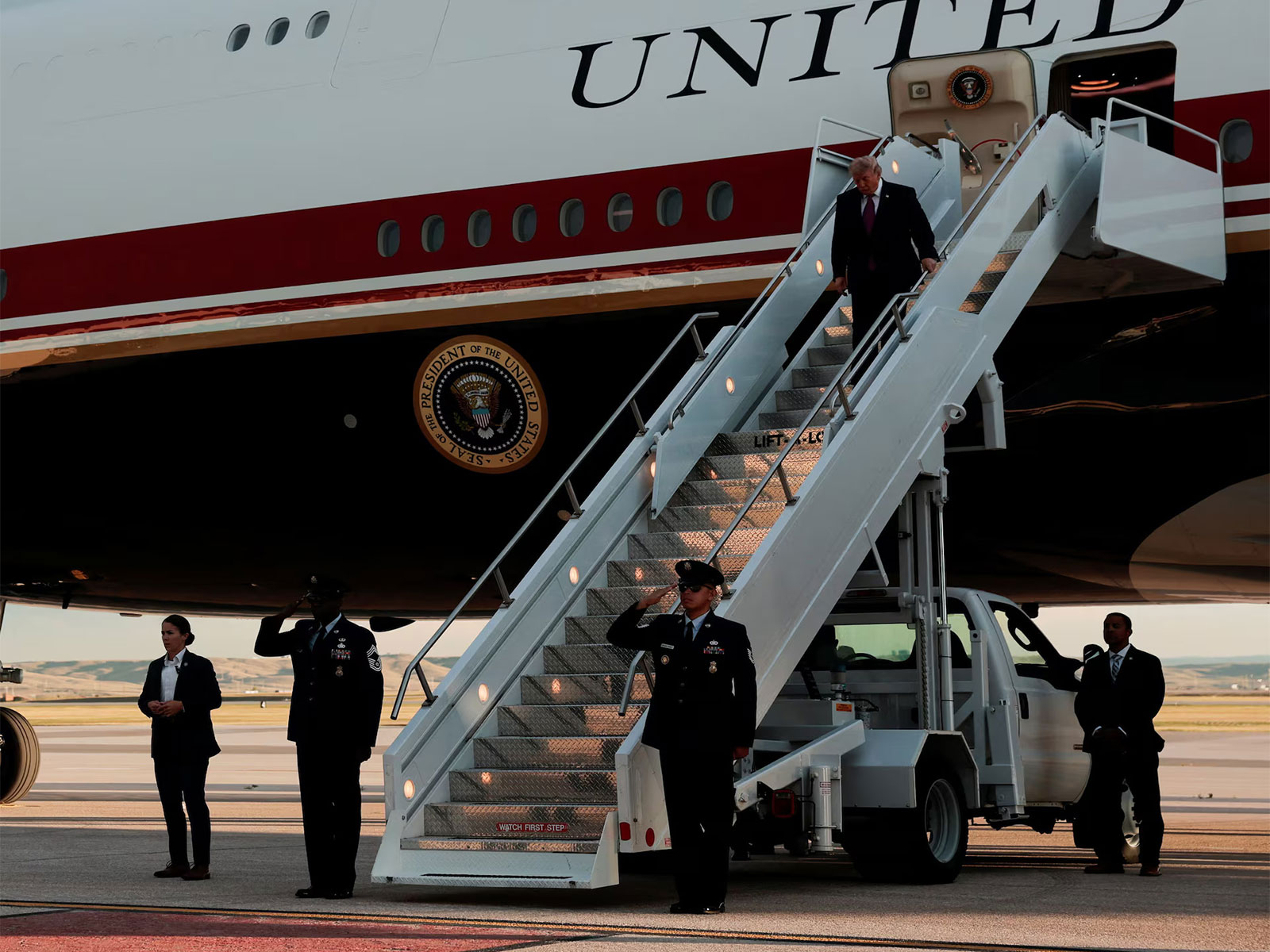
WASHINGTON DC: Air Force One touched down at Joint Base Andrews at 8:01 p.m. EST on Thursday, concluding a historic, nonstop return trip from China that marked the longest continuous sortie in presidential airlift history.
According to a press pooler on board, the presidential aircraft departed Shenzhen at 5:54 p.m. local time and flew directly back to Maryland without a refuelling stop.
During the journey, the press cabin remained quiet, with White House communications aide Margo Martin serving as the sole visitor. Martin stopped by the press section to distribute commemorative gifts from President Donald Trump.
Each member of the travelling press pool received a black Sharpie bearing the President’s signature in gold lettering, alongside a commemorative flight card stamped with the presidential seal and dated November 19, 2026. The card highlighted the aviation milestones achieved during the journey.
“The VC-25B conducted the heaviest takeoff in Air Force history, at just under one million pounds, and completed the longest nonstop Air Force One sortie to date, at nearly 15 hours,” the card stated, according to the pool report.
Flying at an altitude of 33,000 feet and an average speed of 500 knots, the trans-Pacific route carried the aircraft over Shanghai, China; Tokyo, Japan; Shemya, Alaska; Winnipeg, Canada; and Cleveland, Ohio. Passengers gained 13 hours across time zones, arriving slightly ahead of the initially projected 8:20 p.m. arrival under mostly clear skies and 50-degree temperatures.
Highlighting the achievement, White House communications director Steven Cheung took to X and wrote, “A historic trip for a historic President!”
This comes after the first-ever trilateral summit involving the leaders of the United States, Russia and China, held on the sidelines of the Asia-Pacific Economic Cooperation (APEC) Summit in Shenzhen.
discussions focused on major global challenges, including the ongoing conflicts in West Asia and Ukraine, nuclear disarmament, international security and energy cooperation.
Following the summit, the three countries adopted a joint “Declaration towards Peace”, outlining their commitment to reforming the United Nations to enable it to respond more effectively to global challenges and fulfil its fundamental mission of maintaining international peace and security.
According to the declaration, the three leaders reaffirmed that “a nuclear war cannot be won and must never be fought” and agreed to engage in dialogue on reducing nuclear risks and preventing the proliferation of nuclear weapons.
The declaration also highlighted their commitment to maintaining stable energy flows and increasing the production and supply of refined petroleum products. It further emphasised respect for state consent and immunity of state officials, stating that the International Criminal Court (ICC) and similar bodies must not abuse their jurisdiction.
During the discussions, Trump described the trilateral gathering as an opportunity to move away from conventional diplomatic approaches and establish a new course towards global peace and security.
“Together, we are choosing a different course. A historic summit offers us the chance to seek out new opportunities and approaches on a range of very important issues—most of them everybody in this room knows—and hopefully to create a better future for all of us. A very, very much better future and safer future,” he said.
Highlighting the nuclear capabilities of the three countries, Trump said that the United States, Russia and China, as the world’s three largest nuclear powers, were uniquely positioned to discuss reducing nuclear arsenals and minimising the possibility of their use.
“As the world’s three largest nuclear powers by far, the United States, Russia, and China are uniquely positioned to discuss how to reduce the number of nuclear weapons on Earth, and also to lessen the risk that those weapons will ever be used.
The power is unbelievable, unthinkable. In addition to exploring the potential for arms reduction in our own countries—and I must say, it’s quite frankly a very hard thing to do, because once you have the nuclear weapons, it’s very hard to not have them. It’s very hard to give them up as the leader of a country,” Trump said.
The trilateral discussions come amid continued international concerns over the conflicts in West Asia and Ukraine, with the three leaders seeking to explore diplomatic approaches to addressing global security challenges. (ANI)