

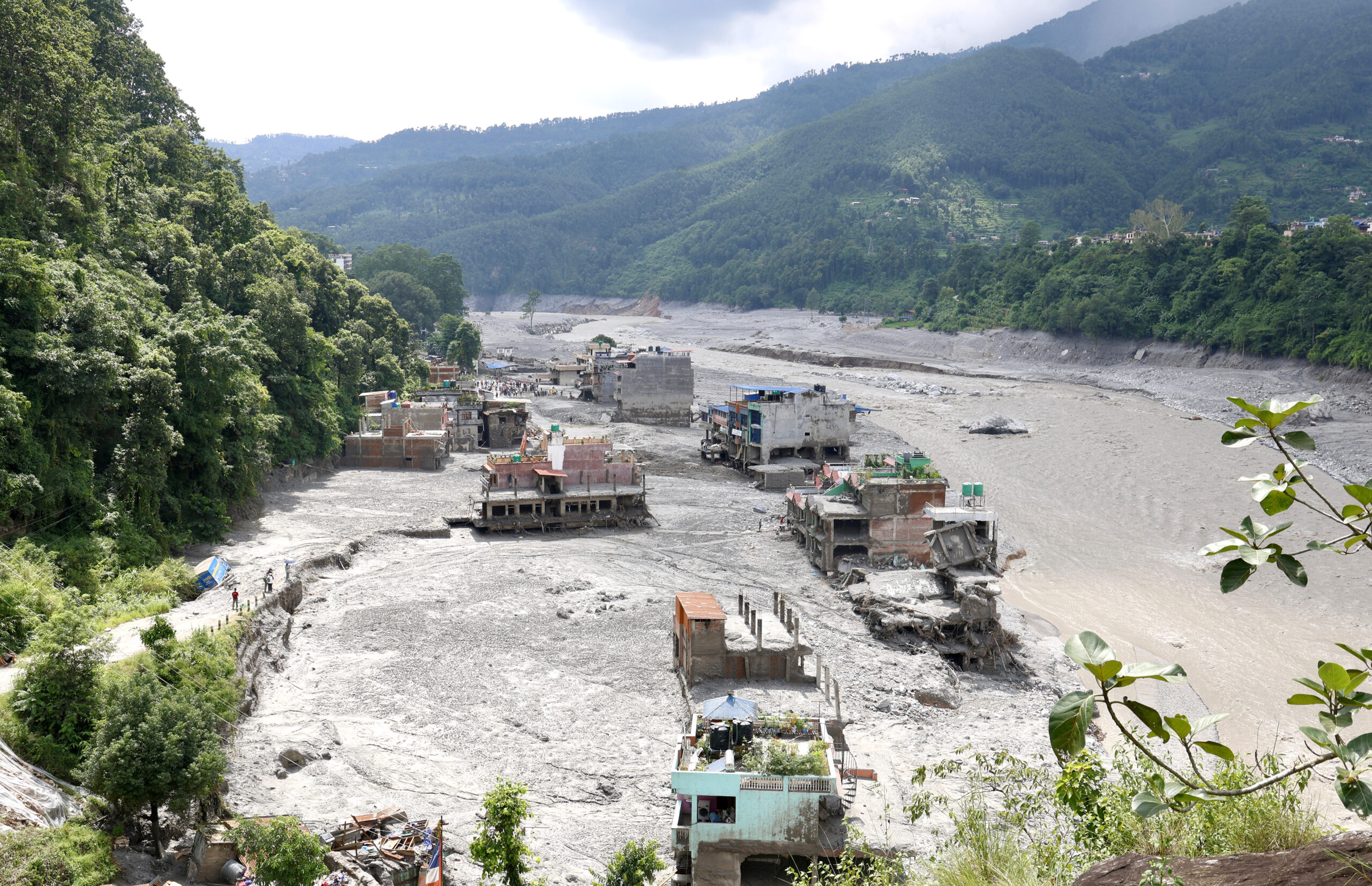
KATHMANDU: Seventeen days after the devastating floods in the Bhotekoshi River, the government has confirmed that 1,385 bodies have been recovered, while 5,130 people remain missing. Foreign Ministry spokesperson Lok Bahadur Chhetri announced that the missing include approximately 600 foreign nationals from 35 countries. To date, 13,676 people, including over 320 foreigners, have been rescued.
Spokesperson Chhetri stated that forensic experts from India, China, Japan, Singapore, and South Korea are working with Nepal Police to collect and analyze DNA samples for identification. Bodies are being temporarily buried following legal procedures to facilitate future identification. The ministry is also conducting a Post-Disaster Needs Assessment (PDNA) to determine the full extent of the damage.
According to the government’s Rapid Damage and Needs Assessment (RDNA) report, the floods caused direct physical infrastructure damage worth approximately Rs 241 billion, with an additional Rs 118 billion in economic losses. The total requirement for reconstruction and recovery is estimated at Rs 640 billion. Short-term reconstruction efforts over the next six months alone will require over 57.6 million USD.
Specialized tunnel rescue teams from India, China, and South Korea are working alongside the Nepal Army to search debris-filled hydropower tunnels. Search operations are also being supported by teams from the UAE, Malaysia, and Australia. Furthermore, 768 Nepali citizens have been safely repatriated through the Tatopani border crossing with the assistance of Chinese authorities.
Prime Minister Balen Shah is in continuous communication with international leaders regarding relief and cooperation. The government has formally requested international assistance, including high-capacity drones, LiDAR systems, underwater drones, Bailey bridges, and DNA testing kits. Infrastructure restoration is ongoing, with an Acro bridge already installed over the Tadi River at Devighat to restore transport. The ministry’s Emergency Control Room remains active around the clock to coordinate the restoration of communication, electricity, and road networks.