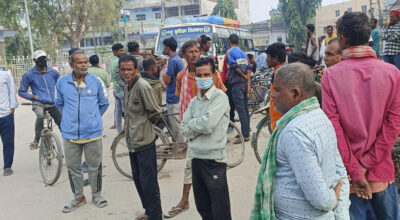


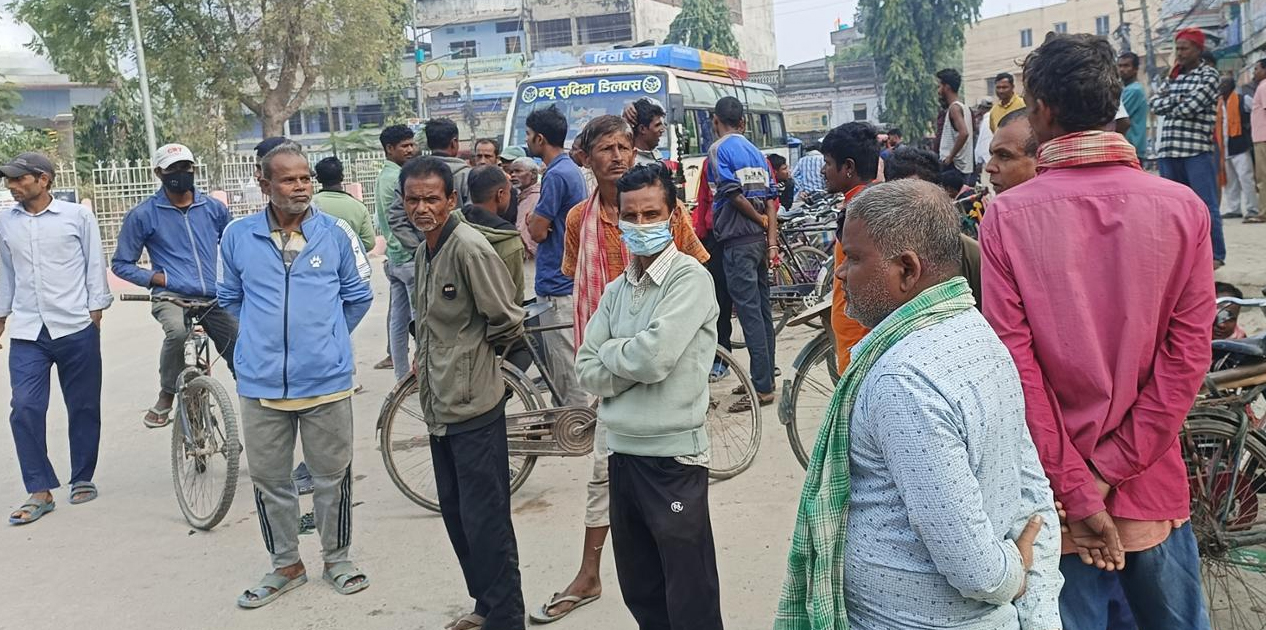
SAPTARI: With the break of dawn, groups of labourers carrying lunch bags start gathering at a familiar spot near Gajendra Chowk in Ward No. 7 of Rajbiraj municipality in Saptari district.
Some arrive on bicycles, others in electric rickshaws, while many make their way on foot to the place widely known as the ‘Mazdoor Bazar’ (Labour Market).
They come with a common hope: to find work for the day and earn enough to provide for their families. Yet, for many, the prospect of securing even a day’s wage remains uncertain, no matter how long they wait.
Driven by unemployment and the struggle to make ends meet, informal-sector workers of different age groups from various parts of the district converge here every morning in search of employment.
They wait for contractors and employers to arrive in search of workers, often uncertain whether they will find a job or return home empty-handed.
Ram Prasad Yadav of Kataiya in Rupani rural municipality is among those who visit the spot every day, hoping to find work and earn a living for his family.
He divulged that contractors generally choose workers based on their physical fitness and ability to carry out assigned tasks, often favouring those they consider strong enough to handle demanding work.
”If we get work regularly, we can earn up to Rs 800 for eight hours of labour. But on days when we fail to find work, even arranging meals for the family becomes difficult,” Yadav offered insights.
He voiced that that workers often spend hours waiting at the site, only to return home without earning anything when no work comes their way.
Likewise, Badri Sada of Bishnupur rural municipality-6 echoed similar concerns, saying that skilled masons engaged in house construction could earn up to Rs 1,200 a day, while other labourers generally receive between Rs 600 and Rs 1,000, depending on the nature of the work and their skills.
He also recounted instances in which workers were not paid fairly despite putting in considerable effort.
Parmanand Sah, a contractor who regularly visits Gajendra Chowk to hire workers, mentioned that he selects labourers from among those gathered at the site.
He explained that workers who perform well and maintain regular attendance are given priority when new assignments are available.
”We regularly call workers who do their jobs well as long as the work continues. However, it becomes difficult to hire those who fail to show up or maintain regularity,” he asserted.
Sah noted that daily wages generally range from Rs 700 to Rs 1,000, depending on the workers’ skills and the nature of the job.
Despite the presence of thousands of labourers across the district, the prescribed minimum wage rates remain largely unenforced in practice, bemoaned Kedar Dev, Chairperson of the Nepal Trade Union’s Madhesh Province Committee.
He pointed out that the lack of a designated and properly managed space for workers has left them with little choice but to gather at street corners every day, hoping to find employment.
”Workers have been coming to this place in search of jobs for nearly five decades. However, the concerned authorities have paid little attention to providing even basic facilities for them,” he lamented.
Dev viewed that even modest amenities, including a proper place where workers could sit while waiting for employment, would make a meaningful difference to their daily lives.