



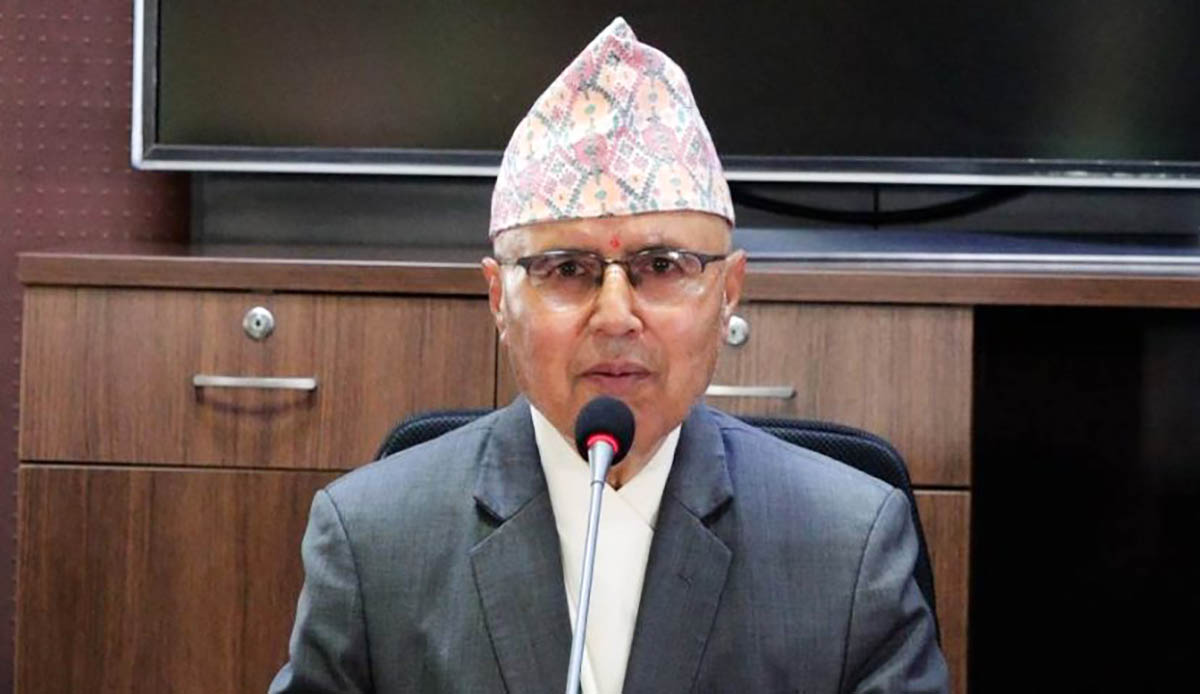
KATHMANDU: Former Finance Minister Rameshore Khanal has said that extensive improvements in insurance, loans, and policy structures are necessary for the revival of micro, small, and medium enterprises (MSMEs) that were hit hard after COVID-19.
Addressing to the policy discussion programme organized here today by the Society of Economic Journalists Nepal (SEJON), Nepal Insurance Authority, and the United Nations Development Programme (UNDP) to release the study report ‘Risk Management in Nepal’s MSMEs’, former Finance Minister Khanal said that policy reforms are needed to protect and promote MSMEs facing economic crises.
He pointed out that although MSMEs play an important role in the economy, the sector has become weak due to a lack of risk management and financial access.
The former finance minister suggested introducing innovative measures in the agriculture insurance programme, such as the government initially covering 100 per cent of the premium for poor farmers and having them pay their share only after receiving compensation, noting that even though the government provides up to 75 per cent premium subsidy, farmers have not been able to fully benefit from it.
“According to the report that was made public on the occasion, only 10 per cent of the nearly 900 thousand MSMEs in Nepal have access to insurance, while the remaining 90 per cent are unprotected against any risks,” he said, adding, “Even though sectors like tourism and construction are gradually recovering after COVID-19, MSMEs are still in crisis, and this situation has contributed to an increase in bad loans and non-banking assets in banks and financial institutions.”
On the occasion, Kalpana Shrestha, Joint Secretary of the Ministry of Industry, Commerce and Supplies, highlighted the need to expand insurance access by integrating the various programmes run by the government to promote micro, small, and medium enterprises.
She mentioned that since nearly 50 per cent of the approximately 923 thousand MSMEs in Nepal are in the informal sector and thus outside the scope of insurance, overall insurance coverage is limited to about 10 per cent. Considering this, the government is running programmes like startup loans, MEDPA programmes, production-based incentives, and the National Enterprise Facility to promote entrepreneurship.
UNDP Nepal’s resident representative Kyoko Yokosuka said that although micro, small, and medium enterprises are the backbone of Nepal’s economy, they are the most affected by increasing climate and economic risks.
She mentioned that UNDP, through the ‘Insurance and Risk Finance Facility,’ is working with 39 countries including Nepal to strengthen financial protection against climate and disaster risks, and expressed a continued commitment to helping expand affordable and appropriate insurance access for MSMEs in Nepal.
Sushildev Subedi, Executive Director of the Nepal Insurance Authority, said that it is necessary to make the insurance system more inclusive, modern, and effective to protect micro, small, and medium enterprises from various risks.
He also expressed the view that MSMEs are the most affected by risks like natural disasters, climate change, financial crises, cyber risks, and health emergencies, so effective risk management is indispensable.