

KATHMANDU: The government has unveiled a new set of standards that determine the permissible pollution limits for vehicles currently in operation, introducing stricter emission rules particularly for newer vehicles.
The Ministry of Agriculture, Forests and Environment said the standards have been prepared with the objective of controlling environmental pollution and maintaining a cleaner environment. The ministry has invited public comments and suggestions within 15 days of the notice.
After incorporating feedback, the government plans to finalize, approve and publish the standards in the Nepal Gazette. The rules are expected to come into force across the country on the 91st day after publication.
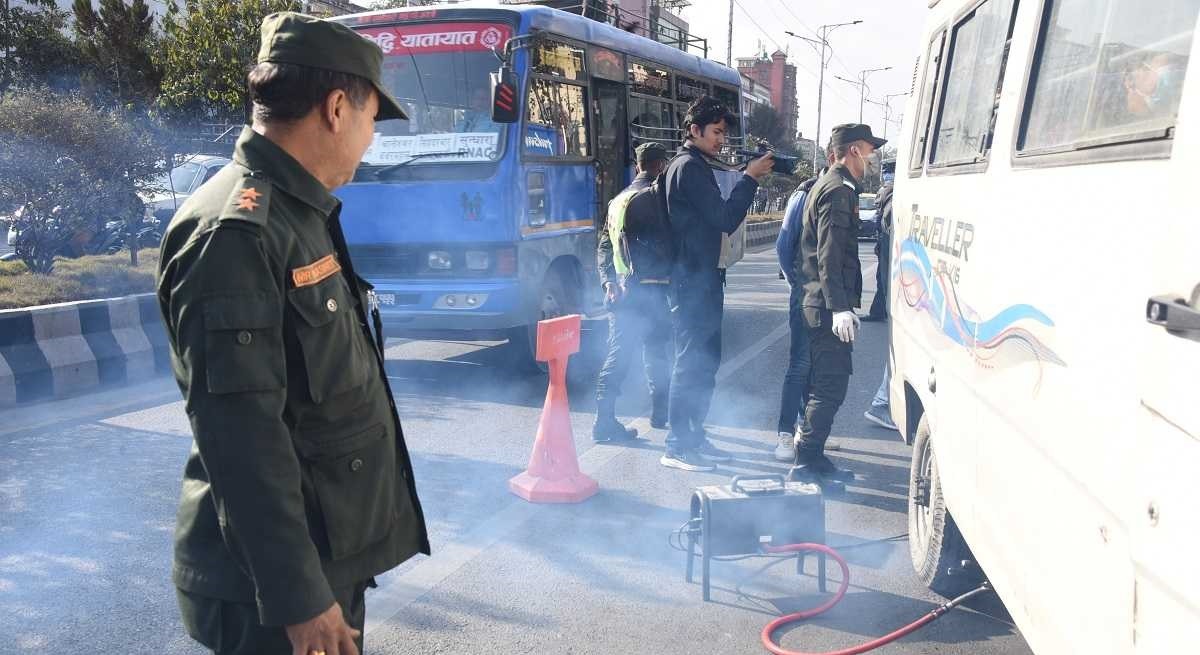
Under the proposed framework, all vehicles in use will be required to undergo regular emission testing and obtain a valid pollution certificate in accordance with existing laws.
Vehicles that exceed the newly prescribed limits will not be allowed to operate on public roads. Earlier gazette notices and related actions will also be aligned with the new standards.
The standards will apply nationwide for vehicles running on petrol and gas, while diesel vehicles will be subject to priority enforcement in the Kathmandu Valley as well as in metropolitan and sub-metropolitan cities.
The rules cover all petrol, diesel and gas-powered (LPG/CNG) vehicles registered under prevailing laws. However, tractors, power tillers, bulldozers, cranes, rollers, excavators and special military vehicles imported on the recommendation of the Ministry of Defense are exempted.
Four categories based on registration date
The government has divided vehicles into four categories according to their registration date and fixed separate emission limits for each group.
Older vehicles registered before 2056 BS have been given comparatively relaxed limits, while stricter standards have been proposed for newer vehicles.
Vehicles registered before 2056 BS
For petrol and gas-powered two- and three-wheelers, the carbon monoxide (CO) limit has been set at 4.5 percent and hydrocarbons (HC) at 7,800 ppm. For four-wheelers, the limits are 3.5 percent CO and 1,000 ppm HC.
Vehicles registered between 2056 and 2069 BS
For two- and three-wheelers, the CO limit has been fixed at 3.5 percent and HC at 4,500 ppm. For four-wheelers, the CO limit is 3.0 percent and HC 1,000 ppm.
For diesel vehicles of all categories registered before 2056 BS, the light absorption coefficient has been set at 3.23 per meter and the Hartridge smoke unit at 75 percent. For diesel vehicles registered between 2056 and 2069 BS, the limits are 2.45 per meter and 65 percent respectively.
Stricter rules for vehicles registered between 2069 and 2082 BS
For petrol and gas-powered vehicles, the CO limit for two-wheelers has been set at 3.0 percent and HC at 3,000 ppm. For three-wheelers, the limits are 3.5 percent CO and 4,500 ppm HC. For four-wheelers and larger vehicles, the limits are 0.5 percent CO and 750 ppm HC.
For diesel vehicles registered during this period, the light absorption coefficient must not exceed 1.62 per meter and the Hartridge smoke unit must remain within 50 percent.
Tightest standards for vehicles registered from 2082 BS onward
The government has proposed the strictest limits for vehicles registered from 2082 BS onward.
For petrol and gas-powered two- and three-wheelers, the CO limit has been set at 0.5 percent and HC at 500 ppm. For four-wheelers and larger vehicles, the limits are 0.3 percent CO and 200 ppm HC.
At high idle speed, petrol-powered two- and three-wheelers must maintain CO within 0.3 percent and an air-fuel ratio of 1±0.03 or as specified by the manufacturer. For four-wheelers and larger petrol vehicles, the high-idle CO limit has been fixed at 0.2 percent, with the same air-fuel ratio requirement.
For diesel vehicles of all categories registered from 2082 BS onward, the light absorption coefficient has been set at 1.62 per meter and the Hartridge smoke unit at 50 percent. The proposed standards represent one of Nepal’s most comprehensive revisions of in-use vehicle emission regulations, with the government aiming to reduce urban air pollution and strengthen enforcement of environmental compliance across the transport sector.