



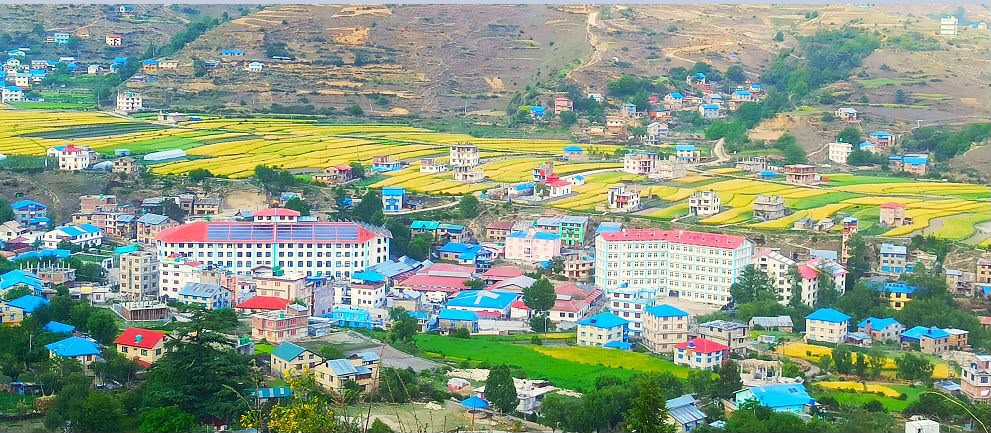
JUMLA: For decades, Jumla was associated with remoteness, poverty, inadequate infrastructure and a chronic shortage of health workers. Even securing a single medical officer for the district hospital was once a challenge, while doctors posted to the Himalayan district often did not stay for long.
The Karnali Academy of Health Sciences has begun producing doctors and specialist physicians in a region that was once dependent almost entirely on health workers brought in from outside. What began as an effort to improve healthcare in one of Nepal’s most remote regions has evolved into a broader medical education and training institution.
The academy has so far produced 14 specialist doctors through its postgraduate programmes, according to Vice-Chancellor Prof. Dr. Suryaman Mennyangbo. Five specialists graduated from the first postgraduate batch, another five from the second and four from the third.
The fourth, fifth and sixth postgraduate batches currently have 4, 9 and 10 students respectively studying in specialties including general practice and emergency medicine, paediatrics, orthopaedics, anaesthesia, surgery and gynaecology.
One of the academy’s graduates, paediatrician Dr. Akina Sainju, is now practising medicine in Australia, demonstrating that doctors trained in Jumla are increasingly entering both Nepal’s and international healthcare markets.
First MBBS batch graduates
The academy has now reached another milestone with the graduation of its first MBBS batch.
Of the 20 students in the inaugural batch, 18 successfully completed their MBBS. They will undertake a one-year internship before appearing for the Nepal Medical Council examination and, upon qualification, entering professional medical practice.
For students who travelled from Nepal’s southern plains and other parts of the country, studying medicine in Jumla was itself an experience that challenged conventional perceptions of the region.
Nurjaha Khatun, from Siraha, said she initially had difficulty adjusting to the Himalayan environment but eventually came to regard Jumla as a beautiful place that gave her the opportunity to become a doctor.
Samir Raj Joshi of Butwal similarly described studying in Karnali as a historic opportunity. He said better infrastructure and roads could help Jumla develop into a potential health-tourism hub.
Hemlata Chand of Baitadi said her experience in Jumla showed that determination could overcome geographical difficulties. What initially appeared to be a place where her dream might fail eventually became, she said, the foundation of her career.
230 students currently studying MBBS
The academy is currently running its sixth MBBS batch. The first batch had 20 students, the second and third 30 each, while the fourth, fifth and sixth batches have 50 students each.
That puts the total number of students currently enrolled in the MBBS programme at 230.
The academy is also beginning to attract students from outside Nepal. Eight Indian nationals are currently studying MBBS in Jumla, including students from Uttarakhand, Madhya Pradesh and Jammu and Kashmir.
The institution formally began its MBBS programme after then-President Bidya Devi Bhandari inaugurated MBBS classes in Jumla on November 26, 2021.
Vice-Chancellor Mennyangbo said the academy would seek an increase in MBBS seats from the government in the coming years.
Medical education expands beyond MBBS
The academy’s expansion has not been limited to medicine.
Its programmes include clinical pharmacy, midwifery, nursing, public health and postgraduate medical education.
The first batch of the Bachelor in Clinical Pharmacy has already graduated with 11 students, while 78 students are enrolled across the second to sixth batches.
In midwifery, 30 students from the first four batches have graduated, while additional students remain enrolled in the fifth and sixth batches.
Nursing programmes have also expanded, with graduates and current students across Bachelor of Nursing Science and BSc Nursing programmes.
The School of Public Health is running both undergraduate and postgraduate programmes, while postgraduate programmes are also being offered under the School of Pharmacy.
From healthcare dependency to medical workforce
The transformation is particularly significant because Jumla’s healthcare system once struggled simply to retain basic medical personnel.
Naresh Bhandari, a former Constituent Assembly member and one of the founding figures behind the academy, said the transformation demonstrated that geographical remoteness did not have to determine development outcomes.
“Nothing in the world is impossible,” Bhandari said, arguing that strong political and institutional commitment could turn geographical challenges into opportunities.
Civil society leader Raj Bahadur Mahat said the academy’s contribution went beyond healthcare. In the past, residents had to spend large sums travelling outside the district for treatment. Increasingly, specialised services are now available locally, while the region itself is producing medical professionals.
The academy’s emergence therefore represents more than the expansion of a medical college. It marks a broader shift in how Karnali can participate in Nepal’s human-capital development.
For a region long viewed primarily through the lens of poverty and remoteness, Jumla is beginning to build a new identity-one based not on the doctors it needs from elsewhere, but on the doctors it can produce itself.