




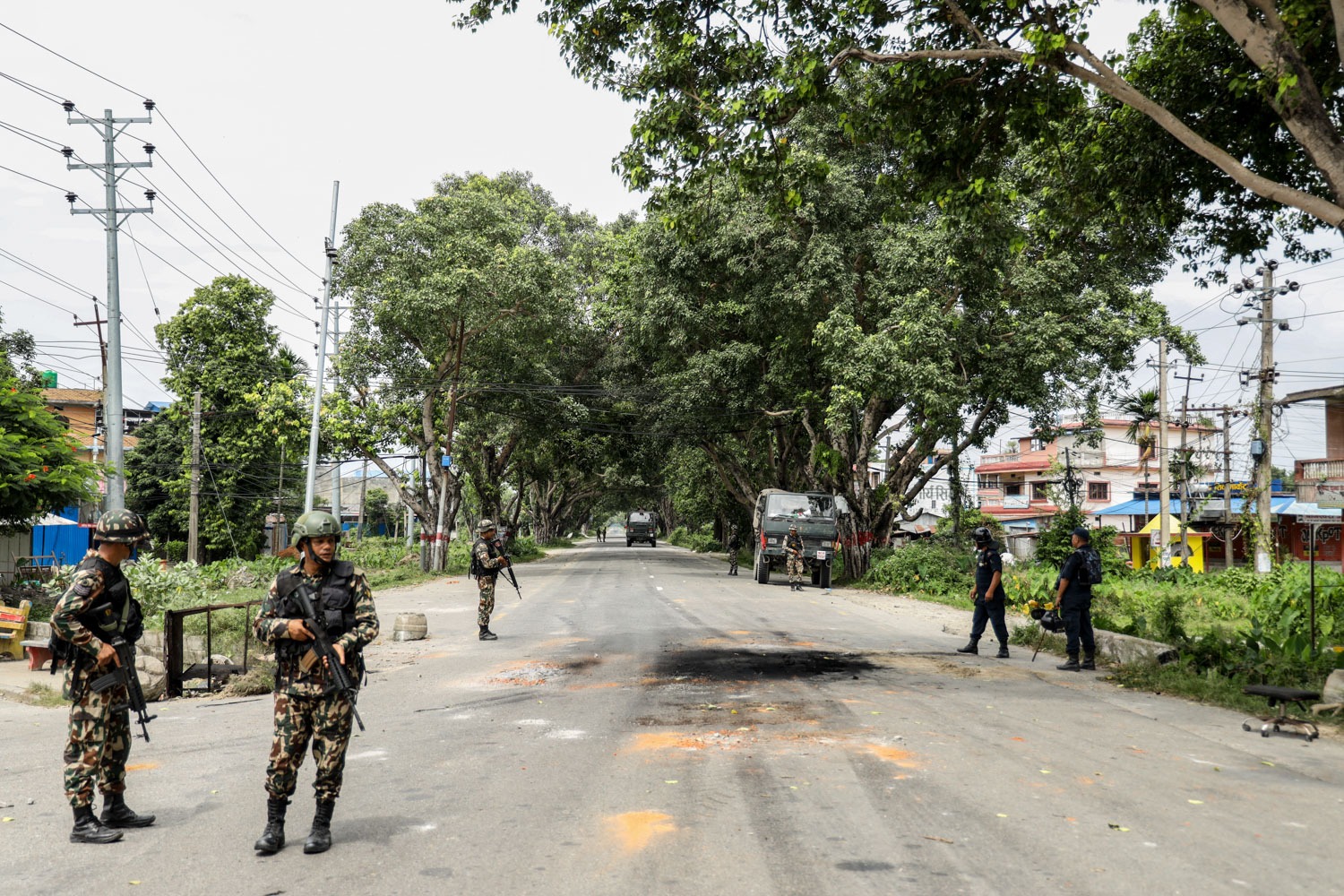
SUNSARI: The violence in Kaptaanganj, Sunsari, is no longer a local disturbance. It has become a test of whether Nepal’s federal state can manage communal tension through political leadership rather than coercive reflex.
What began as a dispute over religious symbols and a Bolbam procession escalated into deadly confrontation, leaving one person dead, several civilians injured and security personnel wounded. The most troubling question is not simply why shots were fired. It is why a dispute that had been visible for weeks was allowed to deteriorate into a crisis with the potential to spread across the Madhesh.
The government appears to have treated the incident primarily as a law-and-order problem. Yet communal conflicts rarely begin as security failures alone. They are failures of anticipation, mediation and political presence.
Ignored warnings
Kaptaanganj did not erupt without warning. Local tensions over the placement and removal of religious flags had already reached municipal and administrative authorities. Security assessments had reportedly identified the border belt of southern Sunsari as a sensitive area where small disputes could acquire a communal character.
The state possessed information. What it lacked was urgency. Instead of convening sustained dialogue between community leaders, local representatives and political actors, the response remained largely administrative. By the time violence broke out, the government was reacting to events rather than shaping them.
A conspicuous political absence
In crises of communal tension, symbolism matters as much as deployment. Residents searched for the presence of the prime minister, the home minister and senior political leaders. What they mostly saw were curfews, security patrols and later drones. The contrast was striking: a government physically present through force, but politically absent through leadership.
This vacuum was quickly filled by competing narratives. Some accused the police of excessive force; others warned of organized provocation and possible external influence. In the absence of credible political communication, suspicion became the dominant currency.
Punishing the chain of command
The government’s decision to remove senior security officials, including the chief district officer and police commanders, may have conveyed decisiveness. It may also have conveyed something else: that accountability would be imposed before facts were established.
Such moves can satisfy immediate public anger, but they risk weakening operational confidence within the security apparatus. Officers become more concerned with political exposure than with difficult decisions on the ground. A state that disciplines first and investigates later often produces caution, not competence.
The danger of a security spiral
The deployment of additional forces and the use of surveillance technology may help contain unrest temporarily. They cannot restore social trust. Communal tensions are not extinguished by drones, curfews or troop movements alone. They are reduced when both communities believe that the state is impartial, accessible and willing to listen before it is willing to punish.
Nepal’s response has shown the familiar tendency of many fragile democracies: when politics becomes difficult, administration expands; when administration struggles, coercion deepens.
A broader warning
The deeper issue is not whether Hindu or Muslim groups were more provocative, nor whether the first shot came from one side or the other. Those are matters for a credible investigation. The larger question is whether Nepal’s federal structure is capable of coordinating local government, provincial authorities, security agencies and national political leadership during a communal emergency. In Kaptaanganj, that coordination appeared fragmented.
The risk is therefore broader than Sunsari. If every local religious dispute is allowed to escalate until security forces become the principal instrument of governance, the state may preserve order intermittently while steadily eroding confidence in its neutrality.
Nepal does not face a communal collapse. But Kaptaanganj has revealed how quickly a manageable dispute can become a national security concern when the state arrives late politically and early coercively. The most important lesson is not that the government fired bullets. It is that it failed to prevent the moment when bullets became thinkable.