

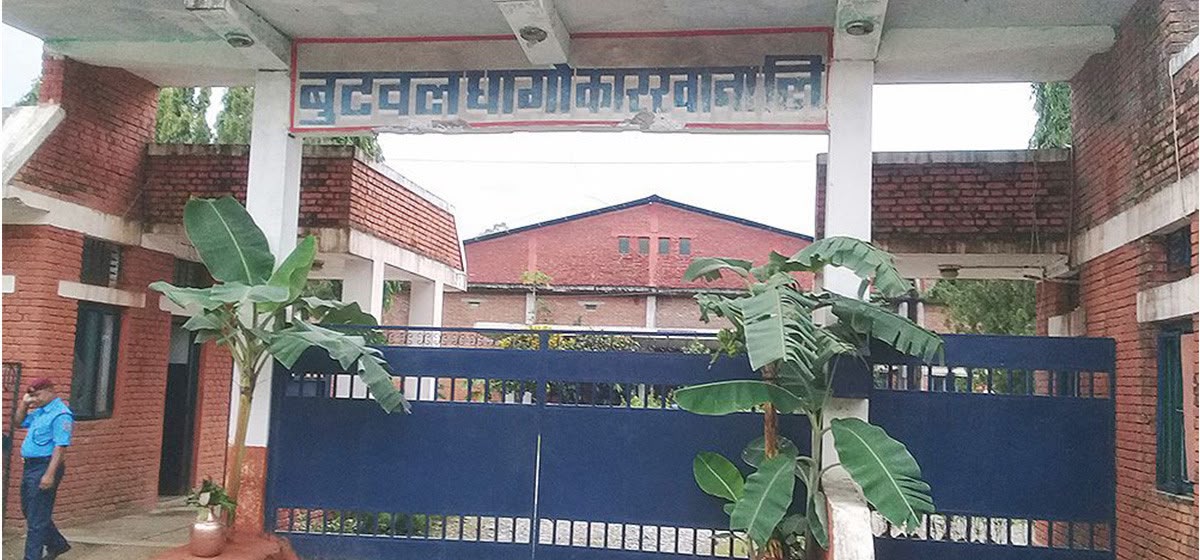
BUTWAL: The government has begun the process of reopening the Butwal Thread Factory, which has remained closed for nearly two decades, by initiating a due diligence assessment of its assets and liabilities and studying its infrastructure, machinery, market potential and investment requirements.
The Ministry of Industry, Commerce and Supplies has started the asset and liability assessment, according to Dol Raj Sharma, acting head of the factory. He said the government would decide on the feasibility and operating model after completion of the assessment.
The factory issued a public notice on August 11, asking stakeholders to submit claims related to outstanding transactions and accounts, backed by supporting documents, within 21 days.
Meanwhile, the Ministry of Finance, with support from the Asian Development Bank (ADB), deployed a five-member expert team to conduct an on-site assessment. The team comprised two chartered accountants, a civil engineer, a mechanical engineer and a legal expert.
The team studied the factory’s infrastructure, machinery, market prospects and investment requirements. Its findings will form the basis for determining the future operating model, Sharma said.
The government had announced in the current fiscal year’s budget that it would begin the process of reviving the factory. The initiative gained momentum after the Cabinet decided in April to reopen sick and defunct industries.
Private sector calls for PPP model
As preparations to revive the factory move forward, private-sector representatives have called for its operation under a public-private partnership (PPP) model.
Hari Prasad Aryal, president of the Butwal Chamber of Commerce and Industry, said the government should move beyond repeated studies and develop a concrete plan to operate the factory. He argued that long-term success would be difficult under government management alone and that private-sector participation was necessary.
Krishna Prasad Parajuli, president of the Rupandehi Industry Association, also said the factory could not be sustained with its old technology and operating model. He called for modernization and a PPP-based operating structure.
Industry shareholder and veteran industrialist Jiwan Prasad Ojha suggested coordinating the factory with the Hetauda Textile Industry to increase domestic production of uniforms for security agencies.
Once employed over 500 workers
Construction of the factory began in 2039 BS (1982/83) with the objective of achieving self-reliance in yarn and cotton textiles using domestically produced cotton. Commercial production began in Baisakh 2048 BS (April-May 1991).
The factory had a production capacity of 10 metric tonnes of yarn per day but typically produced around seven tonnes. Between 80% and 85% of its output was exported to India. At its peak, the factory reportedly generated daily business worth around Rs 10 million and employed more than 500 people.
Established at a cost of more than Rs 370 million, the factory remained profitable for its first decade. However, it began incurring losses in the early 2060s BS, and management weaknesses, political interference and labor disputes eventually led to its closure in 2064 BS (2007/08).
The government declared it a sick industry in 2066 BS and provided separation benefits to 402 employees before laying them off. Commercial production has remained suspended ever since.
The factory currently occupies 143 ropanis of land and has 56 large yarn-production machines. Years of inactivity have damaged both the machinery and physical infrastructure, Sharma said.
“The damaged infrastructure and machinery need to be repaired, while modern technology suited to current requirements also needs to be installed,” he said.
The factory has authorized capital of Rs 600 million, paid-up capital of Rs 370 million and issued capital of Rs 450 million. The general public holds an 8% stake, according to Sharma.
The government will determine the final revival and operating model only after assessing the factory’s actual assets and liabilities, the condition of its infrastructure and machinery, and its market prospects. While the latest move has revived hopes of reopening the long-shuttered factory, modernizing its outdated infrastructure and technology and managing public investment remain key challenges.