

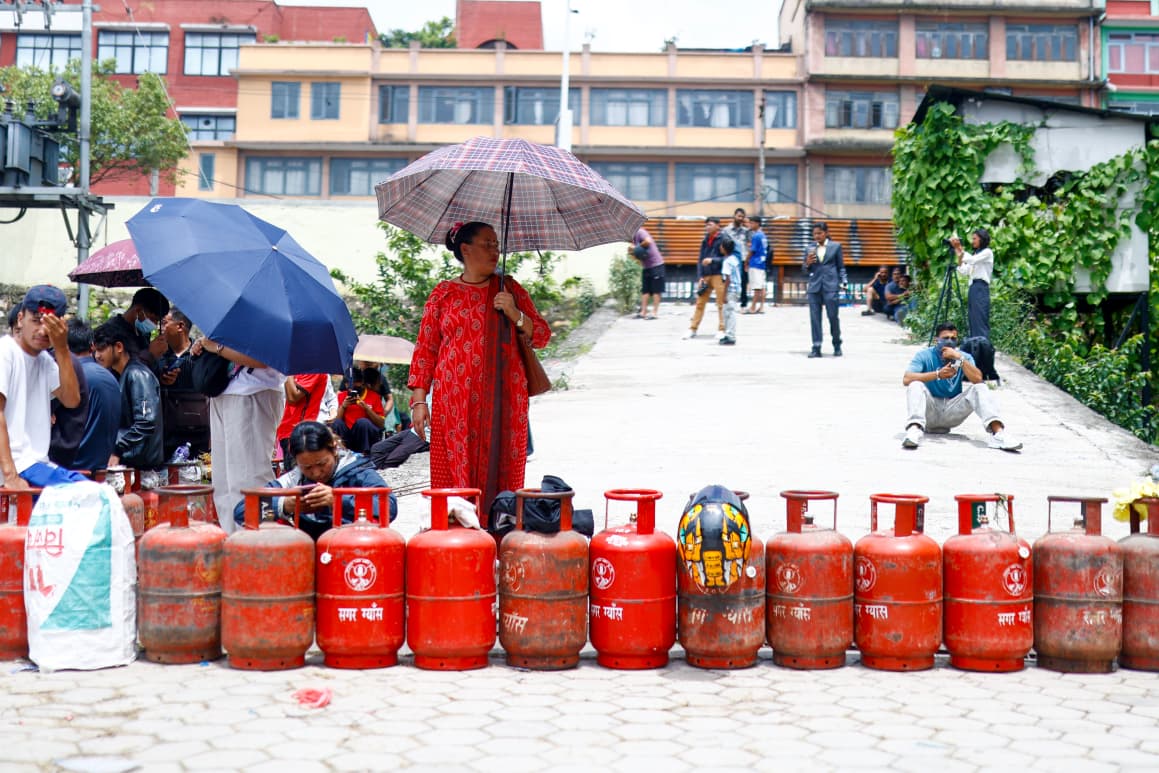
KATHMANDU: Nepal imported a record 54,505 tonnes of LPG in July, enough to fill about 3.84 million cylinders—well above the country’s normal monthly consumption of roughly 3 million cylinders. Yet consumers still queued for hours in scorching heat and monsoon rain to secure a cylinder.
The crisis exposes a deeper problem than inadequate imports: Nepal’s LPG distribution system is structurally weak.
The disruption intensified after the government introduced full-weight cylinders from June 30, replacing the long-used half-filled cylinders. The transition was poorly planned, industry observers say. LPG producers lacked sufficient empty cylinders, while consumers delayed purchases expecting to exchange half-filled cylinders for full ones. Hoarding and weak monitoring further distorted supply.
Former Nepal Oil Corporation executive director Sushil Bhattarai argues that imports must match actual demand, while the domestic distribution network needs much tighter regulation. Consumer rights activists similarly point to failures in last-mile distribution, saying consumers should receive LPG through authorized dealers near their homes.
The LPG sellers’ federation, however, blames government intervention for disrupting an established network of more than 6,000 dealers.
The deeper institutional weakness lies with Nepal Oil Corporation itself. Unlike petrol and diesel, the corporation has limited control over LPG beyond issuing import orders. It has no nationwide LPG storage or distribution network, leaving regulators with limited visibility over inventories and market flows.
The crisis also revealed weak coordination among the Ministry of Industry, Department of Commerce, Kathmandu administration and the oil corporation. No single agency appeared to exercise clear command over the supply chain, allowing shortages, hoarding and distribution bottlenecks to persist.
On Sunday, authorities sold 9,226 cylinders through emergency sales points across Kathmandu Valley, a temporary measure that underscored the failure of the normal distribution system.
Nepal’s LPG industry has 10,100 storage facilities across 58 plants, but these are fragmented rather than strategically concentrated. The result is a system with significant aggregate capacity but little ability to deploy reserves quickly when demand spikes.
The lesson is clear: Nepal’s LPG problem is no longer simply about imports. It is about infrastructure, inventory visibility, dealer accountability and regulatory control.
A sustainable solution would require Nepal Oil Corporation to develop strategic LPG storage, bottling capacity and potentially its own LPG distribution brand, alongside a verified dealer network and real-time monitoring of imports, stocks and sales.
Until that happens, Nepal can continue importing record volumes of LPG-and still leave consumers standing in queues.