

KATHMANDU: Nepal’s stock market opened the week on a negative note, with the Nepal Stock Exchange (NEPSE) Index declining by 33.28 points, or 1.21 percent, to close at 2,701.32 on the first trading day of the week. The Sensitive Index, which tracks the performance of large and blue-chip companies, also slipped 0.41 percent to 471.49 points.
A total of 359 listed securities were traded during the session, with 13.91 million shares changing hands through transactions worth more than NPR 6.26 billion. Trading turnover increased slightly from Friday’s NPR 6.07 billion despite the sharp decline in the benchmark index.
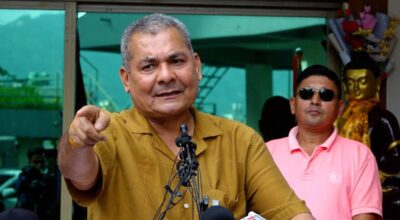
Market analyst Saroj Bhattarai said the day’s decline could not simply be described as a market correction. According to him, the market showed only moderate fluctuations during most of the trading session before ending with a steep 33-point loss, indicating that the fall was more significant than a routine correction or profit booking. He noted that the market had not risen strongly enough in previous sessions to justify such a decline and said the latest movement reflected the continued lack of confidence among investors.
Bhattarai said that short-term traders remain the primary participants in the market, contributing to relatively higher trading volumes, while long-term investors are still hesitant to accumulate shares. He warned that a sharp decline on the first trading day of the week could influence overall market sentiment in the coming sessions.
He further observed that debentures continue to account for a significant share of trading activity, suggesting that institutional investors remain more inclined toward fixed-income instruments than equities. According to Bhattarai, the stock market is unlikely to sustain an upward trend until fundamentally strong companies begin attracting stronger investor demand. However, he believes the market could recover by mid-August if the government introduces positive policy measures and investor-friendly initiatives.
Sector-wise, only two of the thirteen traded sectors closed in positive territory. The Banking Index edged up 0.10 percent, while the Mutual Fund Index gained 0.15 percent. All other sectors ended lower. The Manufacturing and Processing Index recorded the largest decline, falling 2.30 percent. The Trading Index dropped 2.23 percent, Hotels and Tourism declined 2.22 percent, Hydropower fell 1.90 percent, Development Banks lost 1.82 percent, the Others Index slipped 1.69 percent, Microfinance declined 1.27 percent, Life Insurance fell 1.25 percent, Non-Life Insurance dropped 1.21 percent, while the Finance and Investment indices each declined 0.70 percent.
Reliance Spinning Mills emerged as the most actively traded company of the day, recording transactions worth more than NPR 338.6 million. It was followed by Global IME Bank with NPR 281.3 million, Ridi Power with NPR 221.3 million, Kumari Bank with NPR 172.2 million, and Central Finance with NPR 159.9 million in turnover.
Everest Color Limited was the only company to hit the upper circuit limit during the trading session. Gorkhas Finance gained 3.86 percent, while Dhaulagiri Laghubitta Microfinance advanced 3.11 percent.
On the losing side, Atmanirbhar Laghubitta Microfinance posted the steepest decline of the day, falling 13.38 percent. Corporate Development Bank dropped 9.63 percent, while Kalanga Hydropower declined 8.52 percent.