



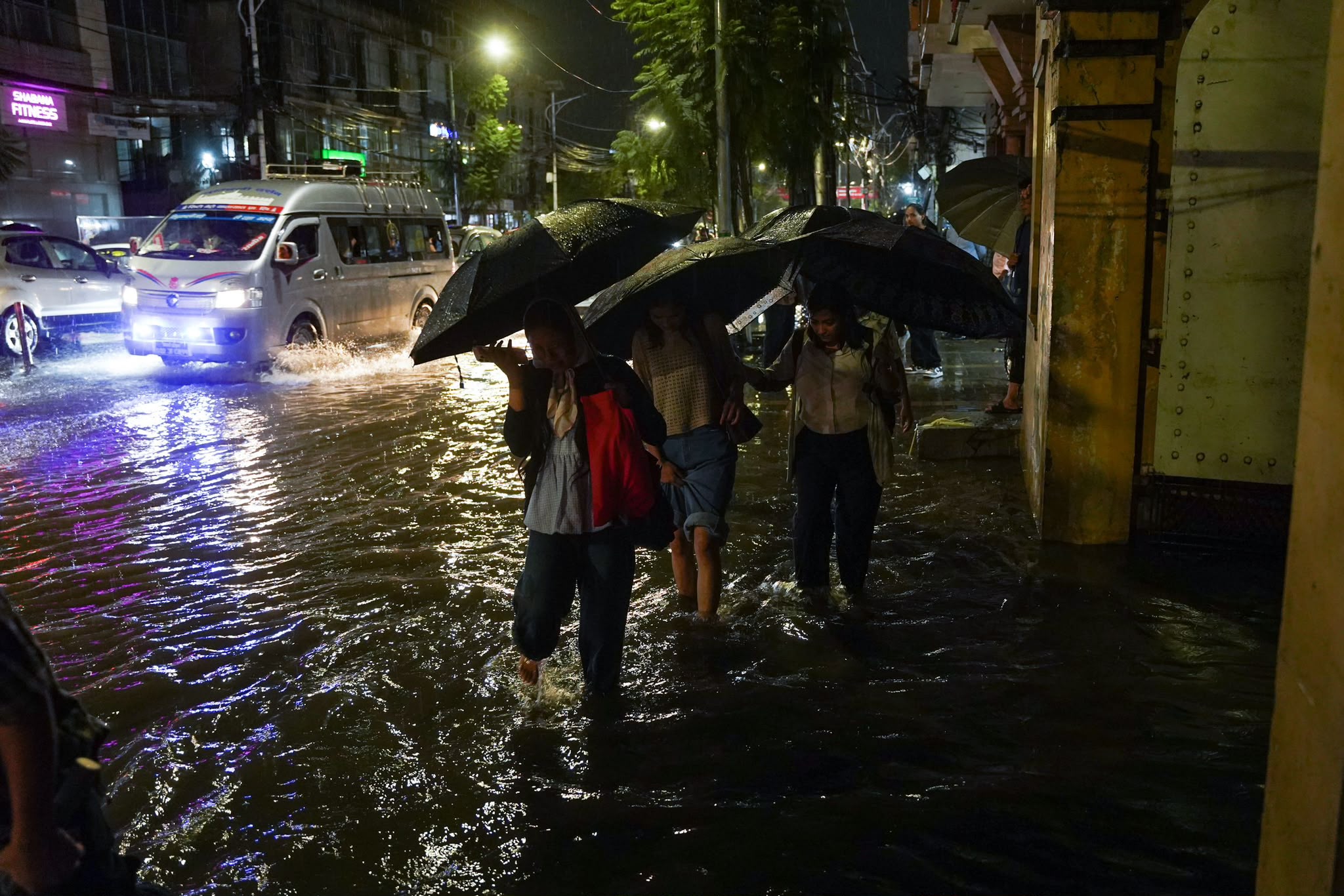
KATHMANDU: A technical study has identified inadequate drainage capacity as the primary reason behind the recurring monsoon flooding in Kathmandu’s Jamal area, concluding that the existing infrastructure is unable to handle the volume of stormwater flowing into the junction.
According to the report, rainwater from four directions converges at Jamal Chowk through drainage pipes measuring 60 centimeters from Jyatha, 90 centimeters from the Election Commission side, 45 centimeters from the Yellow Pagoda Hotel area, and 20 centimeters from the Public Administration Campus. Together, these inlets have a combined flow area of 0.826 square meters, roughly equivalent to a 120-centimeter-diameter pipe.
However, the outlet drain serving the area measures only 60 centimeters in diameter, providing a discharge capacity of just 0.283 square meters. The report states that this significant mismatch creates a bottleneck, causing water to accumulate on roads and resulting in frequent flooding even during moderate rainfall.
The study also found that the small elevation difference between the drainage outlet and the water level of the Tukucha River allows river water to flow back into the drainage system during heavy rainfall, further reducing drainage efficiency and worsening inundation.
The findings were prepared after Kathmandu Metropolitan City’s Acting Mayor Sunita Dangol directed a technical assessment following repeated flooding in the area. The study was coordinated by the city’s Disaster Management Department, while the technical committee was led by Ram Bahadur KC, Chief of the Response Division at the National Disaster Risk Reduction and Management Authority, with representatives from Kathmandu Upatyaka Khanepani Limited, Kathmandu Metropolitan City and the Kathmandu Division Road Office.
The committee has recommended immediate, medium-term and long-term measures to address the problem. Immediate actions include increasing the number of catchpits between Jamal and Keshar Mahal, regularly clearing sand, silt and debris from drains, manholes and catchpits, and improving the flow of the Tukucha River by cleaning its riverbed.
For the medium term, the report recommends replacing the existing 60-centimeter outlet pipe with a higher-capacity trunk drainage line, introducing a diversion system to reduce water pressure at Jamal Chowk, restoring an old drainage network from the Public Administration Campus through Woodland Hotel to the Mahendra statue area, and promoting groundwater recharge systems at nearby institutions, hotels, shopping malls and private properties.
As a long-term solution, the committee has proposed an integrated urban drainage model that would require buildings in the Jamal area to install rainwater harvesting and groundwater recharge systems. It also recommends constructing a dedicated stormwater drainage network and treating collected rainwater for reuse in reservoirs such as Rani Pokhari.
The report further recommends reviewing and updating the 2018 Detailed Design of Sewer Rehabilitation in the Core City Area of Kathmandu Metropolitan City, prepared by the Kathmandu Valley Water Supply Project Implementation Directorate, in coordination with the Kathmandu Division Road Office. It concludes that implementing the revised design is essential for providing a permanent solution to flooding in the Jamal area.