



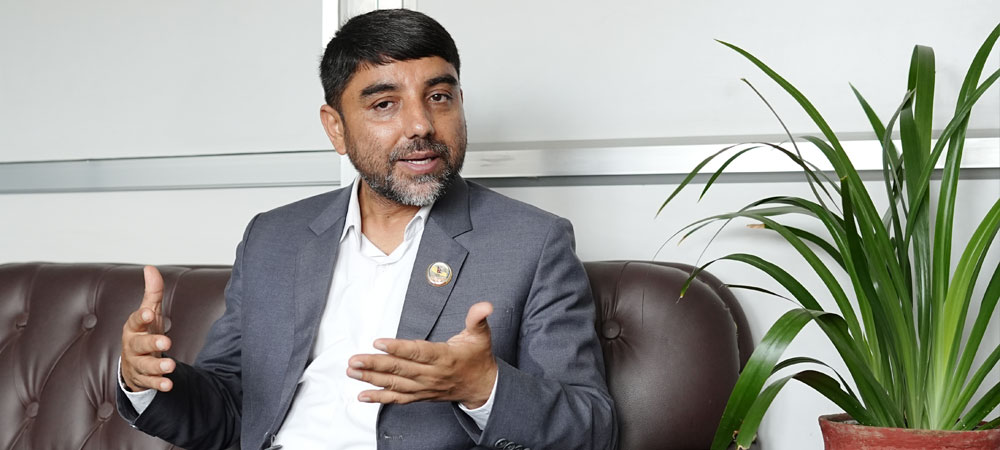
The first national convention of the ruling Rastriya Swatantra Party (RSP) is being held in Chitwan from Sunday. Thousands of people from across the country and abroad are expected to attend the three-day convention of RSP. The historic convention of the RSP, which became the largest party in the parliament established after the Gen Z Movement winning about 48 per cent votes, also reflects the aspirations of the youths. The RSP, which has faced various pressures and challenges since its establishment, is holding its convention as the largest party this time. It is also expected that the policy passed by the ruling party’s convention may affect the future course and action of the government. In this context, Raman Poudel of The Rising Nepal and colleagues from Gorkhaptra had an interview with the General Secretary of the RSP, Kabindra Burlakoti. Excerpts:
How are the final preparations for the general convention going to be held in Chitwan from Sunday ?
Preparations for our first national general convention are almost completed. Delegates are gathering in the field. We are going to hold a general convention by completing provincial conventions through wards, municipalities, and districts. The conventions of our 4,363 wards have been completed. Similarly, the conventions of 609 municipalities and 64 districts have been completed. There are 13 districts left, where some conventions have not been able to take place due to disputes and some due to the organization itself. Similarly, the conventions of six out of seven provinces have been completed well, while the convention of Madhes Province has been postponed to be held after the general convention.
The basic requirement for this convention is organization. If there is an organization, there is enthusiasm in the convention, but if there is no organization, there is no enthusiasm. The enthusiasm that came to us after receiving about 48 per cent of the votes after the general election is also in the organization. Since the process of joining the party and moving forward is going on from villages, homes and neighborhoods, we have taken this as a positive momentum. The growth of the party organizationally was proven through the elections of March 5. After that, we actually needed some time to hold these organizational conventions, but due to the pressure to complete them within six months of the elections, we did not get enough time.

However, now we have completed all the work and are in the final preparations for the general convention. The registration of general convention delegates is completed. Similarly, work has also been finalized on the infrastructure of the general convention, hall, food for delegates, accommodation and transportation. The party has prepared some things itself and has recommended some other things. On June 21, the day we announced the party, the same day as its foundation day, the inaugural session of the first historic general convention of the party will be held.
It was said that the Rastriya Swatantra Party would hold a digital or technology-friendly general convention, different from traditional parties. What are the preparations now ?
The general convention has two sessions. One is the inaugural session, which we also call the open session, and the second is the closed session, which is the election session. The first open session will be held physically and using some digital technology at the Guest House square in Chitwan. Displays will be placed there, musical programmes will be held, and guests will deliver congratulatory speeches. We have tried to register the delegates who will come there through digital means. We are also printing the cards of the delegates by generating QR codes. Since we have little work left to do under the pressure of time and technology, it is in its place; but now we are trying to use digital technology in everything. On the other hand, in our closed session, the candidates will register their candidacies physically on paper. This time we could not make it digital, although we had already gone digital. But since it is a national convention, we have done it in physical form, thinking that it would be difficult if there were any technical problems (glitches) during digital registration. We will convert it to digital later. This time, our voting will be done through an electronic voting machine. This will also speed up the counting of votes.
You mentioned voting. Is there an effort to make the party office bearers and central members unanimous or is it done through the electoral system ?
When we say democratic, everything like dialogue, consensus and internal elections are included. We will adopt all the elements of democratic methods. It will include dialogue, consensus and internal elections, through which we will bring the appropriate person to the leadership of the party. The general convention is about improving policy and leadership. To improve policy and leadership, the Rastriya Swatantra Party adopts democratic methods and processes and is in the process of strengthening the party through this.
It was also informed that making the election of the President and Senior Leader unanimous, what will be the result ?
According to the statute, the President will be elected. If there is only one candidacy, then it will be unanimous. If there are more candidates tomorrow, there will be discussions and dialogues, and the candidacy will be finalized through dialogue. On the other hand, in the case of senior leader, there was no provision for senior leader in the statute before. Now, while preparing for the amendment of the statute, a provision for senior leader has been made, and the senior leaders have been nominated by the central committee on the proposal of the president. Therefore, there is no question of candidacy for senior leaders now. There is a question of candidacy for other positions including the president. As already provided in the constitution and statute, there is a provision for nominating treasurers, spokespersons, co-treasurers, and co-spokespersons, and it is yet to be decided how to bring that into the amendment of the statute through discussions.
Which post are you running for and it is also said more party officials will be added. Please tell us about this ?
Since there is a proposal to amend the constitution, I can only guess what amendments the Central Committee will pass. It is not appropriate to speculate right now. As far as I can tell, the size of the Central Committee will increase slightly in the constitution; because it seems that the organizational size of the party will also increase slightly to address the political horizon in which the party is. Now the next thing is about my position, I am currently General Secretary. I was previously Joint General Secretary, about two years later I became Acting General Secretary, and a year after being the Acting General Secretary, I became the General Secretary. I have already served one term as the General Secretary. In the meantime, the party was in a very difficult, narrow, risky and challenging situation, which I do not need to explain much about. Since we are in the party building phase, we discuss in the party and our idea is to form a party by taking the responsibility that comes out of the discussion and saying ‘this is the appropriate responsibility that should be taken’. We are more involved in building this country through politics than individual-centred politics. Therefore, we put the country first and work with attention to building the party necessary to build the country.
The RSP has been accused of being a populist party and not having a clear ideology. Will this general convention define what the official ideology or engine of the party is or not ?
We have already discussed the official ideology and engine of the party. We have already said in the manifesto of the Jaleshwor meeting that the party is a pluralist democratic party. The proposal that we have put forward for a liberal economy, social justice and a public welfare system proves that our ideological matters are clear. In the context of further refining and explaining it, we passed the proposal in the Jaleshwor meeting. Similarly, we worked to further explain this proposal in the national convention and have also been conducting trainings on that basis. During these four years, while working on improving the party’s policies and ideas, we have clarified many things. This general convention has also changed the leadership and policy matters. It will bring improvement. From the national gathering in Jaleshwor to the general convention in Kathmandu, preparations have been made to improve the party’s political thinking, philosophy and policy.
There is also discussion regarding the RSP’s official position on federalism, secularism, and republican system. It was also about making local governments non-partisan. Will this general convention make any policy decisions on these issues ?
We are clear on these issues. We support the federal model adopted by the Constitution, although we believe certain reforms are necessary to make it more efficient and streamlined. The party has a clear position that the Provincial Assembly should be abolished and replaced with an alternative mechanism. Similarly, we are working toward reducing the size of both the House of Representatives and the National Assembly, streamlining their structures, and transforming the National Assembly into a more enlightened and effective institution.
Regarding religion, the party accepts the constitutional provisions as they currently stand, and we remain firmly committed to republicanism.
The party is currently formulating its strategy regarding local governance. If necessary, we will discuss this issue at an appropriate time. However, it is not a major agenda item for this general convention.
Will this general convention make any strategic decisions regarding the upcoming local and provincial elections ?
No specific strategic decisions on that matter are expected at this convention. However, as provided in the party constitution, we have established a Candidate Club and a Leadership Academy.
These institutions are expected to help unify concepts and practices that have previously been fragmented. Until now, candidates have come through various channels—some were recommended by leaders, some emerged through existing procedures, and others entered through different circumstances. The Candidate Club and Leadership Academy will standardize the candidate selection process and eliminate confusion regarding how candidates are chosen.
Through this system, people will understand that candidates are selected through a transparent process and established methods, rather than through the preferences of individual leaders.
What type of economic model—capitalist, socialist, or mixed—is the RSP adopting to address Nepal’s current economic challenges ?
If we were to explain the country’s current economic policy environment in detail, it would appear quite complex. I believe our approach can best be described as a mixed economic model, although further clarification is needed.
Our party’s Economic Policy Department is currently preparing detailed proposals after conducting extensive research and consultations. Once we receive those recommendations, we will be able to provide a clearer and more comprehensive explanation of our economic policy.
There has been discussion about creating employment opportunities for Nepali youth working in the Gulf countries and elsewhere and connecting them with entrepreneurship opportunities in Nepal. Will any new agenda or policy regarding employment generation be presented or adopted at this general convention ?
I often explain it this way: Nepal currently receives approximately Rs. 2.2 trillion in remittances annually. If those same young people had remained in the country and generated that level of economic output domestically, Nepal’s economy could have exceeded Rs. 10 trillion within five years.
This indicates that we have not utilized our human resources effectively. Therefore, we must direct our capital toward productive sectors and create employment opportunities based on production and economic growth.
The party has established a five-year target of creating 1.2 million jobs. By increasing employment opportunities every year and boosting domestic production, we believe we can convince young people that meaningful employment opportunities can be created within Nepal, encouraging many to return home.
Regarding foreign policy, what should Nepal’s diplomatic relations be with its two major neighbours, China and India, as well as Western countries? Will this general convention make any decisions regarding diplomacy ?
Diplomatic relations operate at two levels. First, there are state-to-state diplomatic relations, in which political parties do not directly interfere. Such relations are established at the national level and generally enjoy the support and ownership of all political parties.
However, the Rastriya Swatantra Party also maintains relationships with political parties and political figures in other countries. These relationships can contribute to strengthening and harmonizing Nepal’s diplomatic engagement.
In this context, the party is actively working to expand its international relationships. Current international affairs may be discussed during the convention, but the party’s diplomatic relationships are not a primary focus of the general convention.
The convention primarily focuses on internal matters such as policies, regulations, the party statute, and ideological clarity. Foreign policy and diplomatic relations are therefore not major agenda items. Nevertheless, we have received goodwill messages from neighbouring countries and Western nations, which contribute positively to strengthening international relations.
What plans are being made to connect the knowledge and skills of Nepalis living abroad with Nepal’s economic development and prosperity? Also, what progress has been made regarding voting rights for Nepalis living overseas ?
Earlier, when discussing digital technology, I noted an important point. During the general convention, voting will be conducted through Electronic Voting Machines (EVMs). At the same time, the party has established Nepali Liaison Department for representatives living abroad.
If any delegates from overseas are unable to attend in person, we are making arrangements for internet voting so they can participate in the leadership selection process remotely. Work is currently underway to implement this system.
Regarding voting rights for Nepalis living abroad, we have submitted recommendations to the Election Commission, and discussions are also taking place within the government. We are making every necessary effort to ensure that Nepali citizens living overseas will be able to participate in future elections from abroad through an appropriate legal framework.
Concerning the utilization of knowledge and skills acquired abroad, the relevant government agencies have already conducted preliminary studies. Efforts are underway to create platforms for young people who wish to return to Nepal and work here, as well as for those who wish to contribute to Nepal’s development while remaining abroad.
The government is also working toward industrialization and exploring ways to transfer technology, expertise, and skills from the Nepali diaspora back to the country. The Ministry of Foreign Affairs and the Ministry of Labour and Employment are working responsibly to facilitate this process and ensure that these resources contribute to Nepal’s development.
Questions have been raised regarding the party’s leadership, and recently disputes have emerged in some districts and within Madhes Province. How might these issues affect the upcoming general convention ?
Considering the scale at which the party is growing, these challenges are not exceptionally large or unmanageable. The party is capable of addressing them effectively.
To resolve such issues, we plan to conduct an organizational audit after the general convention. This audit will be carried out not only in areas where problems have been identified but also in areas where no issues have been reported. The objective is to identify any weaknesses that may have gone unnoticed and implement improvements where necessary.
Although these disputes may have some impact on the convention, they are unlikely to have a significant effect. Representatives from across the country will participate in the convention. While some dissolved committees may not have representation, this will not create any major obstacles to the successful conduct of the general convention.
It has been three months since the RSP won a majority in the March 5 elections and formed a government under the leadership of Balendra Shah. How is the general convention evaluating the government’s initial performance, and what is your assessment as General Secretary ?
At present, the government’s pace of work is very encouraging. It has adopted a plan to complete 100 tasks within its first 100 days, and the party welcomes this level of commitment and momentum.
There are policy and legal obstacles that occasionally hinder implementation, but the government is actively pursuing reforms to address them. After the current parliamentary session, the government intends to introduce several important pieces of legislation during the next session.
Since the current session is focused primarily on the national budget, our immediate attention remains on budgetary matters. Nonetheless, the government remains committed to fulfilling the promises made for its first 100 days.
The public voted with the expectation that an RSP-led government would work toward building a prosperous Nepal. The party remains fully committed to that responsibility and supports the government’s ongoing efforts.
Whenever issues become stalled in Parliament or elsewhere, the party president personally engages in resolving them. Therefore, we believe the government remains focused on achieving its stated goals and objectives.
Finally, what message would you like to share with party leaders, members, and supporters both in Nepal and abroad on the eve of the general convention?
This is the party’s first general convention, and it will be a historic event. It is being closely observed by supporters, members, and well-wishers throughout Nepal and across the world.
I would like to request everyone to contribute to making this general convention a grand success. I hope the convention will produce policies and leadership capable of fulfilling the hopes and trust that the people of Nepal have placed in the Rastriya Swatantra Party.
I sincerely seek the cooperation, support, and goodwill of the general public as we move forward together.