




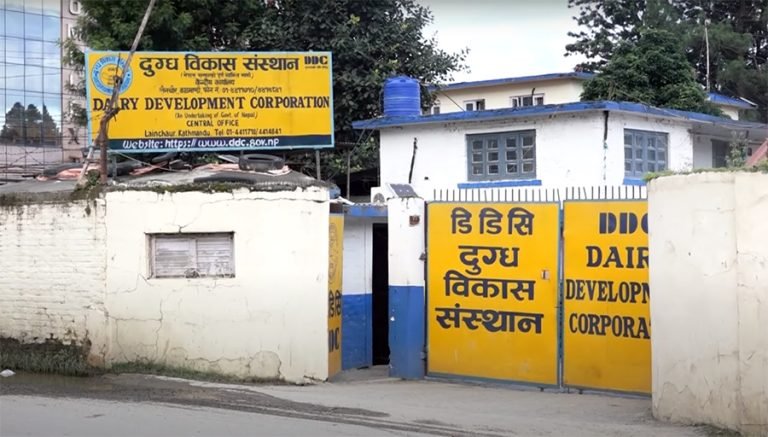
KATHMANDU: The government-owned Dairy Development Corporation (DDC) has reported a strong recovery in sales after Prime Minister Balen Shah and Agriculture, Forest and Environment Minister Gita Chaudhary publicly promoted its products, with the state-owned dairy saying the improved business has also enabled it to clear a large portion of long-overdue payments to milk farmers.
According to DDC, overall sales have increased by 35% over the past three months, boosting revenue and strengthening cash flow. The improved financial position has helped reduce outstanding payments owed to dairy farmers from Rs650 million four months ago to around Rs120 million.
Prime Minister Shah promoted DDC’s yak cheese through a Facebook post on May 16, while Agriculture Minister Chaudhary showcased DDC products during a Cabinet meeting on June 9, distributing the company’s products to ministers as part of a branding campaign.
DDC General Manager Dr. Sharan Pandey said the endorsements significantly boosted public confidence in the state-owned dairy.
“The branding campaign has improved our business performance. Sales have grown by 35 percent over the past three months, and the increase in revenue has strengthened our overall financial position,” he said.
DDC economist Anjan Adhikari said sales during the final three months of fiscal year 2025/26 reached Rs990 million, up by more than Rs20 million from the same period a year earlier.
The corporation also recorded a sharp rise in demand for its signature yak cheese following the prime minister’s endorsement. Sales climbed to 15,000 kilograms during the three-month review period, compared with 11,000 kilograms a year earlier.
The stronger business has allowed DDC to accelerate payments to nearly 150,000 dairy farmers supplying milk through around 700 dairy cooperatives across the country.
Pandey said prompt payment to farmers has become the corporation’s top priority, as many smallholders depend on milk sales for their daily household expenses.
The Central Dairy Cooperative Association also confirmed that DDC has resumed regular payments, saying farmers are once again receiving money consistently, even though some outstanding dues remain.
DDC has also increased the farm-gate price of milk. Effective June 15, the purchase price for milk containing 3% fat and 8% solids-not-fat was raised from Rs65 to Rs66 per litre, following a Rs2 per litre increase in the consumer price.
Bagmati Province remains DDC’s largest milk collection hub, accounting for about 50% of total procurement, followed by Koshi Province (20%), Lumbini Province (15%), and Madhesh Province (5%).
The corporation is also preparing to enter international markets. Pandey said DDC has signed an agreement with a private sector partner to export at least 50,000 litres of ghee annually to the Middle East once certification is completed, with exports expected to begin before the Dashain festival.
To meet rising demand, DDC plans to expand its retail network in Kathmandu Valley from three outlets to 50 before Dashain. The corporation has already launched its first dedicated online sales centre in Ekantakuna, Lalitpur, and is preparing to introduce home delivery services.
The corporation currently collects around 65,000 litres of milk daily and sells approximately 80,000 litres, supplementing fresh milk supplies by reconstituting milk powder produced during the winter surplus season.
Beyond milk, DDC produces yogurt, paneer, cheese, yak cheese, butter, ghee, ice cream and traditional sweets. Milk accounts for around 90% of the corporation’s total business, while yogurt contributes 5% and all other dairy products combined make up the remaining 5%.
DDC also supports around 800 yak herding farms across Rasuwa, Dolakha, Ramechhap and Solukhumbu, involving roughly 3,000 yaks. The corporation pays yak farmers Rs100 per litre of milk-significantly higher than the Rs66 per litre paid for cow and buffalo milk-and provides 50% advance payments to help offset the high costs of yak farming.
Although DDC produces about 60,000 kilograms of yak cheese annually, most sales still come from tourist destinations and the hospitality sector. The corporation expects its recent branding efforts and expanded retail presence to further increase domestic demand in the coming months.