

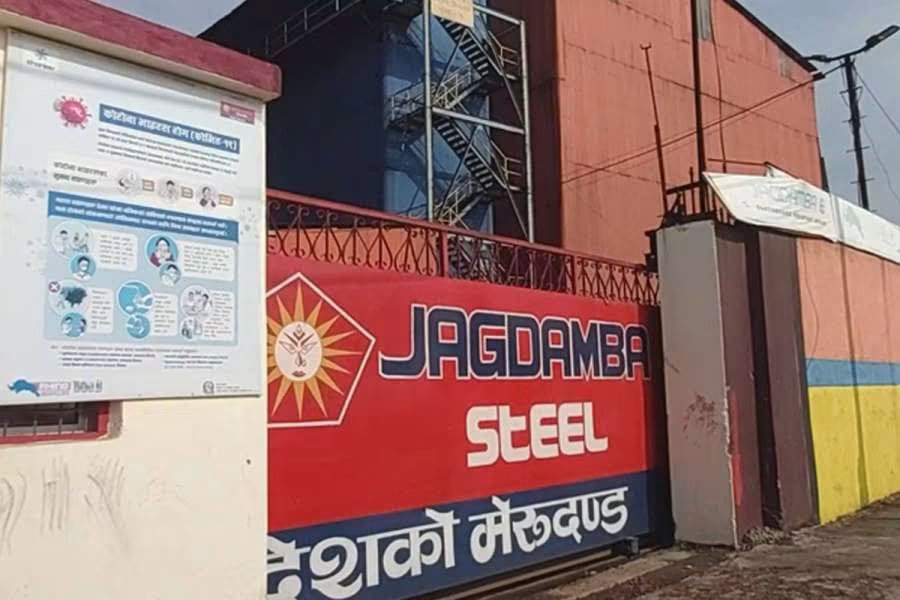
KATHMANDU: Jagdamba Steels Limited, one of Nepal’s leading steel manufacturers, recorded operating revenue of nearly Rs 19 billion in the first nine months of the current fiscal year, according to the latest financial assessment published by Infomerics Credit Rating Nepal.
The company generated Rs 18.995 billion in operating revenue during the nine-month period. While the figure keeps Jagdamba Steels among Nepal’s largest industrial companies by turnover, its financial performance has come under pressure amid weaker demand and a challenging export environment.
Jagdamba Steels had recorded Rs 29.727 billion in revenue in FY 2023/24. Its operating income has since weakened, with the rating report pointing to a decline of around 12% compared with the previous year, largely attributed to difficulties in exports to India following changes in import duties on iron and steel products.
Rs 32.04 billion debt under rating
The company recently obtained credit ratings for bank facilities totalling Rs 32.046 billion, highlighting the scale of its debt-financed operations.
Infomerics has assigned Jagdamba Steels a ‘BBB’ long-term rating, indicating a moderate level of credit risk and adequate capacity to meet financial obligations, although the company remains vulnerable to adverse changes in business and economic conditions.
For its short-term borrowing, the company has received an ‘A3+’ rating, indicating a relatively strong ability to meet short-term obligations, but with some exposure to market and operating volatility.
The ratings provide an important signal for lenders and investors as Jagdamba Steels prepares for its next phase of capital raising.
Profit margins under pressure
Despite its large revenue base, the company’s profitability has remained thin.
Jagdamba Steels’ net profit margin declined from 0.46% in 2024 to 0.22% in 2025, reflecting pressure from lower business volumes and rising operating costs.
Its interest coverage ratio stands at 1.14 times, suggesting that operating earnings provide only a modest cushion over interest expenses.
More importantly, its debt service coverage ratio (DSCR) has fallen to 0.85 times. A DSCR below one indicates that the company’s internally generated cash flow is not fully sufficient to cover scheduled debt-service obligations, pointing to pressure on its debt-servicing capacity.
However, the company’s proposed premium-priced initial public offering (IPO) could provide a significant capital injection and potentially improve its balance sheet, depending on the size and execution of the issue.
IPO could reshape capital structure
The planned IPO is emerging as a key factor in Jagdamba Steels’ financial outlook.
Fresh equity capital could help the company reduce its reliance on bank financing, strengthen its capital base and improve debt-servicing indicators. For lenders and potential investors, the successful execution of the IPO could therefore become an important turning point in the company’s financial profile.
At the same time, the company’s future performance will depend heavily on whether it can restore export momentum, particularly in the Indian market.
Shankar Group backing
Jagdamba Steels has more than three decades of operating history and is part of Shankar Group, one of Nepal’s prominent business groups.
The company is led by Sahil Agrawal, who has more than two decades of business experience, while its management team includes professionals with extensive industry experience.
The backing of Shankar Group and experienced promoters provides the company with additional financial and operational resilience during periods of market stress, according to the broader assessment of its business profile.
Jagdamba Steels has built a nationwide distribution network covering all seven provinces, with 407 authorised dealers currently serving its market.
2.44 million-tonne annual capacity
The company operates its major manufacturing facility in Simara, Bara, with an annual production capacity of approximately 2.444 million metric tonnes.
Its product portfolio includes TMT rebars, pipes, wires and other steel products serving Nepal’s construction and infrastructure sectors.
Brands including Jagdamba E, Rhino 500D and Jagdamba Super Shine have established a significant presence in Nepal’s construction-materials market, helping the company maintain brand recognition despite weaker market conditions.
Export and input costs remain key risks
The company continues to face structural risks common to the steel industry.
International fluctuations in raw-material prices can directly affect production costs, while depreciation of the Nepali rupee against the US dollar increases the local-currency cost of imported raw materials and other inputs.
The highly competitive nature of Nepal’s steel market also limits manufacturers’ ability to pass higher costs fully on to customers, putting additional pressure on margins.
Export conditions are another major variable. India remains an important potential market for Nepali steel producers, but changes in Indian import duties and trade conditions have affected Jagdamba Steels’ export performance.
Outlook hinges on exports and IPO
Jagdamba Steels enters the next phase with a mixed financial picture: large-scale operations and strong market presence on one side, but thin margins, high leverage and weaker debt-service coverage on the other.
The company’s Rs 32.04 billion rated debt, DSCR below one and declining profitability highlight the financial pressure facing the business. However, its large production capacity, nationwide distribution network, established brands and backing from Shankar Group provide important strengths.
The two most important near-term factors are likely to be the successful completion of the planned premium IPO and a recovery in exports to India.
If the IPO strengthens the company’s equity base and reduces leverage, while export markets recover, Jagdamba Steels could improve its financial profile. If weak demand, high input costs and export restrictions persist, however, pressure on margins and debt-servicing capacity could continue.
Overall, the rating assessment portrays Jagdamba Steels as a large and established industrial player maintaining moderate credit strength, but operating with limited financial headroom. Its ability to convert scale and market presence into stronger cash flows will be critical to its next stage of growth.