

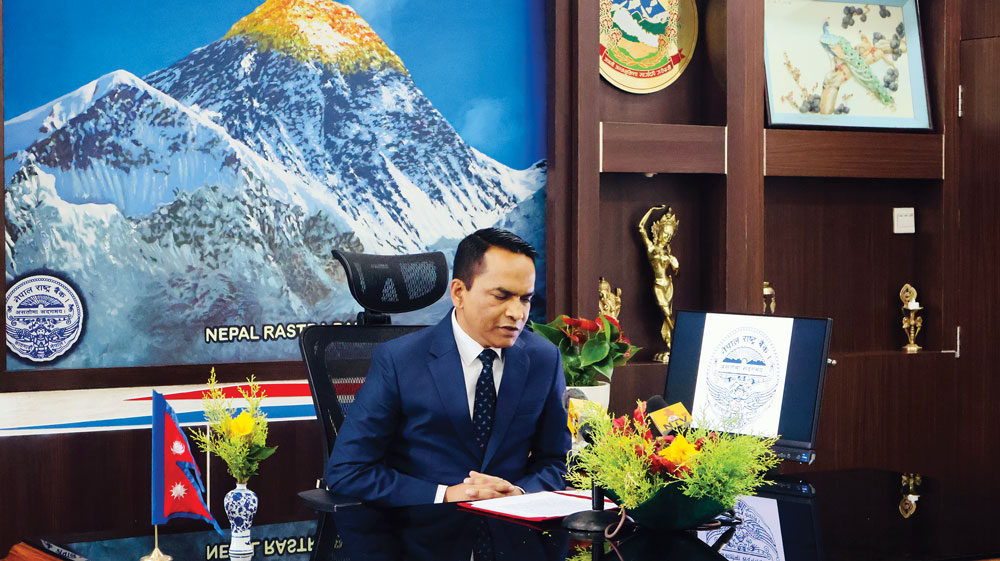
KATHMANDU : Nepal Rastra Bank (NRB) on Tuesday unveiled its Monetary Policy for the fiscal year 2026/27, maintaining a prudent yet flexible policy stance aimed at supporting higher economic growth while preserving macroeconomic stability.
Presenting the monetary policy, Governor Dr. Biswo Nath Poudel said the central bank had kept its key policy rates unchanged, taking into account the current state of the economy and the outlook for the coming year.
As the current foreign exchange reserve position remains comfortable and the overall macroeconomic outlook is favourable, the previously adopted cautious and flexible monetary policy stance has been retained to maintain a low-cost economy, sustain private sector confidence, and support the target of higher economic growth, said Poudel.
NRB keeps flexible policy stance, eyes higher growth
The monetary policy aims to support the government’s target of achieving 7 per cent economic growth while keeping inflation at around 5.5 per cent and maintaining foreign exchange reserves sufficient to cover at least seven months of imports of goods and services.
The government has set a target of achieving 7 per cent economic growth in FY 2026/27. Although this target appears ambitious based on recent trends, it is considered achievable if the government’s economic reform programmes improve the investment climate for the private sector, enhance the government’s capacity to implement capital expenditure, and the external economic environment remains favourable, said Dr. Poudel.
Although inflation has faced some pressure due to external supply-side factors, the central bank expects those pressures to gradually ease. At the same time, stronger domestic demand could exert additional upward pressure on prices.
The weighted average interbank interest rate of banks and financial institutions will continue to serve as the operating target of monetary policy.
The NRB will conduct open market operations using instruments of different maturities to manage structural, regular and emergency liquidity and keep the interbank rate close to the policy rate.
To achieve this, it will use monetary instruments with different maturities, depending on the nature of liquidity, for structural, regular and emergency liquidity management.
Although imports are expected to increase alongside the expansion of economic activity, remittance inflows are projected to remain robust. With the expansion of service exports, including tourism, the current account and the balance of payments are expected to remain in surplus, resulting in a further increase in foreign exchange reserves, said the NRB.
The prevailing liquidity and interest rate conditions in the monetary sector are expected to support the expansion of the economy.
As the fiscal policy has proposed an increase in public expenditure, reductions in income tax, and the implementation of economic reform programmes, aggregate demand is expected to rise, leading to an expansion of overall economic activity and a gradual increase in liquidity absorption.
However, with additional liquidity expected to flow into the financial system through remittance inflows, tourism earnings, public expenditure and other sources, liquidity management is likely to remain a challenge.
Commercial banks allowed to invest in foreign bonds
The NRB has set a credit growth target of 11 per cent for the private sector for the upcoming fiscal year. It has also projected broad money growth at 14 per cent.
The commercial banks will be allowed to invest in foreign government bonds from the coming fiscal year.
The monetary policy states that the central bank will encourage commercial banks to invest in foreign government bonds to facilitate the management of liquidity flows through foreign currency purchases.
The central bank is going to make arrangements for a policy of ‘sterilized intervention’ during foreign currency purchases.
Policy arrangements
The monetary policy states that special policy arrangements will be made to eliminate unlimited liabilities arising from personal guarantees provided as loan collateral, reduce barriers to accessing banking services for individuals blacklisted due to cheque dishonour.
Similarly, special policy arrangements will be made to facilitate the management of non-performing loans in sick industries, support the revival of stressed loans, determine share-backed loan limits based on the financial strength of the institution and ease the loan-to-value ratio for large electric vehicles used as public transport.
To promote simpler regulation and strengthen supervision, the monetary policy states that the directives issued to banks and financial institutions will be streamlined by removing complex language and duplication.
In the first phase, directives relating to lending, interest rates and financial consumer protection will be rewritten.
Likewise, NRB has said that the existing foreign exchange regulations will be further simplified, and the integrated circular issued to institutions authorised to conduct foreign exchange transactions will also be streamlined to facilitate foreign exchange operations.
The Nepal Rastra Bank has also stated that its macroprudential regulatory tools will not be revised except in exceptional circumstances.
A study will be conducted on introducing peer-to-peer lending based on an individual credit scoring system.
The policy rates under the interest rate corridor, including the policy rate, standing deposit facility (SDF) rate, and bank rate, have been kept unchanged.
Currently, the policy rate is 4.50 per cent, the standing deposit facility rate is 2.75 per cent, and the standing liquidity facility rate is 6 per cent.
The existing provisions relating to the Cash Reserve Ratio (CRR), Statutory Liquidity Ratio (SLR), and Standing Liquidity Facility (SLF) have been continued.
The NRB said that the existing interest rate corridor will also be gradually narrowed, as necessary.
To improve efficiency, the monetary policy encourages banks to expand digital financial services and adopt technology-driven operations to reduce operating costs.