



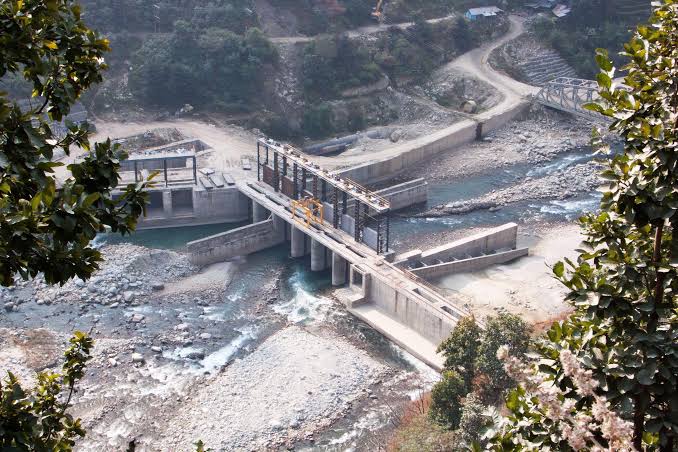
KATHMANDU: More than 5,000 megawatts of hydropower projects in Nepal have been waiting for a decision on power purchase agreements for 426 days, leaving developers unable to take advantage of sharply lower borrowing costs and abundant bank liquidity.
The Nepal Electricity Authority (NEA) asked 54 projects that had signed grid connection agreements to submit documents required for PPAs within four days on June 8, 2025. The developers complied, but the authority has yet to decide whether to proceed with the agreements.
The delay has become particularly costly for investors as commercial lending rates have fallen to around 6–7%, from as high as 12% in previous years. Banks are also sitting on excess liquidity, with an estimated NPR 1.546 trillion available for additional lending under regulatory limits.
“Now is a golden opportunity to borrow at lower interest rates,” said Prakash Dulal, vice president of the Independent Power Producers’ Association, Nepal (IPPAN). “But without PPAs, banks will not lend because the projects do not have a guaranteed electricity market.”
Nepal’s banks have NPR 8.237 trillion in deposits and NPR 5.917 trillion in outstanding loans, putting the system-wide credit-to-deposit ratio at 71.22%. Banks can lend up to a 90% ratio, leaving capacity for roughly NPR 1.546 trillion in additional credit.
The PPA freeze stems largely from a policy shift introduced in the budget presented in May 2025 by then Finance Minister Bishnu Paudel. The government proposed signing PPAs for run-of-river projects under a “take and pay” model rather than the “take or pay” arrangement previously used.
Under take and pay, the buyer is not obliged to purchase all contracted electricity, increasing revenue uncertainty for developers and making project financing more difficult.
Then Prime Minister KP Sharma Oli and Paudel later told Parliament that the controversial provision would be withdrawn, but the change was not implemented.
NEA spokesperson Rajan Dhakal said the PPA process was halted following the budget decision and that the Energy Ministry is now reviewing the issue.
“The process was stopped after the previous budget announced that PPAs would be signed under the take and pay model,” Dhakal said. “The Energy Ministry is currently studying the issue.”
Government promised action within 180 days
The government led by Prime Minister Balendra Shah pledged to resolve the PPA issue within 180 days after taking office in March 2026.
Energy Minister Biraj Bhakta Shrestha subsequently formed a study committee led by a joint secretary. The committee, later headed by Sagar Gautam, submitted its report about six weeks ago, but the findings have not been made public.
The ministry is expected to decide on the future of PPAs based on the committee’s recommendations.
Former Energy Minister Kulman Ghising had also prepared a Cabinet proposal to resume PPAs under the take-or-pay model and had obtained the Finance Ministry’s views on the issue. The Finance Ministry had advised the Energy Ministry to make an appropriate decision after assessing the risks.
Smaller projects may get priority
The NEA has separately formed a three-member task force to examine reopening PPAs for hydropower projects below 10 MW, which are outside the existing quota system.
The task force, coordinated by NEA board member Shambhu KC, is expected to submit recommendations before a decision is taken.
The government’s latest budget has indicated a return to the take-or-pay model. It also proposes cancelling licences of projects that have PPAs but have not started construction and signing new agreements under the take-or-pay system.
The budget also promises immediate PPAs for projects below 10 MW and proposes competitive bidding to determine electricity purchase rates during the dry season.
13,000 MW waiting for PPAs
The scale of the bottleneck extends well beyond the 54 projects currently awaiting a decision.
Hydropower developers representing around 13,000 MW have applied for PPAs with the NEA. Major government-backed projects, including the 1,200 MW Budhi Gandaki, 670 MW Dudhkoshi and 1,063 MW Upper Arun schemes, have also yet to enter the PPA process.
The NEA’s quota system has effectively kept new PPAs frozen for about three and a half years, according to industry representatives, delaying the construction of projects that could add substantial generation capacity to Nepal’s electricity system.
Developers say the delay is particularly damaging now because financing conditions have become significantly more favourable.
A PPA provides a project with a contracted market for its electricity and is a key requirement for bank financing. Without one, developers cannot demonstrate sufficient revenue certainty to lenders, leaving projects unable to reach financial closure even when capital is available.
For an industry that requires large upfront investment and long construction periods, investors say the continued PPA freeze risks wasting both the current low-interest-rate window and the banking system’s excess liquidity.
“PPAs need to be reopened immediately if Nepal wants developers to take advantage of the current financing conditions,” Dulal said.