

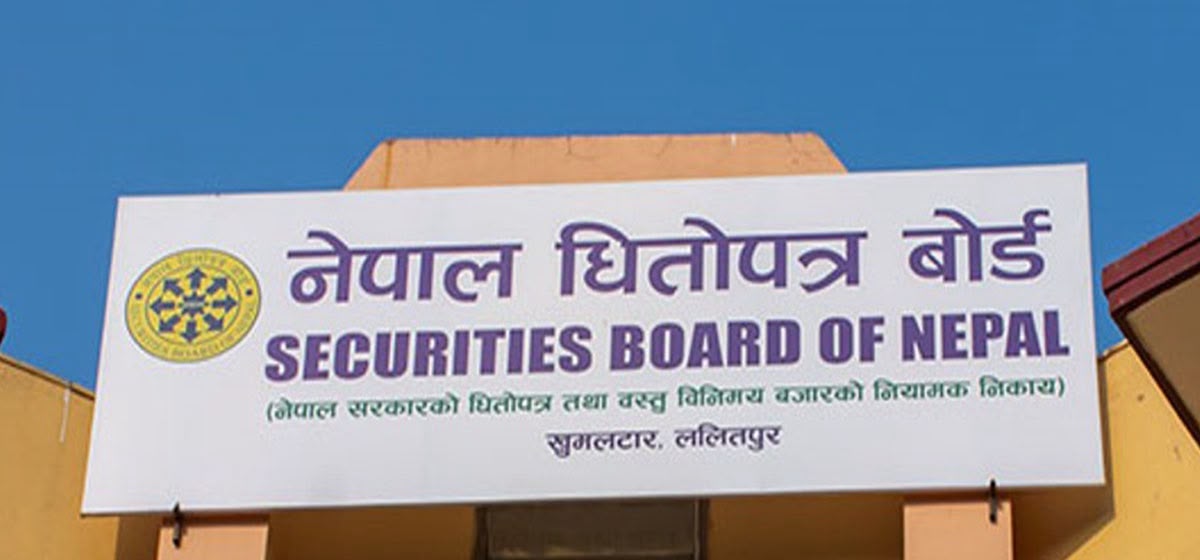
KATHMANDU: Nepal’s capital market regulator is yet to resume approvals for initial public offerings (IPOs), leaving 104 companies waiting to raise more than Rs 69.3 billion through public share sales, nearly three months after the post of chairman at the Securities Board of Nepal (SEBON) became vacant.
The approval process stalled after former SEBON Chairman Santosh Narayan Shrestha resigned with effect from April 18. The government appointed Dr. Gopal Prasad Bhatta as the new chairman through an open competition on June 19, but even after more than a month in office, the board has not issued approval for any new IPO.
According to SEBON, the pending applications involve 104 companies seeking to issue more than 472.89 million shares worth over Rs 69.31 billion.
Nepal’s capital market has increasingly become a preferred avenue for businesses to raise funds, resulting in a steady rise in the number of companies seeking to go public. However, the IPO approval pipeline has remained frozen since early April.
SEBON data show that no company has received IPO approval after April 15. On that day, the board simultaneously approved IPOs for Mount Everest Power, Sarbottam Paints and Everest Color Limited, all of which have since completed their public offerings and share allotments.
During the last fiscal year, SEBON approved IPOs for 24 companies. All except Sarbottam Paints and Mount Everest Power have already been listed on the Nepal Stock Exchange (NEPSE), while the remaining two are in the final stages of listing.
Although Dr. Bhatta was appointed chairman on June 19, he formally assumed office only on June 29 after attending the national convention of the Rastriya Swatantra Party in Chitwan.
After taking office, Dr. Bhatta focused on preparing SEBON’s policy agenda and a roadmap for capital market development. Fifteen days later, on July 14, he unveiled both the board’s policy and programme and its long-term capital market development roadmap.
SEBON says it is prioritising policy reforms aimed at strengthening the capital market and has accelerated consultations with stakeholders to implement the proposed measures.
Dr. Bhatta acknowledged that IPO approvals would take some more time, saying the regulator intends to move beyond its traditional role of merely approving public offerings and instead establish itself as a stronger and more effective regulator responsible for the overall development, expansion and supervision of Nepal’s capital market.
He said the board has already prepared new approval criteria under which companies will be assessed before receiving permission to issue shares.
“We are conducting a fact-based assessment of applicants’ financial health and corporate governance before granting approval,” Dr. Bhatta said.
He added that SEBON is also reviewing whether companies have already raised capital through other means before seeking public investment, and qualified applicants will begin receiving IPO approvals in the near future.
According to SEBON data, hydropower companies account for the largest share of pending IPO applications, with 34 projects awaiting approval. They are followed by 30 manufacturing and processing companies, 18 hotels and tourism businesses, five investment companies, three micro-insurance firms, and 14 companies from other sectors.
The regulator says only companies that fully meet its regulatory standards and demonstrate sound financial and managerial fundamentals will be allowed to enter the market, underscoring that it is prioritising investor protection over speeding up approvals.