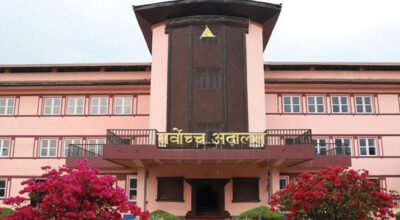


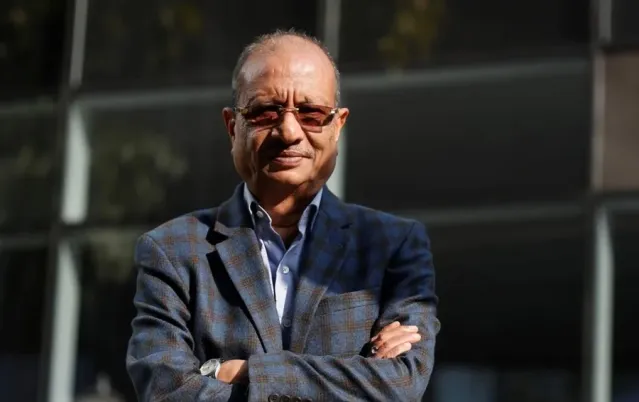
KATHMANDU: The Patan High Court has ordered Shankar Group Chairman Shankar Lal Agrawal to be remanded to judicial custody pending trial.
A joint bench of Justices Arjun Prasad Koirala and Kabi Prasad Neupane issued the order on Thursday after hearing the case.
Agrawal was arrested on Wednesday by the Central Investigation Bureau (CIB) of Nepal Police from Dillibazar. Following his arrest, he was produced before the High Court, which ordered that he be held in judicial custody while legal proceedings continue.
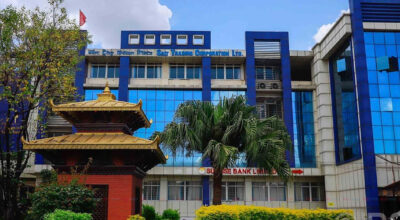
The Shanker Group, one of Nepal’s oldest and largest industrial conglomerates, is facing an unprecedented target from government since Gen-Z protest in September 2025. Amid mounting regulatory scrutiny, leadership arrests, and a protracted battle over insurance payouts following the destruction of its flagship Hilton Hotel venture, the future of the multi-billion-rupee enterprise hangs in the balance.
The group’s foundations trace back to 1960, when Rawat Mal Golyan-who originally arrived from Myanmar in search of business opportunities-established a modest button factory named Sau Udyog. Though the initial venture failed, Golyan pivoted back to trading, laying the groundwork for a broader vision.
In 1979, Rawat’s youngest son, Shanker Lal Agrawal, formalised the enterprise by establishing the Shanker Group, initially focusing on the fabric and ball-bearing trade.
Over the decades, the group expanded aggressively into manufacturing and infrastructure. Driven by major heavy industries including Jagdamba Steels founded in 1994, Jagdamba Cement established in 2001, and the Riddhi Siddhi Cement launched in 2014, the industrial footprint grew rapidly. Alongside these, the group diversified into synthetics, textiles, FMCG, mining, pipes and tubes as the authorized distributor of Tata Steelium since 2006, insurance, capital markets, real estate, and hospitality. Today, the conglomerate encompasses over 40 companies under its umbrella, providing livelihoods to over 20,000 workers and serving as a massive contributor to Nepal’s formal economy.
The group’s crown jewel in tourism-the luxury DoubleTree by Hilton at Naxal, Kathmandu-represented an investment of 8 billion Nepali rupees. Designed to elevate Nepal’s luxury hospitality sector, the hotel instead became a primary target during intense civil unrest and Gen-Z protests on September 9, 2025.
Fueled by unverified social media rumors, protestors launched a massive arson attack that devastated the property. The destruction dealt a severe psychological and economic blow not only to the Shanker Group’s hospitality ambitions but also to Nepal’s broader tourism market.
In the wake of the disaster, the group sought to recover losses through property insurance. However, payouts have stalled indefinitely.
The Hilton Hotel has faced extreme delays due to regulatory obstructions. Complicating matters further the new government has created systemic obstructs. Investigations into post-loss reinsurance arrangements and political scrutiny have left insurance disbursements frozen, denying the group the crucial recovery capital it needs.
The commercial roadblocks have coincided with direct legal actions against the group’s leadership under the Balen Shah led government.
Shanker Agrawal, a long-time well-respected industrialist who has spent decades building the country’s manufacturing backbone, has been targeted alongside other group founders. Government authorities have intensified pressure via investigations into historical financial liabilities, tax queries, money loundring investigation and corporate compliance. The state has continued to arrest its founders and key family figures, effectively targeting the group during its most vulnerable operational period. For a conglomerate that has historically driven Nepal’s industrialization, this convergence of state crackdowns, blocked insurance funds, and executive detentions marks its most severe existential test to date.