

KATHMANDU: Minister for Information and Communication Dr. Bikram Timilsina has made it clear that the government is fully committed to freedom of speech and the press and the protection of citizens’ right to information and that it has kept legal and policy reform in priority to make media sector more decent, accountable and credible.
Responding to queries of the lawmakers raised in the HoR in relation to the Ministry on different topics in the Appropriation Bill, 2083, Minister Dr. Timilsina said that the policy, programme and budget of the Information and Communication Ministry for the FY 2026/27 was focused on five main sectors- mass media, telecom, postal services, film and printing.
For the upcoming FY, Rs. 5 billion 936 million has been allocated for the Ministry. Of the total, 88% will be used for current expenditure while 12% will go for capital expenditure.
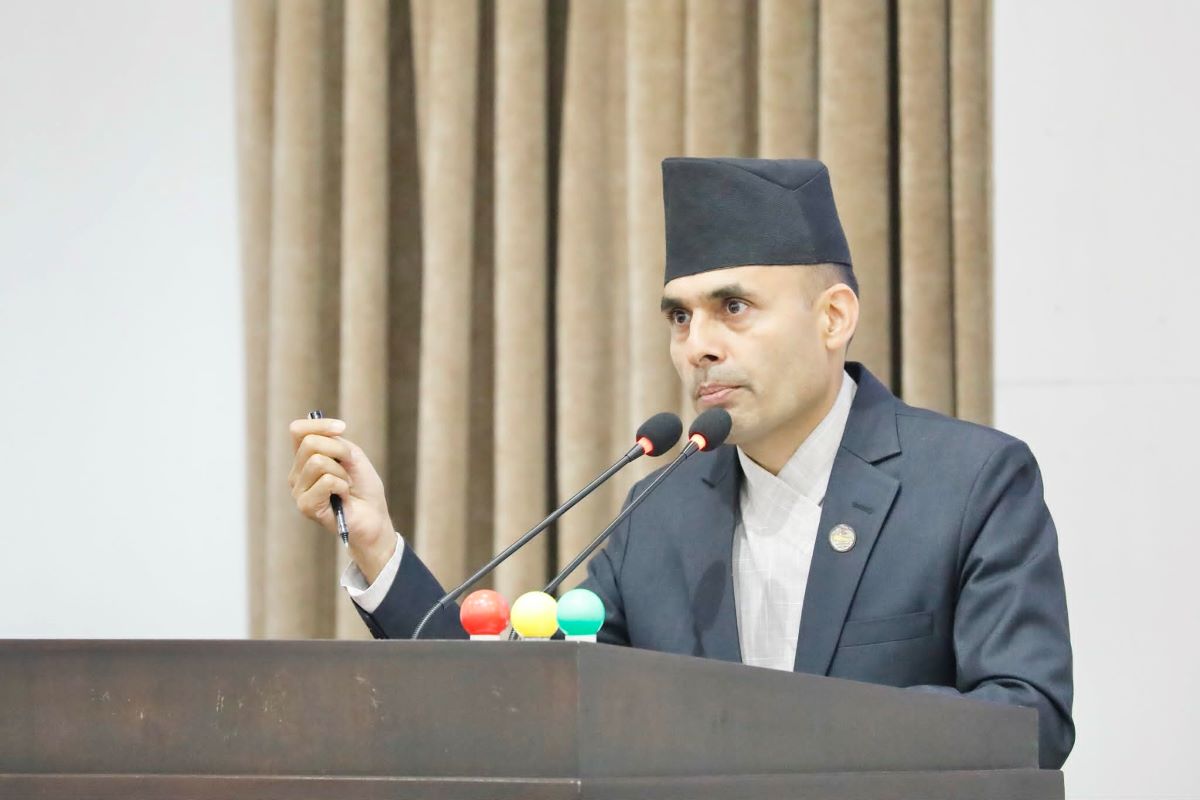
Minister for Information and Communication Dr Bikram Timilsina at the HoR meeting on 17 June 2026. Photo: Sujan Gurung/TRN
Meanwhile, Rss adds:
The lawmakers had raised the queries relating to protection of private media, rights of working journalists, management of social media, digital safety, control of ‘fake news’ etc.
Citizen’s freedom of expression and press freedom would not be suppressed; the National Information Commission has been made active to ensure information of public concern to citizens and make public agencies accountable and credible, he explained.
Ministry has been concerned over journalists’ right to have minimum wage, he said, reminding that the media houses were made mandatory to submit payroll details at Department of Information and Broadcasting for claiming service from the Department. Government is committed to not allow financial exploitation of journalists. Workplace safety is equally important.
Rs 2.4 million allocated for innovation, fact-check
He argued running unions and organizations of media persons with their affiliation to the political parties was against the values of press freedom or international standard. Rs 5 million was allocated for media related organizations, while Rs 2.1 million for investigative fellowship, Rs 2.4 million for media innovation and fact-check, and Rs 4 million for complaint management and transparency programmes.
Minister Dr Timilsina further informed lawmakers that the system of issuing early warning through public broadcasting organizations and through SMS from telecommunications service providers was also being enforced effectively during natural disasters.
In response to lawmakers’ concern over quality of mobile network and internet service in rural, hilly and mountainous areas, the Minister said the expansion of quality and accessible telecommunication services was a top priority of the government. Timely amendment to the Telecommunications Act is afoot, he said, adding that the quality of service is being improved through regular monitoring of mobile networks, drive test and network optimization.
RTDF use for communications expansion
Mobilization of the Rural Telecommunication Development Fund (RTDF) under the Nepal Telecommunications Authority was intensified to expand communication services in the far-flung areas and having fresh demand. Expansion of BTS, e-NodeB, mobile towers and ‘Fiber to the Home’ (FTTH) infrastructure was going on across the country, he said, adding that FTTH service, which reached all 77 district headquarters, is now being extended to all municipalities and rural municipalities.
He argued ongoing expansion of optical fiber will improve quality in the areas along the Mid-Hill Highway and other highways. Currently, broadband internet service has reached 6,743 ward centres, broadband connection already at 4,272 health institutions and 5,341 community secondary schools, according to the Minister.
Total of 763 new infrastructures have been put in place through Nepal Telecom by mid June of current fiscal year, including 2G in 162 locations, 3G in 13 locations and 4G in 588 locations. Process to purchase an additional 1,597 BTS and e-NodeB has been forwarded for the coming fiscal year.
The Minister informed that a campaign was in full swing in a bid to make the postal service modern, technology-friendly and service-oriented. Rs 25 million was allocated to construct information technology infrastructures in 50 more local levels’ post offices next fiscal year. He added informed that investment would also be made in the modernization of the postal service under the Nepal Digital Transformation Project.
Official documents like passports, driving licenses, land ownership certificates, lab samples/reports, ATM cards of the Rastriya Banijya Bank, materials of the Health Insurance Board and various other documents were currently ferried to people’s doorsteps through the post office. EMS service has been expanded to all districts with access to air services in the country. Express postal service is being run connecting 39 countries and parcel service connecting 93 destinations of 71 countries. Efforts are on to restructure the postal service, ensuring it a new model of service. The door-to-door service delivery was running in 62 districts across the country.
In order for the international promotion of films, documentaries and photography, the process for film shooting was eased, Minister Dr Timilsina informed lawmakers. Establishment of a state-of-the-art film studio kicked off in Banepa, Kavrepalanchowk. It is aimed to complete the project within next fiscal year.
A film-related Bill was registered in the federal parliament and was under discussion in the Committee of the House of Representatives, the Minister added. An incentive grant of Rs. 35 million has allocated for the next fiscal year targeting the production of films showing cultural and national values.
Responding to queries about financial crisis and technological barriers facing the country’s printing sector, Minister Dr Timilsina shared that infrastructures were being constructed to produce sensitive printing materials in the country in accordance with Security Printing Act, 2081. Printing postage stamps and driving licenses have already begun in the country.
Out of 2.9 million driving licenses, 1.8 million driving licenses have already been printed and all the remaining ones would be printed within the current fiscal year, according to him. Environment would be created to print license immediately as per the demand from coming fiscal year. Rs 3.24 million budget was allocated for Security Printing Centre for coming fiscal year, 2083/84.
The Minister for Information and Communications said efficiency in allocation was adopted for maximum utilization of budget. Programmes for advancement of government services, strengthening of national cyber security and expansion of digital public infrastructures would be forwarded effectively through Nepal Digital Transformation.
Stating that rapid development in information and communications sector has been making positive impacts in economic, social and educational sectors, the Minister vowed achievement of targeted goals by completing all programmes of the upcoming fiscal year in time.