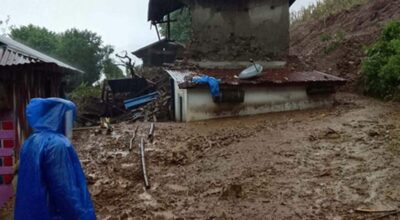


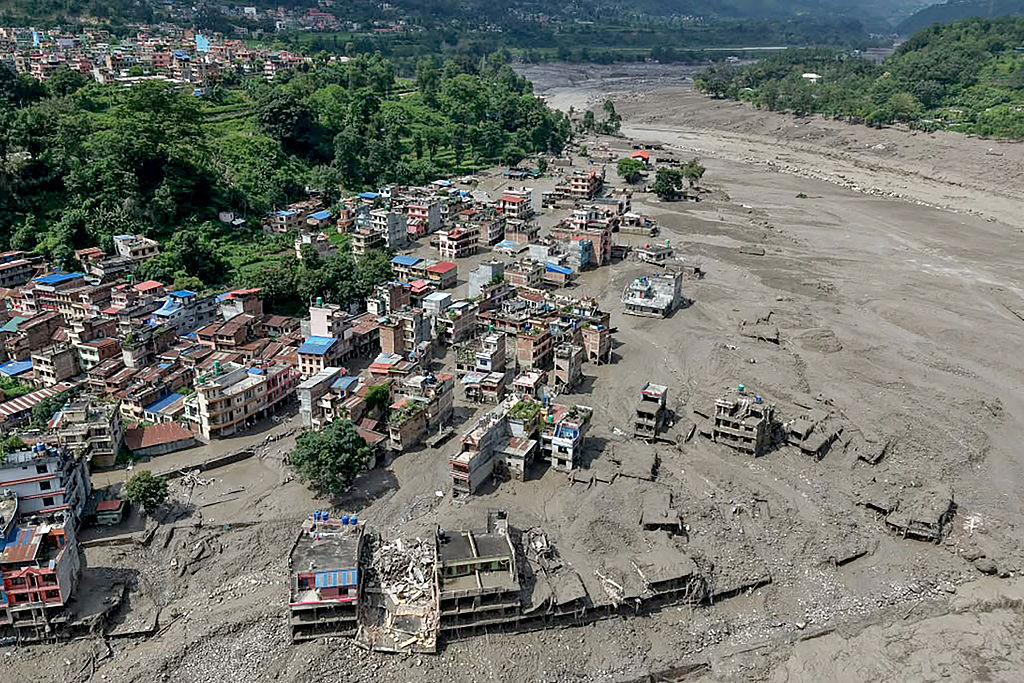
KATHMANDU: Still struggling to fully recover from the 2015 earthquake and the COVID-19 pandemic, Nepal’s economy has suffered another major setback after devastating floods in the Bhotekoshi River caused billions of rupees in physical damage across Rasuwa, Nuwakot and Dhading.
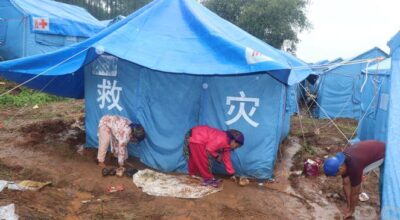
The disaster has destroyed homes, markets, roads, bridges and hydropower infrastructure, leaving thousands displaced and disrupting transport, trade, energy production and local livelihoods. Although the physical destruction is concentrated in three districts, economists warn that the economic consequences will spread far beyond the affected areas.
The government’s preliminary estimate puts the total damage at around Rs 7–8 trillion. Finance Minister Swarnim Wagle gave the estimate while inspecting the flood-affected areas last Saturday, indicating the scale of the disaster and the reconstruction challenge ahead.
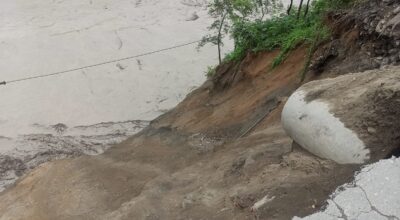
The flood on Bhadra 10 swept away 41 bridges and damaged around 40 kilometres of paved roads. Damage to roads and bridges alone has been estimated at around Rs 20 billion. More than half a dozen hydropower projects, including both operating and under-construction plants, have also suffered major damage.
For an economy already weakened by repeated shocks, the latest disaster could translate into lost production, employment, investment and future economic output.
A setback that could last years
Dr Shivraj Adhikari, former vice-chairman of the National Planning Commission, said the disaster has struck at a time when Nepal’s economy remains sluggish.
“The devastating floods, landslides and natural disasters have delivered a major shock to the economy amid an already weak economic environment,” Adhikari said.
He estimates that climate-related disasters and Nepal’s geographical vulnerability could push the country’s economic development five to 10 years backwards.
The damage to hydropower plants, roads, bridges, customs points, agriculture and private businesses will directly affect economic growth, he said. With Nepal’s economy estimated at around Rs 66 trillion, even a 3–4 percent impact represents a significant economic loss.
The real cost, however, could be considerably higher once lost employment, production, business activity and time are taken into account.
Adhikari also pointed to the long-term value of infrastructure. Hydropower and major infrastructure projects are designed to generate economic returns for decades. When such assets are destroyed, Nepal loses not only the money spent on construction but also years of future production and income.
He said Nepal must also rethink how infrastructure is planned in a country increasingly exposed to climate-related disasters.
“Climate change and geographical vulnerability are making such disasters more frequent. Forecasting, risk assessment and research must become fundamental to development planning,” he said.
Nepal also lacks adequate research and academic expertise on high-altitude and mountain economies, according to Adhikari. That knowledge gap has weakened the country’s ability to assess long-term risks from glacial lake outbursts, floods and landslides.
Reconstruction could become an economic stimulus
Economist Dr Dilli Raj Khanal estimates the physical damage alone could reach around Rs 750 billion.
But he sees reconstruction as an opportunity to revive economic activity if the government can move quickly.
Roads, bridges, electricity, drinking-water systems and communication infrastructure destroyed by the floods will have to be rebuilt. Rapid reconstruction over the next one to two years could generate demand, employment and investment, helping the economy regain momentum.
Khanal points to the post-earthquake period as an example. Reconstruction following the 2015 earthquake contributed to a strong expansion in economic activity, with economic growth reaching around 7 percent at the time.
The challenge now is to avoid reconstruction becoming another prolonged bureaucratic process.
Khanal also argues that Nepal should seek compensation under the principle of climate justice. Nepal contributes little to global emissions but remains highly exposed to climate-related disasters.
“Instead of relying primarily on loans, Nepal should seek grants and compensation through international climate funds and diplomatic channels,” he said.
He also suggested using excess liquidity in Nepal’s banking system through a special mechanism and lower-cost financing for reconstruction and productive economic activity.
A donor conference involving bilateral and multilateral development partners, international financial institutions and aid agencies could also help mobilise resources, he said.
Recovery must include relocation
Economist Dr Govinda Nepal estimates that the latest disaster could push Nepal’s economic recovery five to six years backwards and that full reconstruction and economic recovery could take at least three to four years.
He warned against simply rebuilding settlements in areas that remain exposed to floods and landslides.
“Resettlement must be based on scientific risk assessment. People should not be forced back into high-risk areas,” he said.
According to Nepal, affected communities should be relocated to safer areas where housing and livelihoods can be secured together. Reconstruction, he said, should not merely replace what was destroyed but reduce future vulnerability.
He also called for stronger regional cooperation among Nepal, India and China, including advanced real-time monitoring and early-warning systems for floods and other disasters.
Another shock in a long chain of crises
The Bhotekoshi disaster is the latest in a series of major shocks to Nepal’s economy.
The 2015 earthquake caused around Rs 881 billion in economic losses and claimed 8,970 lives, according to government estimates. The COVID-19 pandemic subsequently brought large parts of the economy to a standstill, with its effects continuing to weigh on businesses and household incomes.
The Gen-Z movement of Bhadra 23–24, 2082 BS caused an estimated Rs 84.45 billion in damage to public and private property.
Now, the Bhotekoshi floods have added another enormous reconstruction burden.
The immediate challenge is to restore roads, bridges, electricity, communications and basic services. The bigger challenge is ensuring that reconstruction does not simply recreate the same vulnerabilities.
For Nepal, the disaster is therefore more than a humanitarian emergency. It is an economic test of whether the country can turn reconstruction into recovery-and build infrastructure capable of surviving the next climate shock.