

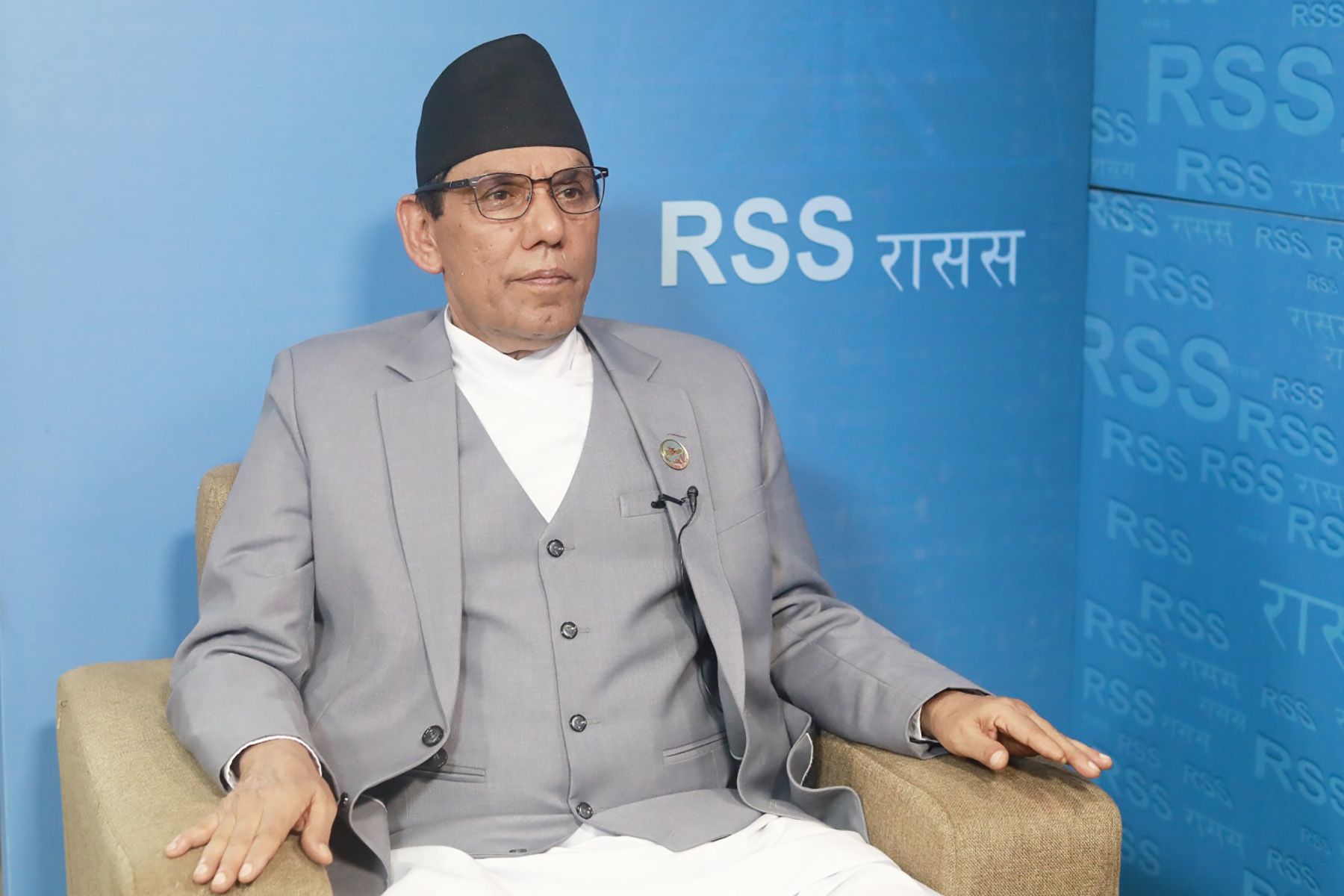
KATHMANDU: National Assembly Chairperson Narayan Prasad Dahal has said that it is essential to foster an environment of national consensus and unity for the very grave and important task of making amendments to the Constitution.
Furthermore, the parliament should serve as the primary venue for the amendment process, where all must participate in the deliberations surrounding such amendments.
“With the exception of fundamental principles achieved through the people’s struggle—such as the federal democratic republic, secularism, and proportional inclusion—all other provisions of the Constitution are subject to change,” Dahal said while noting that the Constitution, attained through the long struggle and sacrifices of the Nepali people, should be protected, implemented, and developed through the shared responsibility of us all.
He also pointed out the need of enacting the necessary laws and establishing effective coordination across all tiers of the state to ensure that the rights and achievements granted by the Constitution are tangibly reflected in the people’s standard of living. “To this end, the government, parliament, political parties, elected representatives, and the general public must all fulfill their respective roles responsibly.”
However, the necessary laws required for the effective implementation of the constitution have not been formulated with the urgency that was needed. While some laws have been enacted—leading to the establishment of provincial structures and local levels, the holding of elections, and increased acceptance of the constitution—progress remains incomplete.
The National Assembly Chair said due to the lack of sufficient legislation progress has fallen short of the Nepali people’s aspirations and desires. The pace of implementation has not matched expectations. “It is natural for questions and grievances to arise among the public regarding whether the constitution is actually being implemented,” he said, “but in reality, it is not that the constitution is failing to be implemented, but rather that the necessary legislative and structural work has not progressed at an adequate pace.
He also pointed out that the pace of lawmaking has lacked the expected urgency, while refereeing to instances where drafting a single bill takes six to eight months, only for it to stall due to various reasons; consequently, the parliamentary session concludes, and the bill lapses.
NA Chair Dahal suggested a stronger political will to prioritize and advance the legislative process, with political parties, relevant government bodies, the bureaucracy, lawmakers, and parliamentary officials are playing their respective part with due responsibility.
Referring to the government declaring this year a “Year of Lawmaking”, he expressed the hope that the government’s initiative to make this a year of lawmaking proves successful.
On a different note, the NA Chair pointed out the need to better convey the fact that the National Assembly holds a significant role clearly defined by the Constitution. The National Assembly can play and is indeed playing a vital role, particularly regarding federalism, relations with provincial and local levels, and long-term policy matters.
He said the National Assembly is always ready to advance legislation that supports the Constitution and the political system, and serves the interests of the country and the people.
To a question related to the House of Representatives Rules, 2083, providing for a two-thirds majority of the combined total of both Houses for a constitutional amendment, he said the Constitution mandates a separate two-thirds majority in each of the two Houses for any amendment. It also stipulates the requirement for provincial consent where necessary. Therefore, parliamentary rules cannot alter this requirement; any such change would necessitate a formal constitutional amendment.